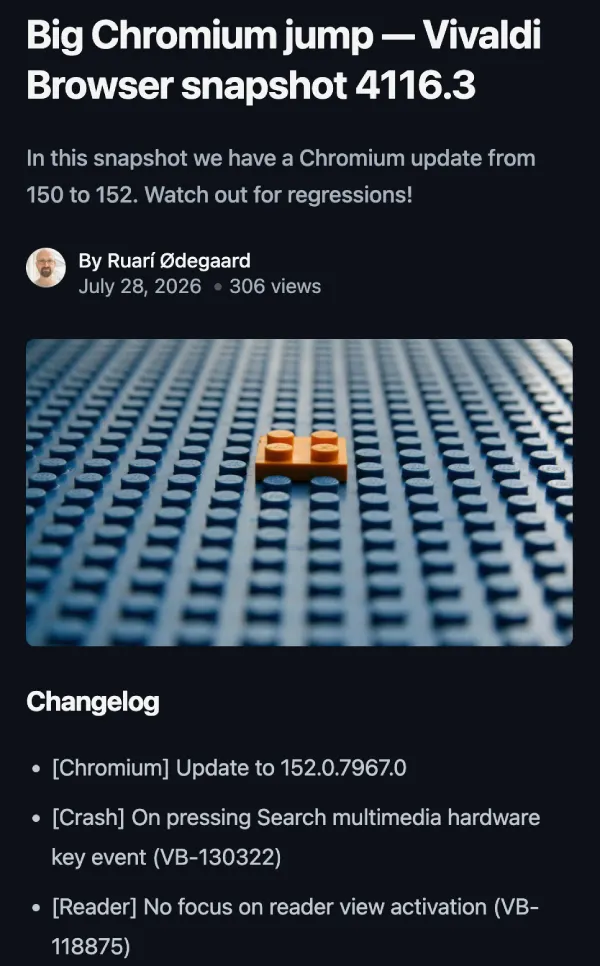
Vivaldi has pushed out a new desktop Snapshot build, and it comes with one change that many testers were expecting but probably weren’t looking forward to. Snapshot 4116.3 jumps straight from Chromium 150 to Chromium 152, completely skipping Chromium 151 in the process.
The official changelog is tiny. It includes the Chromium update along with fixes for a crash caused by the Search multimedia hardware key and a Reader View focus issue. Vivaldi’s release notes also carry a short warning that says, “Watch out for regressions!”
It didn’t take long for users to find one.
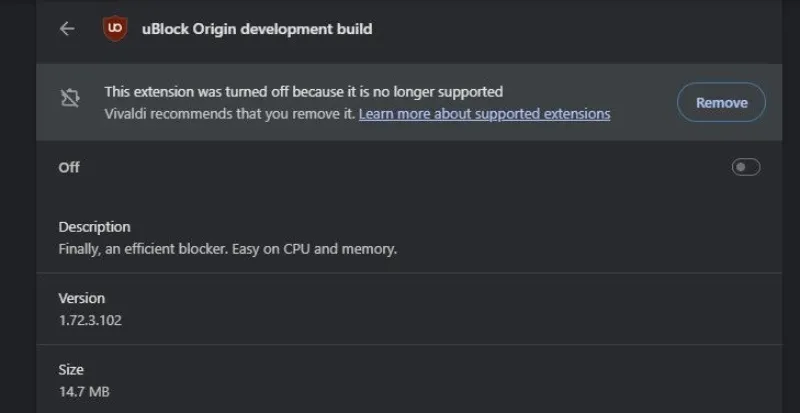
The biggest talking point in the comments isn’t either of the bug fixes. It’s the fact that the classic version of uBlock Origin no longer works. Shortly after the snapshot went live, users confirmed that the browser had finally lost support for Manifest V2 extensions, effectively putting an end to uBlock Origin in its original form.
That lines up with what we reported earlier this month when Vivaldi clarified its position on Manifest V2 support. The company said it would continue supporting MV2 extensions for as long as it was technically feasible, but admitted there would eventually come a point where upstream Chromium changes would make that impossible.
Previously, we had also reported on how Chrome started tightening restrictions on Manifest V2 extensions with Chrome 150 before removing support almost entirely in Chrome 151. Vivaldi managed to hold onto compatibility a little longer, but this jump to Chromium 152 appears to have closed that window.
Not everyone in the Snapshot thread is ready to abandon the browser, though.
Several users have already switched to uBlock Origin Lite and say it’s good enough for everyday browsing. One commenter wrote that YouTube ads and Startpage ads are still blocked, while another pointed out that Lite now includes an element picker and supports importing custom filters.
The comments also mention a handful of fresh bugs. Some testers reported freezing YouTube videos, problems interacting with the address bar when vertical tabs are enabled, and Linux launch issues on certain unofficial builds. Since this is a Snapshot release, those kinds of regressions aren’t unusual, and that’s exactly why Vivaldi labels these builds as testing releases rather than something meant for everyday use.
The desktop Snapshot arrives just days after Vivaldi’s latest Android Snapshot, which mostly focused on stability while adding a few quality-of-life improvements like tab switcher reordering and better PDF handling. We also recently covered the stable Vivaldi 8.1 update, which was a much smaller release centered around bug fixes.
This is also the latest reminder that Vivaldi, despite all of its custom features, still follows Chromium’s direction under the hood. Earlier this month, we covered Helium Browser’s developer arguing that Vivaldi’s interface is essentially a Chromium extension. With Chromium 152 now underneath it, the browser is once again inheriting both the benefits and the baggage that come with upstream changes.


Dwayne Cubbins
3055 Posts
I cover fast-moving stories across apps, online platforms, and everyday tech — phones, wearables, consoles, and whatever else people are fighting with this week. Bugs, rollouts, scams, policy enforcement, and the occasional internet-culture rabbit hole are all fair game. My goal is simple — make confusing tech news readable. When I'm not working, I'm working out or chilling with my dog. Got a tip? You can find me on X @dcubbins.
Next article View Article