





TODO 😅
— Andreas Kling (@awesomekling) July 14, 2026
Andreas Kling, the lead developer for the Ladybird browser, has confirmed that HDR video support is still on the to-do list.
The post attached below shows the response from Andreas to a query on X, where someone asked about HDR support on Ladybird.
So, this confirms that the browser still lacks HDR playback, though most basics have improved recently.
The browser already lets users change the playback speed without warping voices, and allows muted videos to autoplay. However, it may take a while before support for HDR is added.
For those unaware, Kling is the project president of the Ladybird Browser Initiative, which is a non-profit. A small engineering team supported by community testing runs this project, and they’ve built the entire engine from scratch, without using any code from Chromium, WebKit, or Gecko, making it a highly ambitious project.
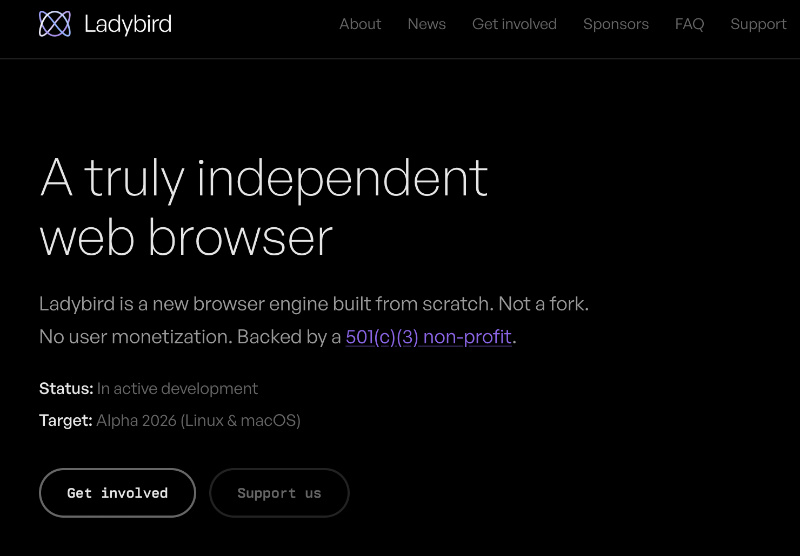
It aims to create a truly independent browser, which is free of the usual corporate data collection or user monetization. Initially, it began as a simple HTML viewer inside SerenityOS and grew into a standalone engine.
Progress on features is fast-moving. It recently gained file downloads with progress tracking, a dedicated downloads page, and proper browsing history (via about:history), along with real OS sandboxing. More on that here.
Additionally, memory usage has dropped nearly 80 percent on heavy pages like X timelines. We covered that here. To those concerned about ad-blocking, Brave’s ad-block engine is being used, making it reliable. There are also vertical tabs (which appear on the left or right).
However, many features people use daily are still absent, so for most people, it’s not suitable as a primary browser just yet. We don’t have full Windows support, HDR, and more. Building and using Ladybird is a rather complex process, involving cloning the GitHub repository and then compiling it yourself. There’s no public one-click installation yet.
The project is currently in active pre-alpha development. The core team closed the public contribution queue to stabilize the code, ahead of the first alpha release. A beta version is expected in 2027, followed by a stable/public release in 2028. While enthusiasts can still build and test the browser out, we’re around 2 years away from a public build.

We stand out from the tech-media crowd because we break news stories; we mainly bring you stuff that you won’t find anywhere in the mainstream tech media. Our stories have been picked up by some of the world’s most popular websites and media outlets—more info is available here.

Sudhanshu K
315 Posts
I have been a consumer technology enthusiast for over 5 years. Thanks to my experience in software beta testing and product reviews, I've understood and learnt a lot about what bugs and issues bother people, and I spend time trying to simplify their solutions. I cover smartphones, software, social media, apps, AI, and most consumer tech gadgets. Actively pursuing a Computer Science bachelor’s degree. I'm mostly active on Twitter/X (@TechWhirlUlt), drop a DM or tag me if you want to share info or connect!
Next article View Article
Google just opened Chrome’s on-device embedding API for testing
Google has started rolling out another piece of its built-in AI platform for Chrome, but this one is aimed squarely at developers. Members of the Chrome Built-in AI...
Jul 16, 2026 2 Min Read