


After months of anticipation, every major web browser now has native support for JPEG XL. Yet according to a large real-world benchmark from Firefox developer Jake Archibald, websites should probably hold off on making it their default format instead of AVIF.
When looking at regular compressed photos on the web, Archibald stated that “For lossy photos on the web, AVIF almost always produces smaller files than JPEG XL.” Even if you crank the compression tools all the way up, JPEG XL files usually end up 6% to 20% heavier than their AVIF counterparts.

Privacy-focused browsers were quick to adopt the standard too, as we saw when Brave 1.97 added default JPEG XL support on desktop earlier this month. Having browser support is great, of course, though it does not automatically make the format the best pick for every webpage.
The gap gets way worse when you move away from standard photography and try to compress flat graphics or transparent images. Archibald noted that “For screenshots and illustrations, AVIF is much better than JPEG XL,” with JPEG XL sometimes spitting out files that are nearly double the size.
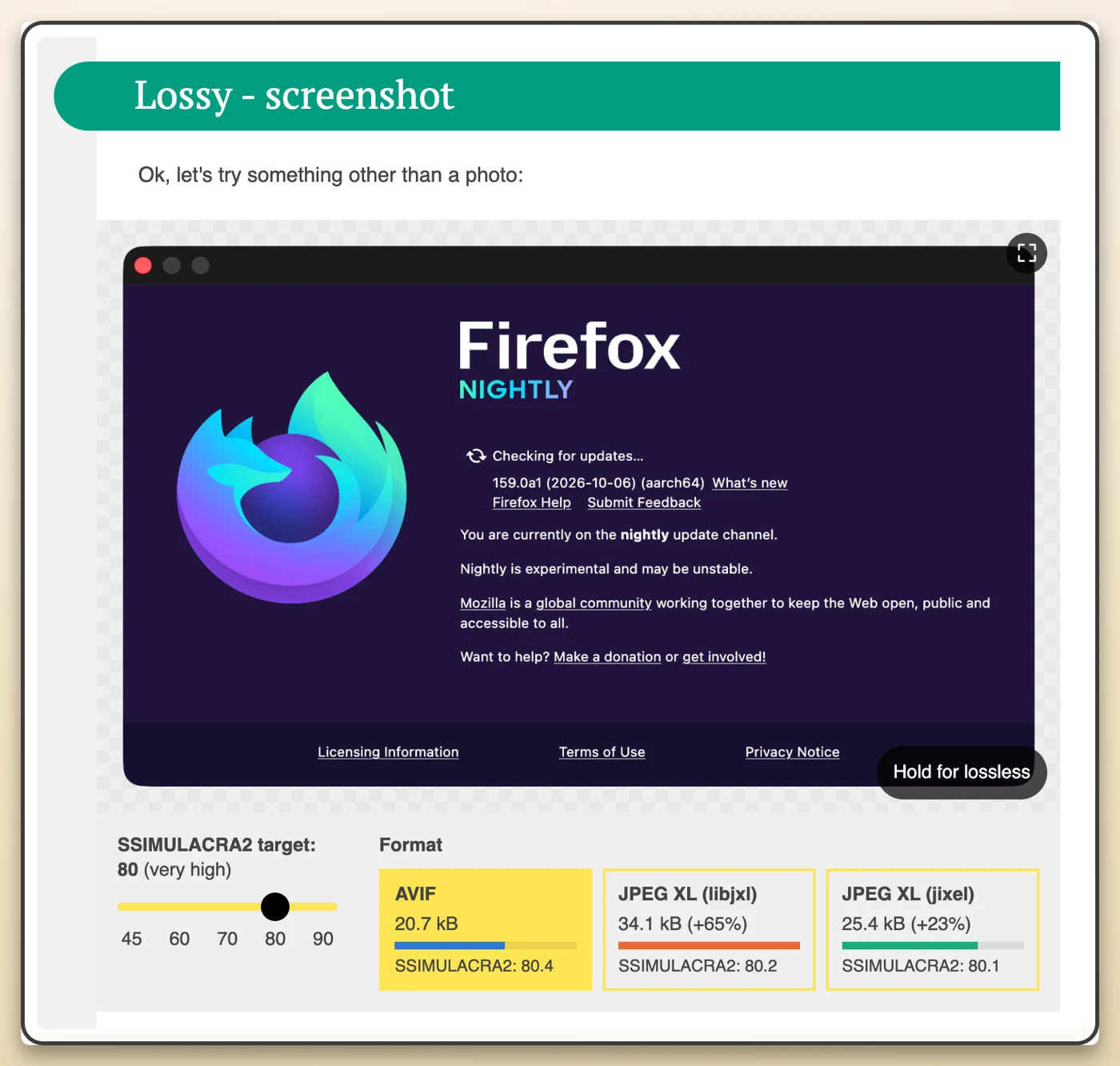
Even with those drawbacks, browser makers are still pushing forward, though the rollout has been a little bumpy since Microsoft Edge 155 listed the feature in its changelog before it actually worked in our testing. Beyond raw file weight, AVIF also decodes two to three times faster at medium quality settings, meaning images pop onto your screen much quicker.
Where JPEG XL genuinely shines is uncompressed quality and shrinking down old photo libraries without ruining them. As Archibald put it, “JPEG XL can make existing JPEGs 9–20% smaller, without further loss,” and “For lossless, JPEG XL is the clear winner.”
With Firefox v158 bringing out-of-the-box JPEG XL support alongside everyone else, developers finally have both options on the table. We recommend checking out Jake Archibald’s full blog for more details.


Dwayne Cubbins
3140 Posts
I cover fast-moving stories across apps, online platforms, and everyday tech — phones, wearables, consoles, and whatever else people are fighting with this week. Bugs, rollouts, scams, policy enforcement, and the occasional internet-culture rabbit hole are all fair game. My goal is simple — make confusing tech news readable. When I'm not working, I'm working out or chilling with my dog. Got a tip? You can find me on X @dcubbins.