






Mozilla’s president, Mark Surman, recently warned that the open internet is heading straight off a cliff. In an interview with CBC News in July, Surman said, “If economic incentives for independent creation disappear, original reporting and human-driven knowledge risk being replaced by closed systems.”
He argued that the industry will need a sustainable revenue model for creators or risk having all web content “come from big and powerful companies, or from governments, or from AI itself.”
That warning feels painfully relevant right now as Google is reportedly testing an AI contribution pilot inside Search Console.
The company is now offering select publishers payouts if their content is used to shape answers in any of Google’s AI products, like Gemini, Overviews, and AI Mode. It sounds like a reasonable plan on paper, but when you dig deeper, it’s a messy road to the end of the internet as we know it.
Here’s a screenshot of the alleged Google AI contribution document that select publishers received:
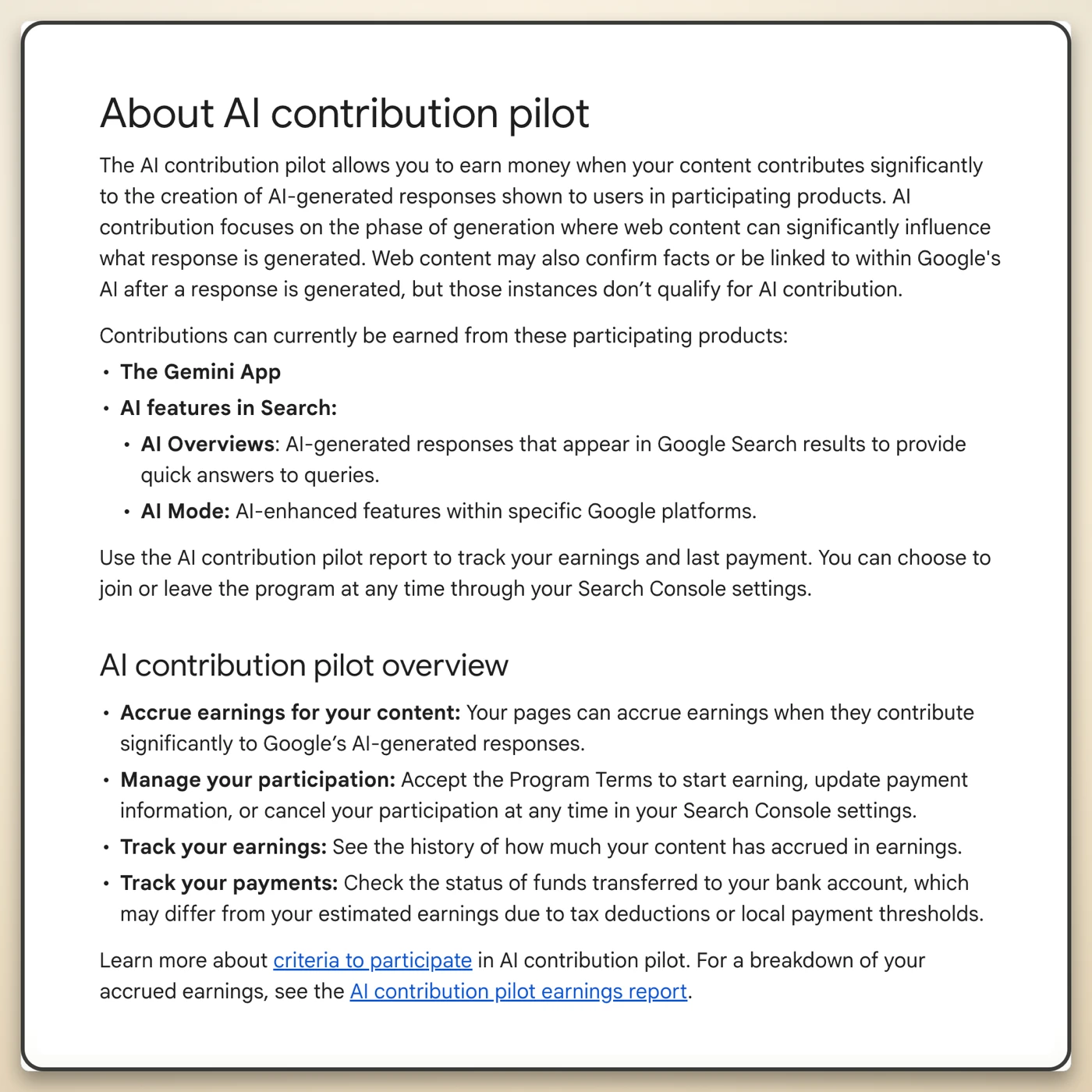
Traditional web navigation is collapsing because search engines are determined to trap users inside their own walls.
We recently covered how bot traffic has already overtaken humans online, with automated scrapers and AI agents flooding the web while real human visits drop off a cliff.
Browsers were originally created so people could explore independent websites, but with AI-powered search engines, we’re all being forced to sit back and watch our work get summarized and repackaged just for companies like Google to keep users glued to their platforms.
In fact, I already ranted about how Google is crushing independent sites while pretending everything is business as usual, and this latest payout experiment makes the whole situation feel even more sinister.
With this, Google is basically handpicking publications to throw a bone to. And worse yet, it means Google is, in a way, deciding who gets to keep the lights on and what information gets to be seen by the public. Depending on how the partnership is set up, one could argue that it’s a form of hush money for publishers.
Imagine if a newsroom starts seeing a reliable stream of revenue coming straight from Google. Would they be willing to report on Google’s anti-competitive behavior or shady algorithm updates? Unfortunately, we don’t have an answer to that. But it’s a scary thought, and one that we’ll only find out in the coming months or years.
So Mozilla’s Surman is right to raise the alarm on the future of human creators on the internet. A secretive payout pilot inside Search Console will not save the open web.
This is also why companies like DuckDuckGo are pushing hard to end Google’s search monopoly. Whether or not these warnings actually bring about a change in the way Google operates remains to be seen.


Dwayne Cubbins
3031 Posts
I cover fast-moving stories across apps, online platforms, and everyday tech — phones, wearables, consoles, and whatever else people are fighting with this week. Bugs, rollouts, scams, policy enforcement, and the occasional internet-culture rabbit hole are all fair game. My goal is simple — make confusing tech news readable. When I'm not working, I'm working out or chilling with my dog. Got a tip? You can find me on X @dcubbins.