
Bots have already pushed past humans on the internet, and even Cloudflare’s CEO seems a bit surprised by how fast it happened. A few months after saying bot traffic would beat human traffic by 2027, Matthew Prince is now pointing to his own company’s data that shows the flip has already taken place.
In a post on X, Prince said bots and “agentic” traffic have now passed human traffic online for the first time. He linked to Cloudflare Radar so people could look at the charts themselves.

Here’s a screenshot for reference:
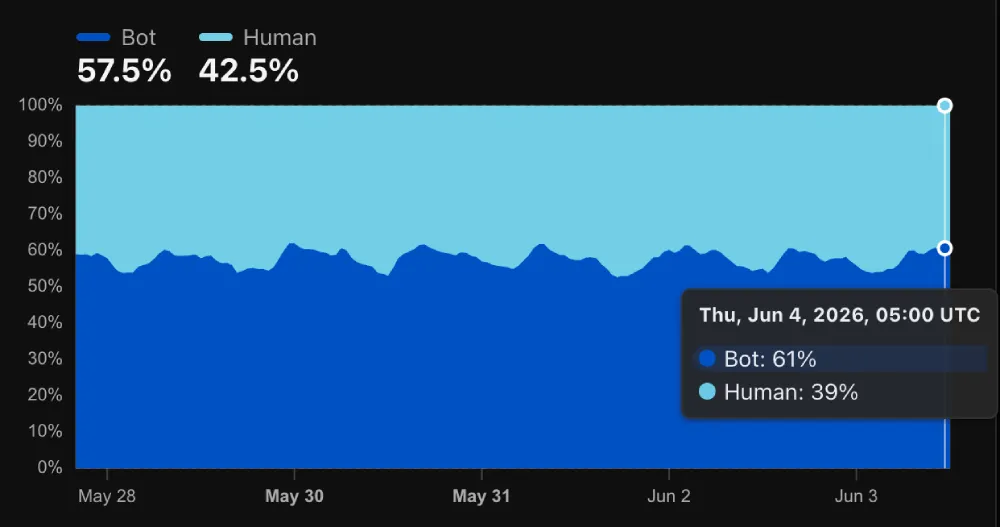
Cloudflare Radar tracks traffic patterns across a huge chunk of the web, since the company sits in front of something like a fifth of all websites. That gives it a pretty strong vantage point on what is hitting servers every second. In those charts, automated traffic has edged past human traffic as a share of overall hits and the line is still rising.
Prince had already laid out the logic earlier at SXSW when he told TechCrunch that AI bot traffic would exceed human traffic by 2027.
He pointed out that a human might open five sites while shopping or researching. An AI agent can hit thousands of pages to answer a single query or complete a task for someone. That difference in behavior is now visible in Cloudflare’s live data instead of just words in an interview.
Before the generative AI wave, Cloudflare saw around 20 percent of internet traffic coming from bots, with things like Google’s crawler sitting at the top. There were always shady bots too, the scrapers and scam traffic, but they were still a minority. Now there is an entire layer of AI agents on top of that, hitting more endpoints, more often, and often on behalf of regular users who never see most of the pages being fetched.
Matter of fact, we also recently highlighted how the folks at Browser Use have now made it possible for AI agents to surf the web for a very low cost.
Put that next to what Cloudflare is seeing and it starts to make sense. If it’s this cheap to spin up agents and let them loose on thousands of sites, they’re obviously going to drown out normal browsing.
As things stand, it’s still uncertain how this will impact the industry as a whole. But be ready for humans only accounting for a fraction of the overall internet traffic.


Dwayne Cubbins
3060 Posts
I cover fast-moving stories across apps, online platforms, and everyday tech — phones, wearables, consoles, and whatever else people are fighting with this week. Bugs, rollouts, scams, policy enforcement, and the occasional internet-culture rabbit hole are all fair game. My goal is simple — make confusing tech news readable. When I'm not working, I'm working out or chilling with my dog. Got a tip? You can find me on X @dcubbins.
Next article View Article