
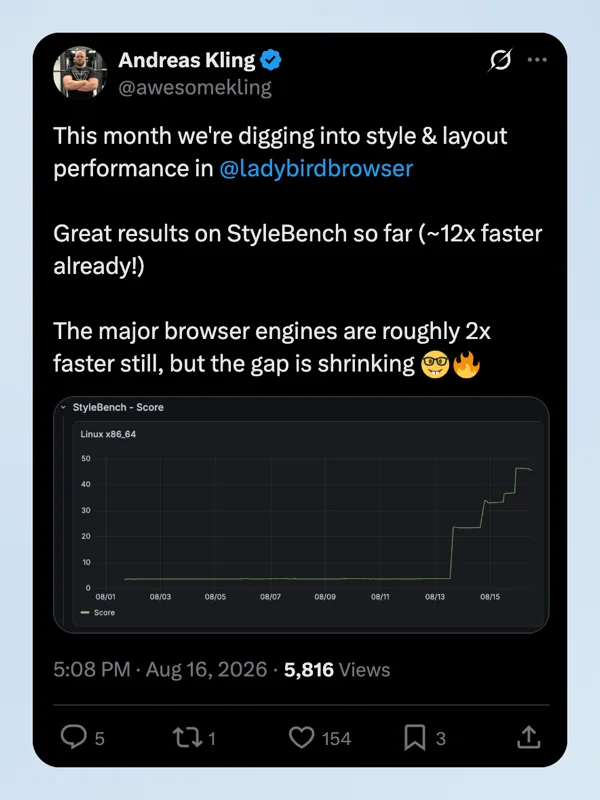
Ladybird’s development has been anything but slow over the past few months. And the latest breakthrough has been all about raw speed. Andreas Kling, the person leading the project, shared some numbers on X this weekend that put things in perspective.
He says that his team spent a whole month tearing into how the browser handles styles and layouts, which is basically the work a browser does to figure out where everything on a page should go and what it should look like.
The results are pretty impressive for an engine that’s brand new. On a benchmark called StyleBench, which measures exactly that kind of work, Ladybird is now running around 12 times faster than it was.
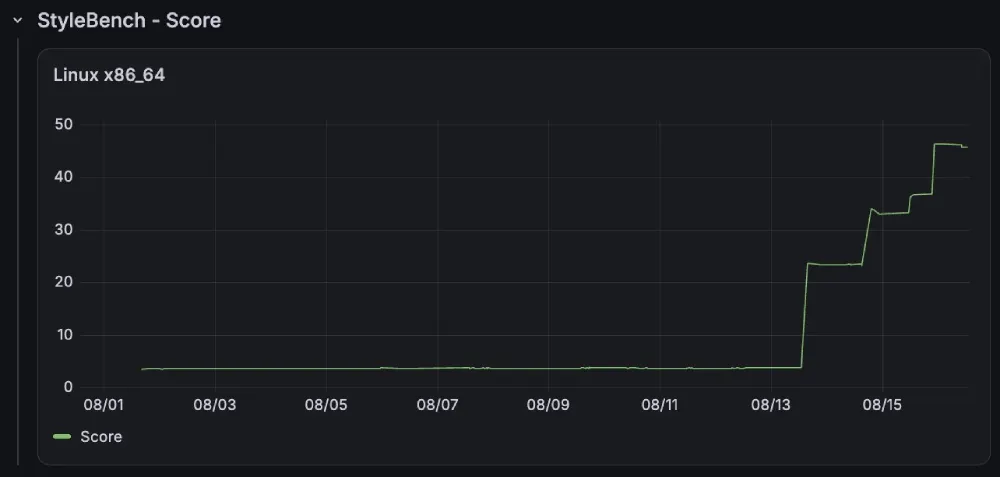
And this all comes hot on the heels of a busy stretch that added downloads, history, and sandboxing to the browser, so the team clearly isn’t slowing down.
That said, Kling did point out that major browser engines are still roughly 2x faster than Ladybird’s engine. But this rapid progress is impressive by any standard. A browser built entirely from scratch, without borrowing any of the code that powers Chrome or Safari, is now within striking distance of engines that giant companies have poured decades of money and engineering into.
A chunk of this speed likely traces back to the work we covered when Ladybird added private browsing and multiple profiles, where the team moved a big part of the styling and layout engine over to Rust. Kling said at the time that the move “unlocks some very tasty opportunities for parallelism,” which just means the browser can split the work across your processor instead of doing it all in one line.
All of this feeds into the push toward Ladybird’s first alpha, the same goal behind the decision to close off public code contributions earlier this year. And it lands at a moment when speed claims in the browser world deserve a careful eye, something we saw firsthand when Aside said it had doubled its speed and the numbers didn’t quite hold up.
Ladybird’s gains, on the other hand, are just the team comparing its browser to where it stood a month ago, so there’s not much room to fudge them.


Dwayne Cubbins
3060 Posts
I cover fast-moving stories across apps, online platforms, and everyday tech — phones, wearables, consoles, and whatever else people are fighting with this week. Bugs, rollouts, scams, policy enforcement, and the occasional internet-culture rabbit hole are all fair game. My goal is simple — make confusing tech news readable. When I'm not working, I'm working out or chilling with my dog. Got a tip? You can find me on X @dcubbins.
Next article View Article