A new Chrome Canary flag is hinting that Google wants Gemma 4 to power some of Chrome’s on‑device AI. I spotted a “Gemma 4 for Built‑in AI” flag in Canary, then followed the linked early preview page, which straight up mentions “Gemma 4 Integration” as part of Chrome’s next testing wave for built‑in AI.
The flag itself sits with the other Chrome AI experiments in Canary and says it “enables all built‑in AI APIs (Prompt, Summarizer, Writer, etc.) with the Gemma 4 model” on desktop and ChromeOS.

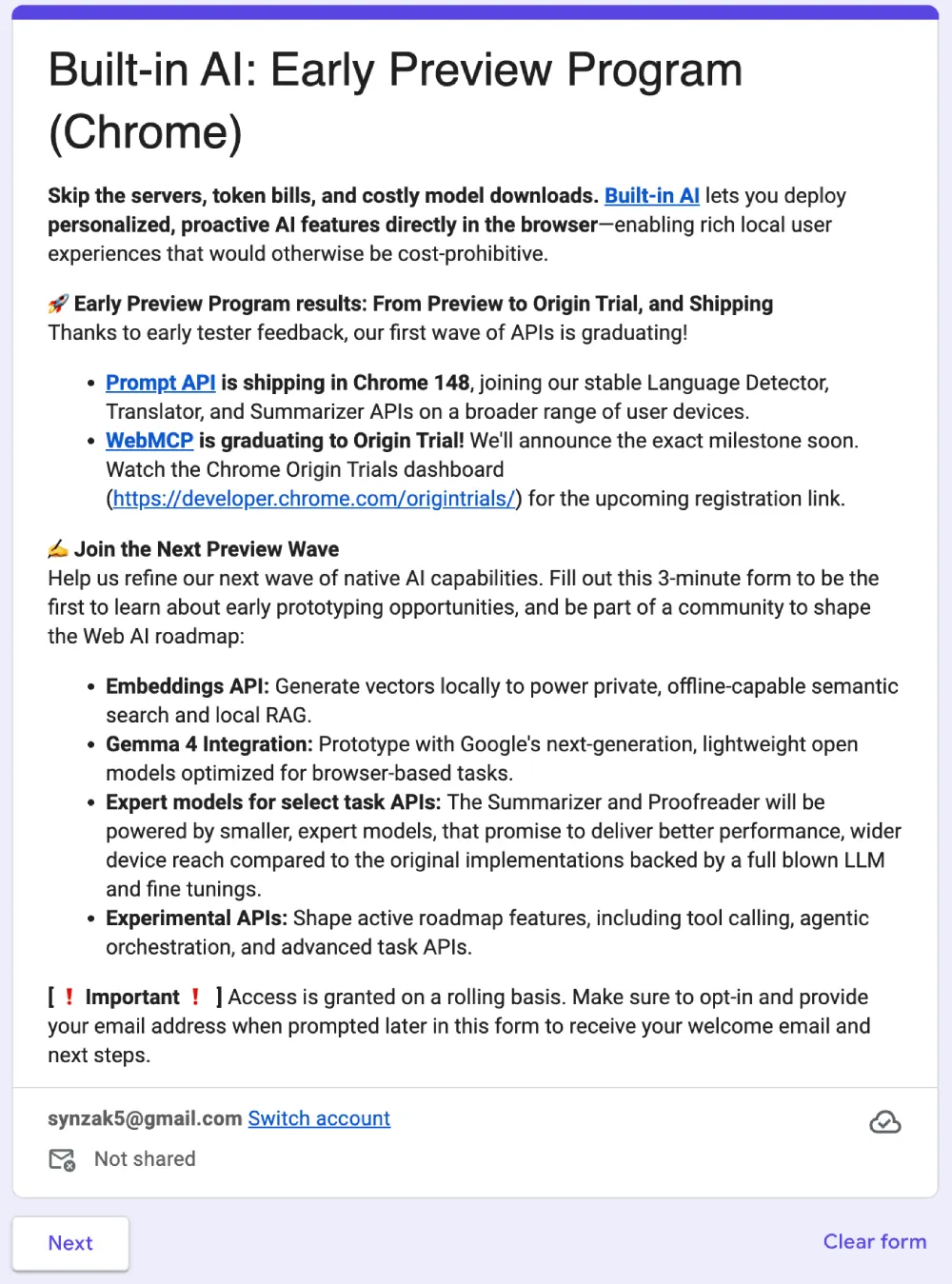
The link under that flag takes you to Google’s Built‑in AI Early Preview Program form, which lays out what’s coming next for testers.
Under “Join the next preview wave,” Google lists a few things it wants developers to test, including a local Embeddings API, expert models for some task‑specific APIs, and a bullet called “Gemma 4 Integration” that lets people “prototype with Google’s next‑generation, lightweight open models optimized for browser‑based tasks.”
In case you’ve not been following. Gemma 4 is Google’s newer open model family that’s designed to run on regular devices instead of living only in the cloud, with a focus on better reasoning and efficiency. That makes it a natural fit for Chrome’s built‑in AI plan, where the browser quietly downloads a model in the background and then lets websites tap into it through APIs without shipping their own giant AI stack. If Google actually wires Gemma 4 into these APIs, you’re looking at potentially faster responses and more capable summarizing and writing tools that can lean more on local processing instead of sending every request out over the network.
As mentioned above, the preview form also talks about a new Embeddings API for local search and note‑style features and mentions “expert models” for task‑specific APIs like Summarizer and Proofreader. That suggests Chrome won’t just have one big brain handling every AI feature. It could lean on smaller, focused models for certain tasks while Gemma 4 covers more general reasoning or heavier prompts. Experimental APIs on the same list hint at future features where Chrome’s AI can call tools and handle multi‑step actions, which gets closer to full browser agents than today’s simple prompts.
Gemma 4 sliding into this picture comes after a pretty messy few weeks for Chrome’s AI story. We already covered how Chrome quietly pulled down a roughly 4 GB Gemini Nano file to some desktops, which triggered privacy and bandwidth backlash before Google tried to defend the move and tweak the messaging.
A few days later, Canary quietly added a dedicated Gemini Skills off switch so users could keep the main Gemini features but kill the reusable workflows layer if they didn’t want it running. In parallel, Chrome has been testing more UI‑level controls such as individual side panel alignment for Gemini, bookmarks, and the reading list.
Today we also spotted a Circle to Search‑style upgrade for Ask Gemini that lets you select parts of the screen and send them straight into the side panel. All of that points to a browser that’s being rebuilt with AI being the focus.
On paper, plugging Gemma 4 into Chrome’s built‑in AI APIs gives Google a way to keep pushing flashy Gemini features while leaning on an open, lighter model family under the hood that can run closer to the user. With a Canary flag already referencing Gemma 4 directly and the early preview program calling out “Gemma 4 Integration” by name, it looks like Google is getting ready to test exactly that.
P.S. I wasn’t able to fully verify whether the flag already switches Chrome’s built‑in AI stack over to Gemma 4, since the model still showed as “downloadable” during my quick checks in Canary.


Dwayne Cubbins
3151 Posts
I cover fast-moving stories across apps, online platforms, and everyday tech — phones, wearables, consoles, and whatever else people are fighting with this week. Bugs, rollouts, scams, policy enforcement, and the occasional internet-culture rabbit hole are all fair game. My goal is simple — make confusing tech news readable. When I'm not working, I'm working out or chilling with my dog. Got a tip? You can find me on X @dcubbins.
Next article View Article