


Barely a few days after Ladybird officially went public with its macOS and Linux alpha, the independent browser has already passed Firefox on Web Platform Tests while shipping a fresh batch of bug fixes.
Jelle Raaijmakers, COO at the Ladybird Browser Initiative, posted on X that after recent CSS parsing and interpolation work, “parsing the gap property was enough to get us past Firefox in the WPT suite!”
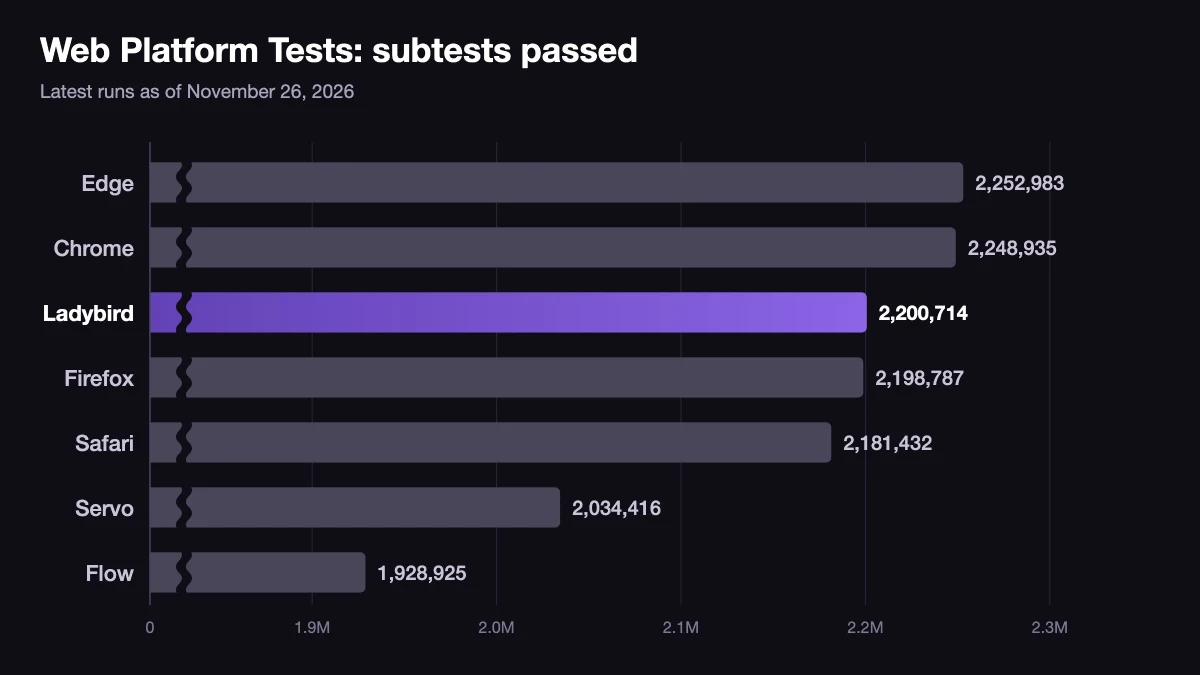
That comes right on the heels of Ladybird passing Safari Technology Preview on WPT in its October update, which honestly feels wild for an engine built completely from scratch.
When someone in the replies asked how many tests exist in total, Raaijmakers pointed out that “that number varies depending on how many tests a browser can actually run,” so the team looks at the highest subtest pass count any browser has ever hit instead.
Meanwhile, the developers just pushed Ladybird 2026.47.8 alpha to clean up the rough edges early adopters ran into over the last couple of days.
Mac users who opened the browser only to get complete silence finally have working audio again, and a crash triggered when assistive tools asked about closed tabs is gone too.
Over on Linux, reconnecting to a network will no longer break pages with an “Unable to resolve host” error, and machines without an NVIDIA graphics card will stop crashing because of an NVIDIA driver quirk.
Linux builds on older setups like Ubuntu 24.04 also pick up WebGL crash fixes, alongside Wayland improvements that stop crashes when moving tabs between windows.
Daily browsing annoyances got cleaned up as well, so Gmail’s search box will stop randomly collapsing until you resize the window, and bumping up YouTube quality on AV1 videos should stop the decoder from crashing. I’ve added the full changelog below for those interested. Click/tap to expand the respective sections:
Web compatibility
- #15775: Gmail no longer collapses its search box until the window is resized. Scripts inserted together with a subtree now read correct element sizes.
- #15429: A 2D
<canvas>larger than the GPU’s maximum texture size no longer crashes the compositor. It is now drawn from memory instead of staying blank. - #15126: Fixed a crash when reading
offsetParent, and emptygetComputedStyle()results. Both happened with slotted elements that moved between hidden and shown slots, and one crash was reported on a YouTube watch page.
Media
- #15555: Fixed an issue that could leave Ladybird with no audio output on macOS.
- #15605: Fixed a video decoder process crash when an AV1 video switched to a larger size, for example when changing quality on YouTube.
- #15605, #15744: Prevented broken video playback when a media or video decoder process is exiting while a new video is starting to load.
Networking
Stability
Platforms
- #15765: On Linux machines without an NVIDIA GPU, the NVIDIA driver no longer causes a crash.
- #15418: Fixed a crash when creating a WebGL context on Linux builds made with older headers, such as Ubuntu 24.04.
- #15458: Wayland fixes for the Qt interface. Builds made with Qt 6.10 now work with the Qt 6.11 runtime, and a crash when moving a tab between windows is fixed.
Since the alpha launch pulled over 565,000 visits and 4.3 TiB in downloads in a single day, testers have been flooding the team with feedback. The update installs automatically on macOS, while Linux folks can grab it through their package manager.


Dwayne Cubbins
3246 Posts
I cover fast-moving stories across apps, online platforms, and everyday tech — phones, wearables, consoles, and whatever else people are fighting with this week. Bugs, rollouts, scams, policy enforcement, and the occasional internet-culture rabbit hole are all fair game. My goal is simple — make confusing tech news readable. When I'm not working, I'm working out or chilling with my dog. Got a tip? You can find me on X @dcubbins.