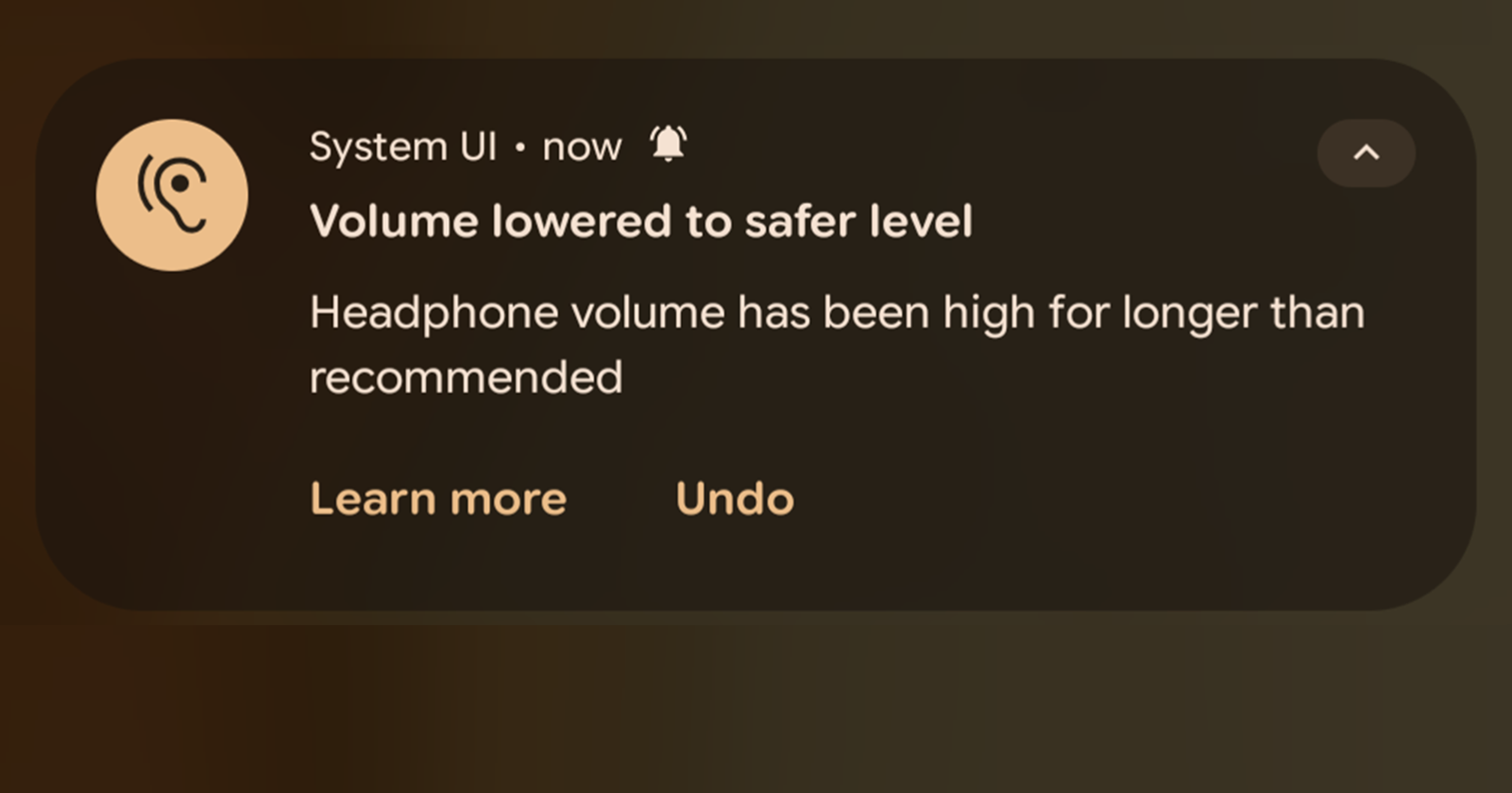
Google’s hearing safety feature on Android was meant to protect users from prolonged exposure to loud audio, but for many Pixel owners, it has mostly become a recurring annoyance. Months after a hidden Hearing Wellness menu surfaced and hinted at more user control, Google still hasn’t rolled out any proper first-party solution, even as fresh complaints continue to pile up from Pixel users frustrated by sudden volume drops during music playback, navigation, workouts, and Bluetooth audio sessions.
The issue itself is not new. Google first announced the headphone loud-sound alert system at I/O 2023, as part of Android 14, introducing a sound dose framework that measures momentary exposure levels over a rolling seven-day period. Once the system determines you’ve been listening at high volume for too long, it shows a warning. Ignore that prompt, and the phone automatically lowers the volume to what it considers a safer level.
That may sound reasonable on paper. In actual use, plenty of people hate it.
Pixel users are still complaining about forced volume drops
A couple of recent threads on Reddit have once again put the feature in the spotlight. In one post, a Pixel user shared a screenshot showing the familiar “Volume lowered to safer level” notification, then summed up the experience bluntly: “Seriously, I cannot STAND this ‘feature’.”
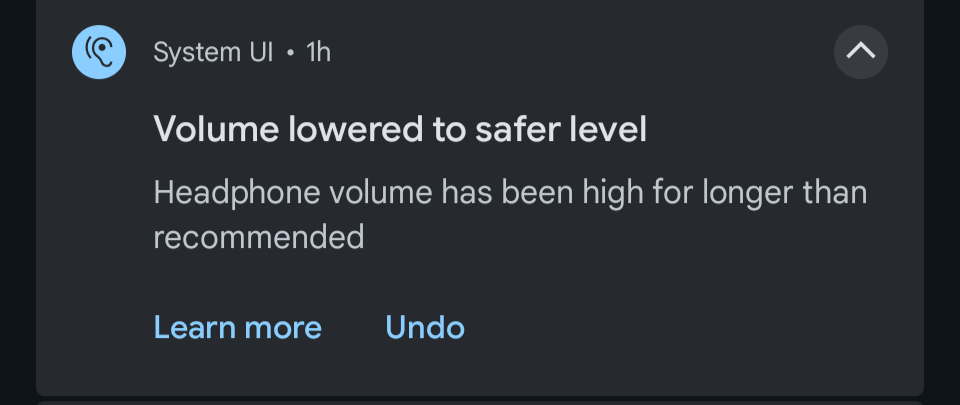
The frustration is easy to understand. The original poster said the phone keeps turning the volume down while they’re driving and using maps, which makes spoken navigation prompts harder to hear mid-route. That is not some edge-case complaint from someone trying to melt their eardrums at the gym. It is a practical use case in which the phone interferes with a function the user relies on.
And judging by the response, they are far from alone. The thread has racked up hundreds of upvotes and well over 160 comments in less than 24 hours, with many others saying they are dealing with the same thing and want a way to disable it entirely.
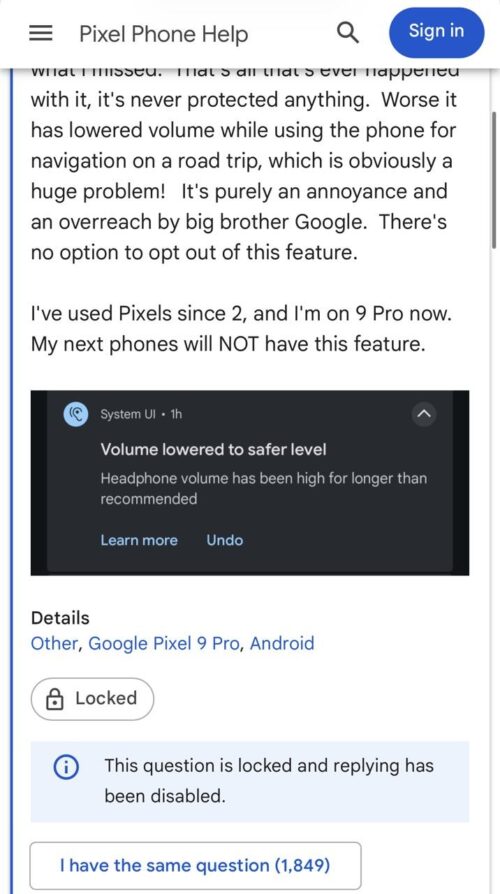
That alone should have been enough to push Google into action by now.
Google already appeared to have a solution in the works
What makes this situation even stranger is that Google seemingly recognized the problem months ago.
Back in August 2025, the folks over at Android Authority uncovered a hidden Hearing Wellness settings page on Pixel phones. According to that discovery, the menu was designed to give users more control over how the hearing safety system works. It included two separate toggles: one for Sound Exposure Notifications and another for Hearing Health.
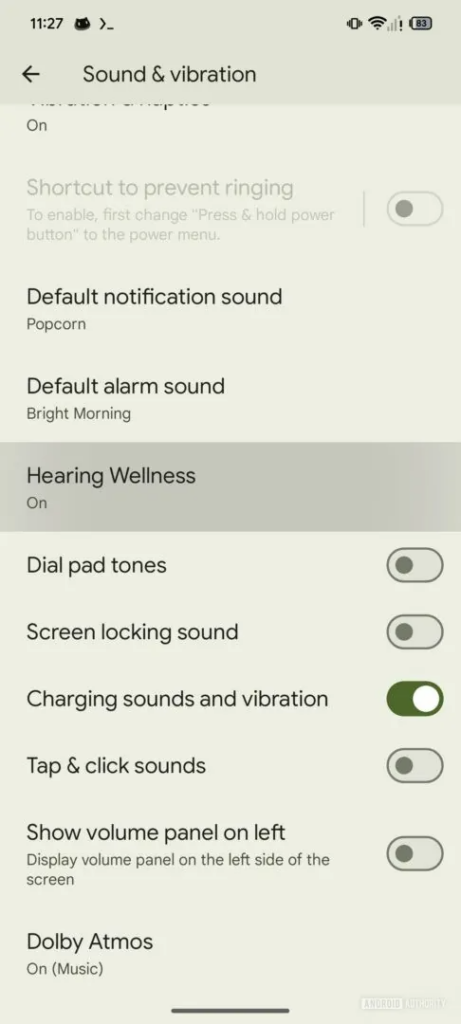
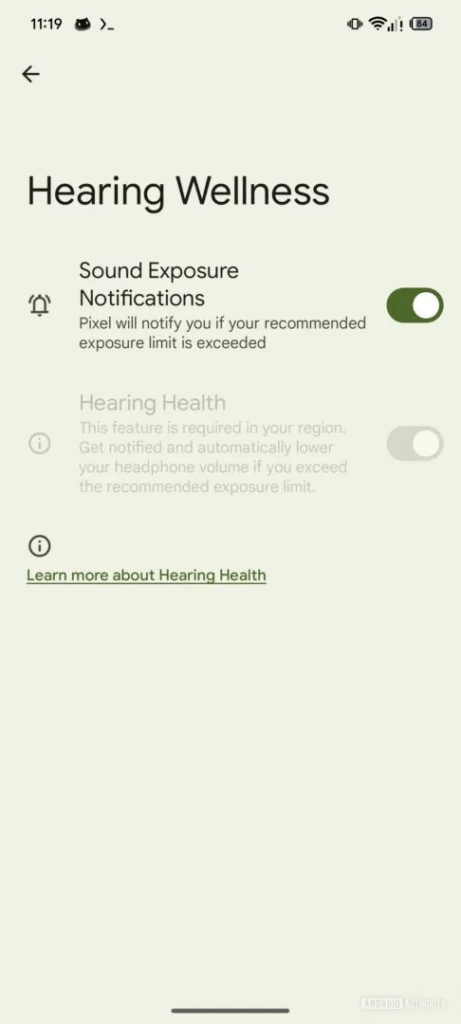
From the screenshots shared, this looked like a fairly complete user-facing feature, not some half-broken internal test buried in code with no interface. One screenshot showed the full Hearing Wellness page with both toggles visible, while another showed the Hearing Wellness entry sitting inside the Sound & vibration settings menu.
In other words, Google had already built what looked like the framework for a much better implementation.
Android Authority explained that when both options are enabled, the phone behaves pretty much the way it does now. Once you cross the safe listening threshold, your Pixel prompts you with the option to keep listening or lower the volume. But if you dismiss that notification without choosing, the system defaults to safety and lowers the volume automatically anyway.
That default behavior is exactly what many users are still complaining about today.
More importantly, Android Authority found that if both toggles were turned off, both the alert and the forced volume reduction were disabled. That is the volume control many Pixel users have been asking for all along.
The problem is that Google still hasn’t shipped it
I checked our in-house Pixel devices running the latest Android 16 stable build and Android 17 Beta 3, and that hidden Hearing Wellness menu still isn’t live. So despite evidence that Google has at least worked on a more flexible solution internally, end users remain stuck with the same rigid implementation.
That’s where this whole thing starts to feel especially absurd.
Android has spent years building its reputation around choice, flexibility, and customization. Pixel phones, meanwhile, are constantly marketed as Google’s best expression of Android. Yet here we are with a system-level feature that can interrupt music, car audio, and navigation prompts, while giving users almost no meaningful control over how it behaves.
For a platform that likes to talk about being open and adaptable, this is a surprisingly locked-down mess.
There is a legal complication, but it doesn’t explain everything
Part of the delay may come down to regional laws.
Some markets in the European Union, along with the EEA and Switzerland, require safe-listening protections by law. In those regions, users may not be allowed to disable certain features, particularly the part that automatically lowers volume after prolonged exposure. In fact, the Hearing Health toggle, which controls the auto-lowering behavior, could not be turned off in countries such as France, Germany, Italy, and Spain because of those legal requirements.
That makes sense as far as regulated markets go.
But it does not fully explain why Google has still failed to roll out a region-sensitive solution elsewhere. On Pixel phones, both Hearing Wellness options were enabled by default regardless of region, and there was no way to switch them off. In places like the US and Canada, where the same legal mandate does not broadly apply in the same way, users should logically have more control. Yet here we are.
So the likely issue here is not that Google lacks a menu. It is probably that Google has not yet figured out, or not yet finalized, a clean region-based rollout that satisfies compliance rules in some countries while restoring user choice in others.
That is a real challenge. But it has also been many months now, and users are still the ones paying for that delay every time their phone decides it knows best.
Android 17 Beta is stable, and the feature still isn’t here
At this stage, the timing does not look especially promising.
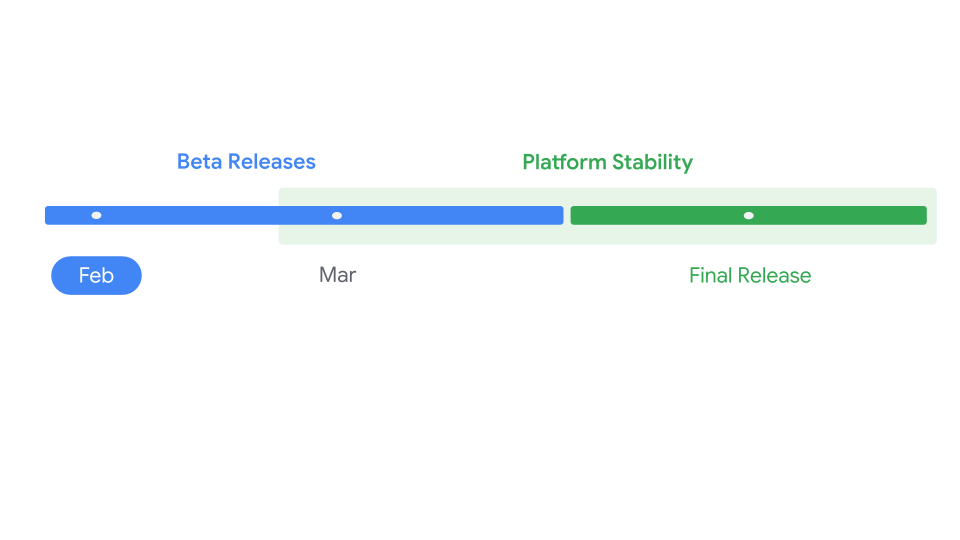
With Android 17 Beta 3 already at platform stability, it feels increasingly unlikely that Google will suddenly flip the switch and ship Hearing Wellness to end users as part of the core Android 17 rollout. If this feature is still coming, a future Pixel Feature Drop seems like the more realistic home for it.
That said, Google has not publicly confirmed that it plans to release the hidden menu at all.
So for now, users are left waiting for a feature that appears to exist, addresses a widely reported annoyance, and still somehow remains unavailable.
Users are resorting to workarounds instead
Because Google still has not provided an official solution, affected users have done what Android users always end up doing when the platform becomes weirdly stubborn: they’ve found their own workarounds.
One option uses Shizuku and SystemUI Tuner to disable the safe audio warning without root. Another uses MacroDroid to listen for the System UI notification that says the volume has been lowered, then automatically cranks the media volume back up to 100%. That workaround is especially useful for people who use their Pixel phone as a source device for car audio, external speakers, or other Bluetooth setups where the actual listening volume is being controlled elsewhere.
There is also a simpler workaround that works in some cases: changing the connected Bluetooth device type from headphones to speakers. That can stop Android from treating the accessory like a personal listening device subject to hearing safety enforcement. The problem is that this does not work consistently, and some devices are locked to a fixed type anyway.
These workarounds are clever, but they also make the situation look worse for Google. Users should not need automation tools, Shizuku, or Bluetooth trickery just to stop their phone from lowering audio output in cases where they are not even relying on the phone itself for final playback volume.
Google needs to stop dragging its feet
This is not really a debate about whether hearing protection matters. It does. The problem is how Google has implemented it on Pixel phones.
Right now, the feature feels overly rigid, poorly communicated, and detached from real-world use cases. There is a big difference between protecting someone from unsafe headphone listening and interfering with navigation prompts or a phone connected to a car stereo where the handset volume is simply acting as a source level.
That nuance matters, and Google’s current implementation still does a poor job respecting it.
The hidden Hearing Wellness menu showed that Google likely understands the problem. The continued absence of that menu, months later, suggests the company either has not prioritized the fix or is still struggling to reconcile regulation with user control.
Either way, Android and Pixel users are still waiting.
And until Google actually rolls out a proper first-party solution, the complaints are not going anywhere.


Hillary Keverenge
2723 Posts
Tech has been my playground for over a decade. While the Android journey began early, it truly took flight with the revolutionary Lollipop update. Since then, it's been a parade of Android devices (with a sprinkle of iOS), culminating in a mostly happy marriage with Google's smart home ecosystem. Expect insightful articles and explorations of the ever-evolving world of Android and Google products coupled with occasional rants on the Nest smart home ecosystem.
Next article View Article