



Mozilla has shared the results of a large study involving nearly 25 million Firefox users, and the findings are encouraging: its latest privacy updates are helping reduce invisible web tracking. Mozilla lowered the share of users who could be uniquely tracked from 75% to 46% by simply changing how it shares hardware information.
If you’ve checked out our explainer on how browser fingerprinting works and the myths you should ignore, you already know that clearing cookies does not really stop companies from following you anymore. Trackers just look at your screen size, installed fonts, and processor details to stitch together a profile that singles you out across the web.
To see what actually moves the needle in the real world, Mozilla’s security researchers simulated the exact tracking scripts used by commercial giants like Fingerprint Pro, Akamai, and Signifyd. They found that trackers don’t need dozens of obscure data points to identify you; just ten basic signals are enough to spot 80% of unique users.
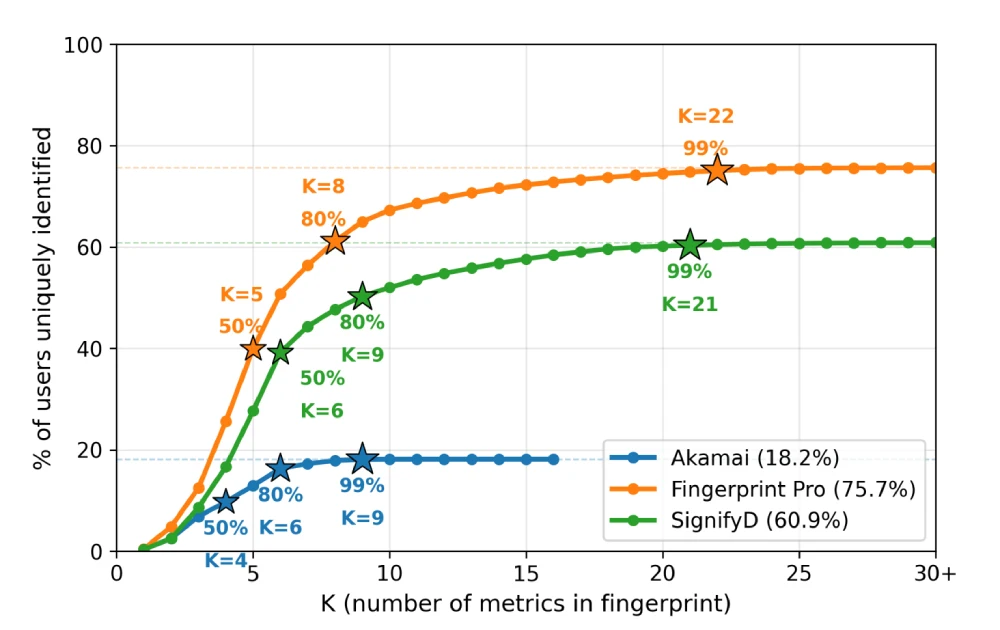
Instead of trying to block everything and hoping for the best, Firefox now tweaks a handful of those high-impact details so millions of people look identical to tracking scripts. For example, the browser hides the exact size of your desktop taskbar or dock, and it reports your processor core count as either 4 or 8 instead of giving away the real number.
They first mentioned some of these macOS and desktop tweaks in a July roundup of recent Firefox privacy and security improvements, but now we finally have the hard data to prove they work.
One of the trickiest things about addressing fingerprinting is that websites often need some hardware information to work properly. As the researchers noted in their paper, “users are more likely to disable such protections than tolerate disruptions,” which is why super-strict privacy modes usually backfire when your calendar app shows the wrong time zone or a video call freezes up.
We saw the engineers talk about this exact balancing act when the Firefox security team explained plans for better fingerprinting protection during a Reddit AMA last month.
Some of these safer protections are already turned on for everyone by default, while the more aggressive ones sit inside Private Browsing and Strict Enhanced Tracking Protection until Mozilla knows they will not break everyday sites. This whole push to bake stronger privacy tools directly into the browser also lines up with what Firefox’s latest quarterly newsletter revealed about its security direction just last week.


Dwayne Cubbins
3194 Posts
I cover fast-moving stories across apps, online platforms, and everyday tech — phones, wearables, consoles, and whatever else people are fighting with this week. Bugs, rollouts, scams, policy enforcement, and the occasional internet-culture rabbit hole are all fair game. My goal is simple — make confusing tech news readable. When I'm not working, I'm working out or chilling with my dog. Got a tip? You can find me on X @dcubbins.