





If you’ve recently been tapping extension icons in Google Chrome on your Mac and then found yourself staring at a frozen screen, you’re not imagining it. A strange lag is causing popups to take anywhere from a few seconds to a full minute to appear.
This is especially true with password managers such as 1Password and Bitwarden; when people click the toolbar icon to fill in their login details, they get nothing, while the browser just sits there doing nothing.

The 1Password support team has confirmed they are receiving complaints about the lag, telling one user on X that “there is a known issue in Google Chrome at the moment which can cause extension popups to take considerably longer than normal to open.”

Chrome appears to misclassify these popups as low-priority background tasks when they try to open. Since macOS slows background tasks on modern Macs to conserve battery, the popup lacks the resources it needs until the browser finally realizes what it is doing. This is why it takes so long to appear.
We normally take the time to warn people about dodgy add-ons, for instance by discussing how a toolkit has managed to get rogue extensions into Chrome and Edge without permission, or by referring to a study which showed that one malicious extension took control of the browser’s AI on five separate browsers. This time, however, the issue isn’t due to a malicious developer; it’s built directly into Chrome.
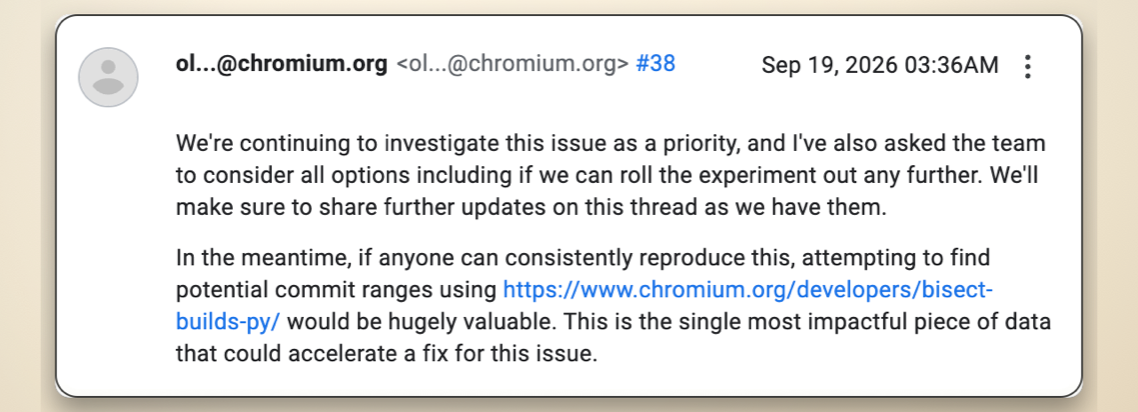
That said, there’s at least some good news here. We spotted a thread on the Chromium Issue Tracker, where the bug’s status is marked as ‘Top Priority’. A member of the Chromium team also recently commented on the bug report to reassure users, stating, “We’re continuing to investigate this issue as a priority, and I’ve also asked the team to consider all options including if we can roll the experiment out any further. We’ll make sure to share further updates on this thread as we have them.”
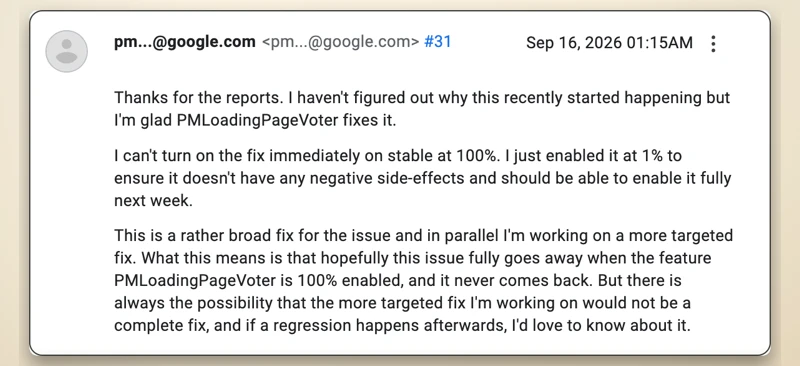
Google has begun testing, in the background, an internal patch which makes Chrome give extensions the appropriate priority when they are being loaded. The update is currently being offered to about 1 percent of users on the stable version to ensure it doesn’t cause other issues, with the intention of expanding the rollout shortly.
In the meantime, Mac users will have to carry on waiting. Just know it’s not your extension developer’s fault.


Dwayne Cubbins
3038 Posts
I cover fast-moving stories across apps, online platforms, and everyday tech — phones, wearables, consoles, and whatever else people are fighting with this week. Bugs, rollouts, scams, policy enforcement, and the occasional internet-culture rabbit hole are all fair game. My goal is simple — make confusing tech news readable. When I'm not working, I'm working out or chilling with my dog. Got a tip? You can find me on X @dcubbins.