
Google is preparing a minor but serious upgrade to Chrome that will most likely go unnoticed by most users. This is because the company is replacing part of the code in Chrome responsible for opening JPEG pictures with another piece of code also written in Rust.
This language was selected because the previously used programming language was highly vulnerable to attacks and had a long history of being a common attack vector. In fact, the Chromium team had already documented plans to use safer languages like Rust in the future. So this seems to be part of that same plan.
Of course, this isn’t going to be one of those features that will make people want to jump ship from their current browser to Chrome, but it’s still a small step toward making Chrome faster and safer. And, in case you missed it, Chrome’s recent rendering speed-up was also achieved through a similar course of action.
The Chromium project, which develops the open-source version of Chrome, has also received this change. This means that it may appear in other browsers based on Chromium in the future. The code was provided by the developer Sergio Gonzalez, who described his contribution to the code as follows: “Add Rust JPEG decode/encode implementation behind Finch flags”.
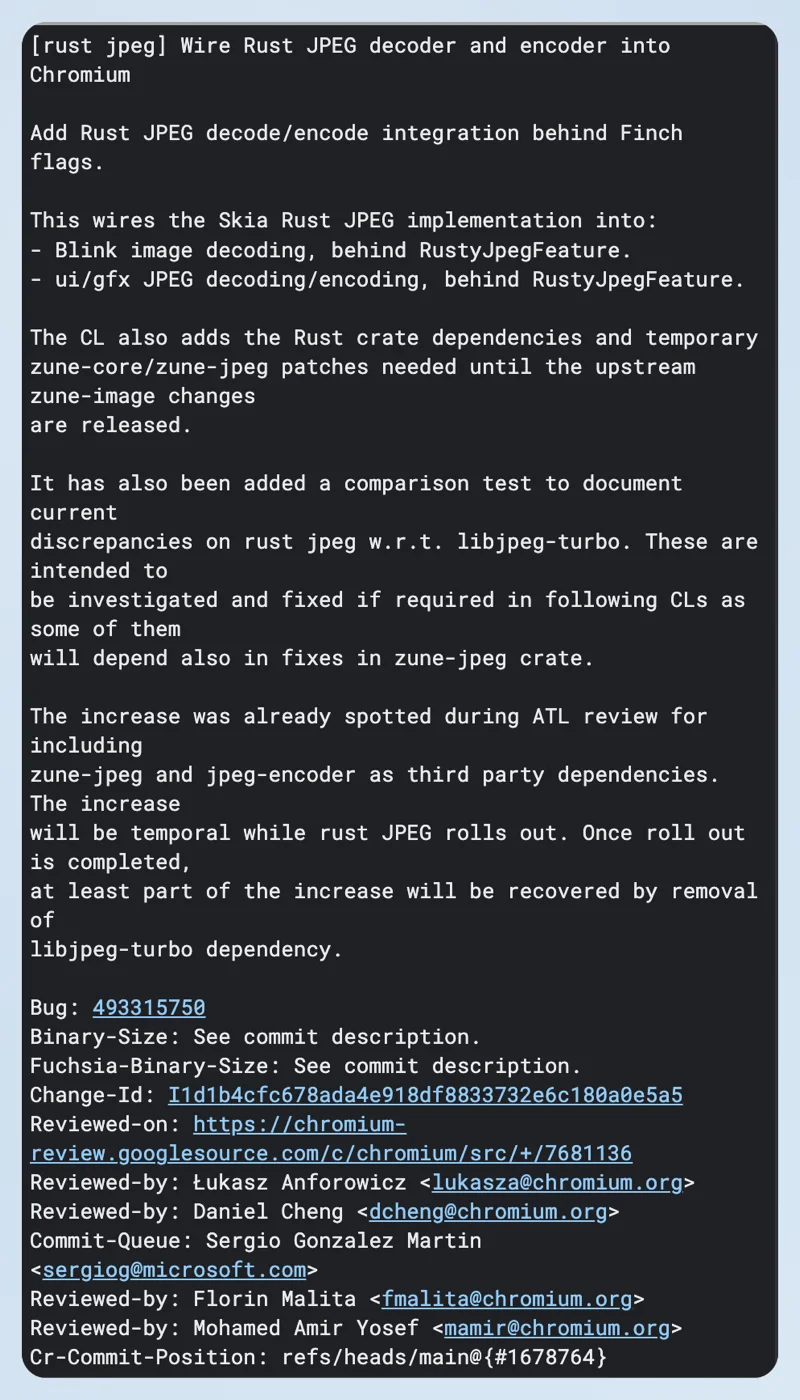
The fact that the implementation is behind the Finch flags indicates that it is currently disabled and being tested by developers. I found the option myself in Chrome Canary 153.0.8009.0.

However, there is one caveat, which is highlighted in Google’s official description of the change. They admit that the new Rust decoder does not yet produce results that perfectly match the old one on certain images, and the team says those differences are “intended to be investigated and fixed if required in following CLs.”
You will hardly notice any difference when the new option is enabled, because it only affects the display of images in Chrome. Thus, everything is set to make your browsing experience comfortable and safe without you even having to think about it.


Dwayne Cubbins
3088 Posts
I cover fast-moving stories across apps, online platforms, and everyday tech — phones, wearables, consoles, and whatever else people are fighting with this week. Bugs, rollouts, scams, policy enforcement, and the occasional internet-culture rabbit hole are all fair game. My goal is simple — make confusing tech news readable. When I'm not working, I'm working out or chilling with my dog. Got a tip? You can find me on X @dcubbins.
Next article View Article