Google has started rolling out another piece of its built-in AI platform for Chrome, but this one is aimed squarely at developers. Members of the Chrome Built-in AI Early Preview Program can now test the new Embedding API, giving them a way to generate text embeddings directly on a user’s device instead of sending data to the cloud.
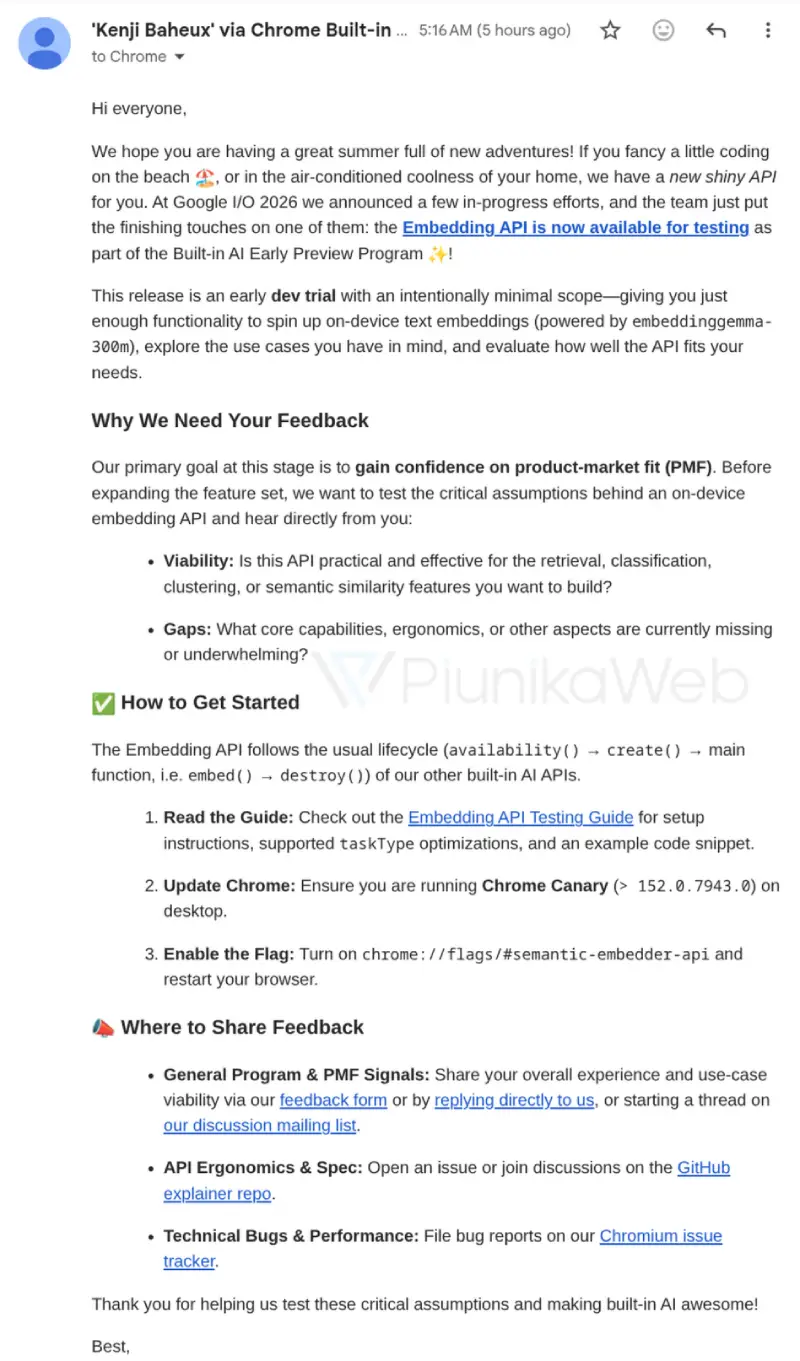
The company announced the preview in an email to program members earlier today. It described the release as an “early dev trial with an intentionally minimal scope,” saying the goal is to let developers experiment with the API and figure out whether it works well for real-world apps before Google expands it further.
If you’re wondering what text embeddings actually are, think of them as a way for AI to understand the meaning behind text instead of just matching exact words. That makes features like semantic search, document clustering, spam detection, recommendation systems, and finding similar content much more accurate.
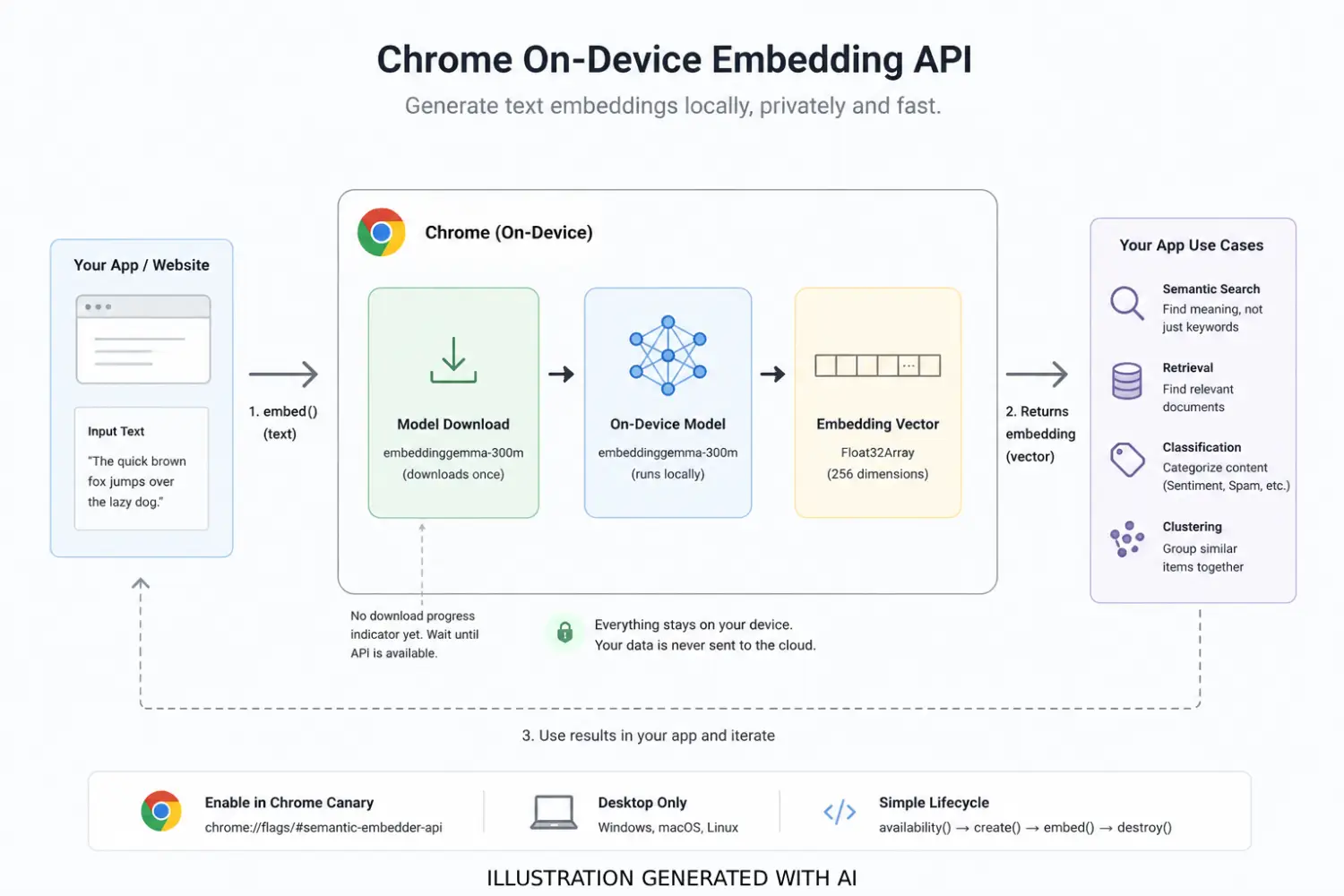
Unlike cloud-based services, this API runs entirely on the user’s computer. According to Google’s documentation, it uses the built-in embeddinggemma-300m model and currently works only on desktop versions of Chrome Canary running on Windows, macOS, and Linux.
Google says it especially wants feedback on whether the API is useful for retrieval, classification, clustering, and semantic similarity tasks. It is also asking developers what feels missing before the feature moves any further.
“Our primary goal at this stage is to gain confidence on product-market fit,” the Chrome team wrote in the announcement email.
Testing is fairly straightforward if you’re already part of the preview program. You’ll need Chrome Canary version 152.0.7943.0 or newer, enable the experimental semantic-embedder-api flag, and restart the browser. The API follows the same pattern as Google’s other built-in AI APIs with availability checks, creation, execution through embed(), and cleanup afterward.
One thing to keep in mind is that the model downloads the first time it’s used. Google notes there’s currently no download progress indicator, so developers have to wait until the browser reports that the API is available before creating an embedder instance.
This release also fits into Google’s broader plan to bring more AI capabilities directly into Chrome. Last month, we reported that Google was preparing to integrate Gemma 4 into Chrome’s built-in AI platform, along with an early preview of the Embeddings API itself.
The Embedding API is still very much an early experiment, but it offers another look at where Chrome’s built-in AI platform is headed. Instead of relying on remote servers for every request, more AI features could eventually run locally, making them faster while keeping more data on the user’s own device.


Dwayne Cubbins
3137 Posts
I cover fast-moving stories across apps, online platforms, and everyday tech — phones, wearables, consoles, and whatever else people are fighting with this week. Bugs, rollouts, scams, policy enforcement, and the occasional internet-culture rabbit hole are all fair game. My goal is simple — make confusing tech news readable. When I'm not working, I'm working out or chilling with my dog. Got a tip? You can find me on X @dcubbins.
Next article View Article