Google is keeping its foot on the gas this week. Shortly after initiating the Google Gemini rollout for Chrome desktop users in the UK, the tech giant has started pushing a fresh batch of updates across its browser ecosystem. Desktop and Android users are receiving a crucial Chrome 150 point update that patches multiple security vulnerabilities, while ChromeOS users have some channel updates of their own to digest.
Google Chrome on desktop and Android gets essential security patches
Google is rolling out a new Stable channel update for desktop platforms. Windows and Mac users will see their browser updated to version 150.0.7871.124 or .125, while Linux users are receiving version 150.0.7871.124. Simultaneously, the Google Play Store is pushing the same version (150.0.7871.124) to Android devices.
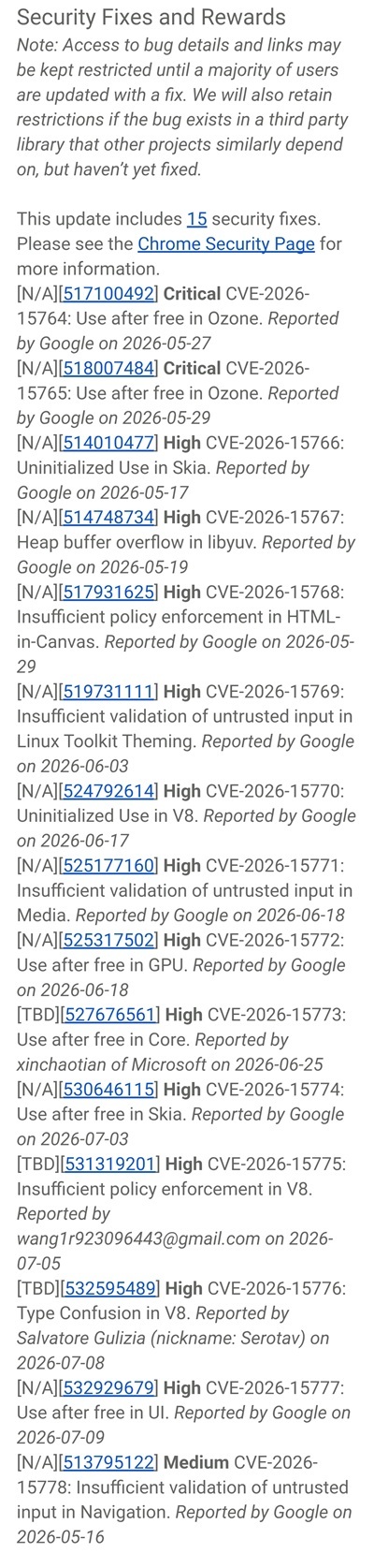
The primary focus of this release is security. The update packs 15 specific security patches, patching vulnerabilities discovered over the past couple of months by Google’s internal teams and external researchers. Notable fixes include two critical severity bugs:
- CVE-2026-15764: Use after free in Ozone.
- CVE-2026-15765: Use after free in Ozone.
The patch also addresses 12 high-severity vulnerabilities, primarily addressing use after free, uninitialized use, and insufficient policy enforcement issues within core components like V8, Skia, and Media along with one medium severity flaw in Navigation.
Google has been aggressively tightening Chrome’s defenses lately. This release follows closely on the heels of a massive security sweep just last week, where a previous Chrome 150 update delivered 27 security fixes.
Beyond security, these stable updates traditionally carry under-the-hood performance and stability improvements. We are hoping this update addresses some of the frustrating usability quirks early adopters have faced, such as the disappearing Android downloads that surfaced shortly after the initial v150 rollout.
Speaking of Android, users updating their mobile browsers might also notice UI and feature adjustments as Google continues to refine the mobile experience. A prime example of this ongoing UI evolution is the recently redesigned bottom navigation bar for Gemini in Chrome for Android.
ChromeOS channel updates
Chromebook users also have some movement to track across both the Beta and Stable channels.

Google has recently bumped the ChromeOS Beta channel to OS version 16733.19.0, up from the previous version 16700.25.0. More importantly, this updates the underlying browser to version 151.0.7922.23 (up from browser version 150.0.7871.40), giving beta testers on ChromeOS and ChromeOS Flex devices an early look at what to expect in the v151 release cycle.
Meanwhile, for those keeping track of the standard Stable channel, ChromeOS received its update late last week on July 10. That rollout brought most ChromeOS devices to OS version 16667.62.0, keeping the built-in browser operating on version 149.0.7827.238.
Because Google staggers its rollouts, the new Chrome 150 updates for Windows, Mac, and Linux will reach users over the coming days and weeks. You can manually check for the update on desktop by navigating to Settings > About Chrome. Android users can check for pending updates via the Google Play Store.


Hillary Keverenge
2723 Posts
Tech has been my playground for over a decade. While the Android journey began early, it truly took flight with the revolutionary Lollipop update. Since then, it's been a parade of Android devices (with a sprinkle of iOS), culminating in a mostly happy marriage with Google's smart home ecosystem. Expect insightful articles and explorations of the ever-evolving world of Android and Google products coupled with occasional rants on the Nest smart home ecosystem.
Next article View Article