![Firefox 152 crashing linked to Raptor Lake CPUs, Mozilla says a fix is coming [U: Fix released]](https://piunikaweb.com/wp-content/uploads/2026/06/Firefox-3-1.jpg "Firefox 152 crashing linked to Raptor Lake CPUs, Mozilla says a fix is coming [U: Fix released]")
Update 19/06/26 – 03:18 pm (IST): The issue has now been resolved with the latest Firefox 152.0.1 update. You can find all the details in our fresh report here.
Original article published on June 18, 2026, follows:
Software updates are supposed to make our daily digital lives smoother, but if you recently updated your Firefox browser to version 152, you are likely experiencing the exact opposite.
Over the past few days, a wave of user reports has flooded community forums like Reddit, detailing severe performance issues immediately after installing the latest update. Instead of a seamless browsing experience, many users are dealing with a browser that stubbornly freezes upon launch, refuses to load pages, and suffers from massive memory spikes.
Going through the complaints, the symptoms of this bug range from annoying to completely unusable. For some, the browser locks up so intensely that clicking the top-right “X” does nothing, forcing users to right-click the taskbar icon or open the Task Manager to force quit the application.
Others are seeing bizarre resource hoarding. One user noted that after using Firefox for just five minutes, their Task Manager showed the browser consuming over 3,800 MB of memory. Another user noticed disk usage spiking to 100%, with the Windows Antimalware Service Executable running in overdrive trying to scan whatever the browser was doing.
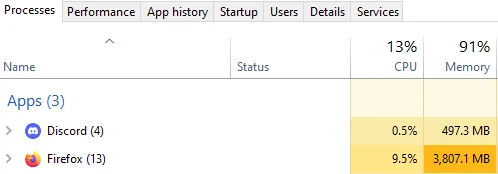
While a bad software update is easy to blame, tracking the bug reports points to a highly specific hardware culprit. The crashes seem strongly correlated with known instability issues found in Intel Raptor Lake CPUs (13th and 14th Gen processors).
In a Reddit thread discussing the problem, a verified Firefox Engineer stepped in to clarify, stating:
“You sadly seem to have a Raptor Lake CPU with known instability issues, which is highly correlated with this crash.”
This isn’t the first time Raptor Lake has caused headaches for the Mozilla team. Similar instability was reported when v151 launched. However, this time, the crashes aren’t just taking down individual tabs—they are taking down the entire browser.
Mozilla is currently tracking this under Bug #2039575. A Mozilla employee candidly noted on the forums that developers are essentially playing “whack-a-mole” with the underlying Raptor Lake problem, but they are actively working on a workaround for the broader user base.
Official acknowledgment & current workarounds
The good news is that the Mozilla team is fully aware of the crashing issue and is fast-tracking a patch. According to official support channels, they are planning to roll out a v152.0.1 release in the next few days to mitigate the crashes.
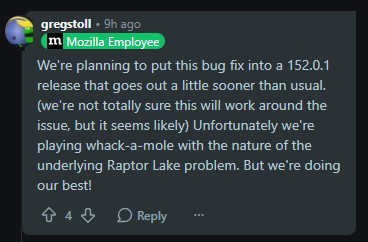
Interestingly, the development team has already implemented a fix in the Beta v153 channel, though, for reasons unknown, the Nightly v154 build remains affected.
If you rely on Firefox for your daily workflow and find yourself stuck in a crash loop, here are the most effective steps to regain control right now:
- Update your BIOS: For users running Intel Raptor Lake processors, several community members confirmed that flashing their motherboard to the latest BIOS version eliminated the crashing in Firefox.
- Switch to Firefox ESR: If you need a stable browser right now and don’t want to leave the ecosystem, downgrade to Firefox ESR (Extended Support Release) v140. This version receives fewer feature updates, making it far less prone to these unexpected, cutting-edge bugs.
- The private window trick: One user reported a temporary workaround: force-quit the frozen browser, open a Private Window directly from your taskbar (which bypasses loading your previous tabs), and then open a normal window.
We will keep an eye on this situation and update this article as soon as the v152.0.1 patch goes live.


Hillary Keverenge
2723 Posts
Tech has been my playground for over a decade. While the Android journey began early, it truly took flight with the revolutionary Lollipop update. Since then, it's been a parade of Android devices (with a sprinkle of iOS), culminating in a mostly happy marriage with Google's smart home ecosystem. Expect insightful articles and explorations of the ever-evolving world of Android and Google products coupled with occasional rants on the Nest smart home ecosystem.
Next article View Article