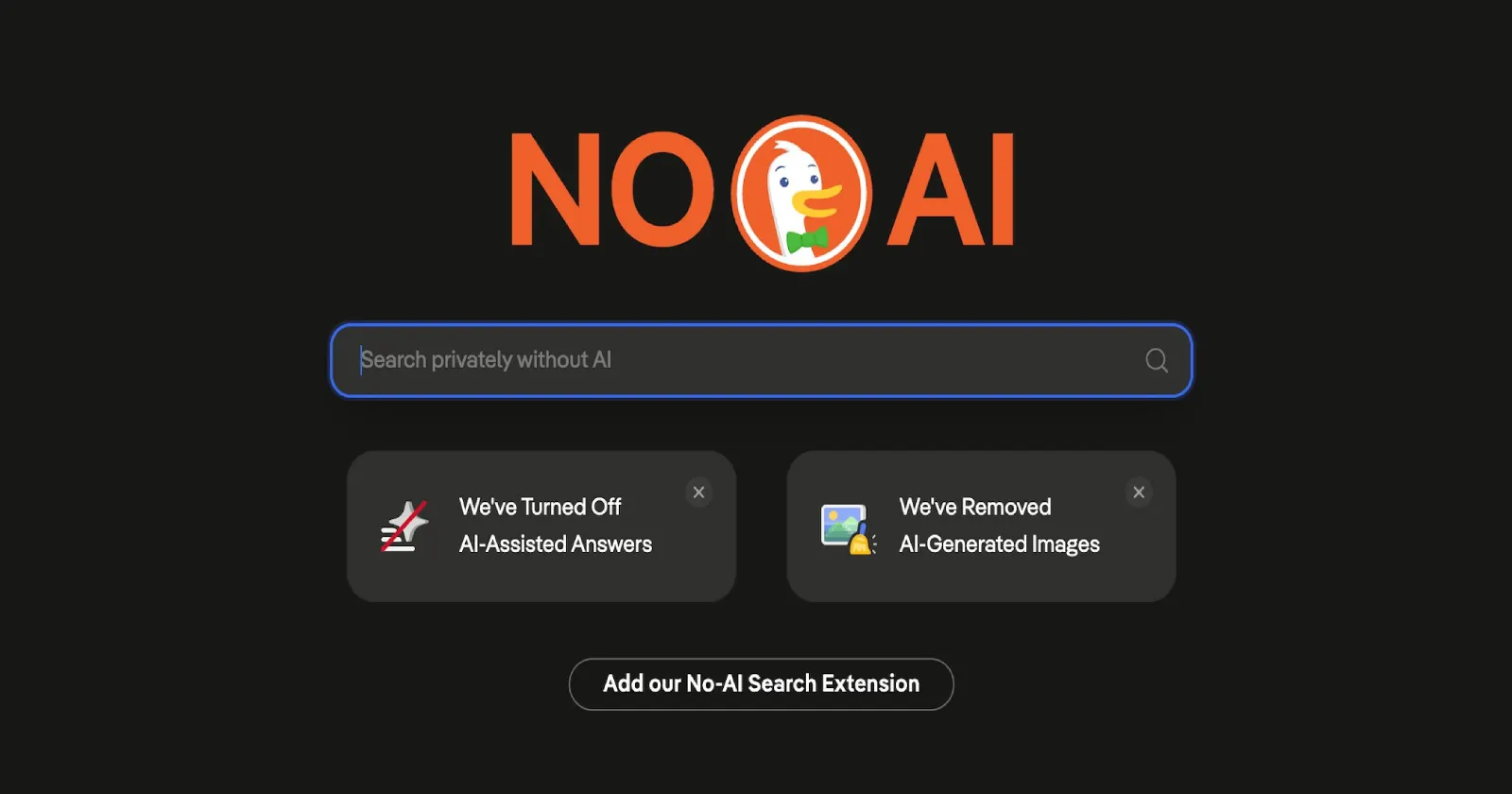
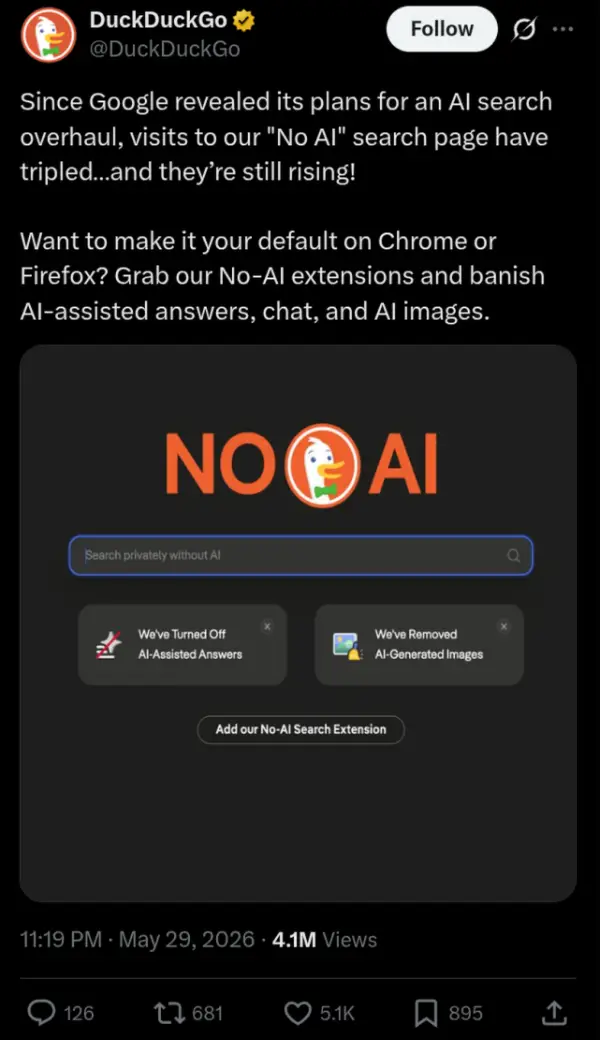
Visits to DuckDuckGo’s dedicated “No AI” search page tripled immediately following Google’s rollout of its heavily AI-reliant search engine overhaul. DuckDuckGo announced the traffic spike on X, pointing directly to user backlash from Google’s mid-May I/O conference.
To capitalize on the sudden migration, DuckDuckGo also put the spotlight on its dedicated No-AI Search Firefox add-on alongside a Chrome extension. These tools hardcode the browser to a specific version of the search engine that filters out AI-generated images and completely removes conversational summaries.

Google recently pushed its conversational AI Mode deeper into its main interface, forcing users to wade through algorithmic overviews before reaching traditional web links. Google says the system has strong uptake and reaches over a billion users.
That said, it is exhausting to watch a foundational web utility turn into a bloated, data-hungry guessing game just to chase a tech industry trend. Instead of solving actual user problems, Google’s new layout treats a standard search query like an opening prompt for a chatbot.
We covered the whole ordeal last week, where we also pointed out that while DuckDuckGo is in the spotlight, retaining users will be the bigger challenge.
It’s worth pointing out that the DuckDuckGo experience is still not perfect. It has noticeable indexing gaps, as it pulls core search results from Microsoft Bing, an ecosystem similarly obsessed with embedding AI models into daily workflows.
DuckDuckGo commands a tiny 1.8 percent of the domestic market share. The sudden traffic spike proves that people are desperate for clean layout directories, but the platform must still prove its basic indexing is reliable enough to keep frustrated searchers from drifting back to Google.


Dwayne Cubbins
3073 Posts
I cover fast-moving stories across apps, online platforms, and everyday tech — phones, wearables, consoles, and whatever else people are fighting with this week. Bugs, rollouts, scams, policy enforcement, and the occasional internet-culture rabbit hole are all fair game. My goal is simple — make confusing tech news readable. When I'm not working, I'm working out or chilling with my dog. Got a tip? You can find me on X @dcubbins.
Next article View Article