





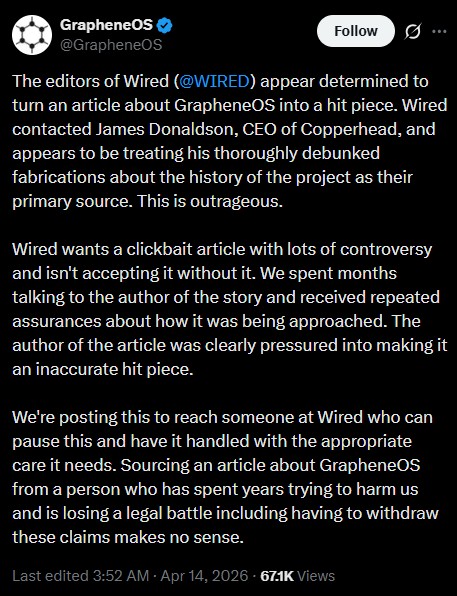
WIRED (@WIRED) has gone ahead with publishing an extraordinarily inaccurate article about GrapheneOS. It presents a highly inaccurate history of the GrapheneOS project heavily based on fabrications from James Donaldson. WIRED failed to incorporate most of our responses to his…
— GrapheneOS (@GrapheneOS) April 21, 2026
A little over a week after GrapheneOS publicly warned that WIRED was preparing a hit piece, the magazine has now published its feature. In the article, the publication acknowledges GrapheneOS as the gold standard of mobile security, but the story leans heavily into the long-running feud between project founder Daniel Micay and former Copperhead CEO James Donaldson rather than the software itself.
In WIRED’s version of events, Donaldson is cast as the business half of Copperhead while Micay is presented as the intensely private technical force behind the hardened Android project. The article revisits CopperheadOS’ early rise, its move away from a fully open model, Donaldson’s push toward bigger contracts, and the eventual collapse over signing keys in 2018.
WIRED quotes Donaldson calling defense work “the holy grail,” then later saying he and Micay now “speak through lawyers now.” It also includes Dave Wilson defending Micay’s decision to destroy the keys as “a testament to the integrity of the project.”
GrapheneOS is now pushing back hard on that framing. In its post-publication response, the project said WIRED had published an “extraordinarily inaccurate” article. It argued that the story relied too heavily on Donaldson’s version of events while failing to incorporate the answers GrapheneOS provided during fact-checking meaningfully.
On the official GrapheneOS forum, the team said WIRED repeatedly suggested the article would not be centered on Micay or on the project’s early history, only for that exact material to become the core of the finished piece. The project also said months of interviews about GrapheneOS features and values were mostly discarded.
The most important part of GrapheneOS’s rebuttal is that it does not just complain in broad terms. It disputes specific pieces of the published history. In the long fact-check response published in the forum, GrapheneOS says Copperhead had three founders, not two, as WIRED claims in the article.
It says Micay met Donaldson in late 2014, not between 2011 and 2013. It says the hardened Android project existed before Donaldson became involved, and it also says Donaldson wanted direct access to the signing keys, not merely information about how they were stored.
The team also points to a different legal center of gravity than the one most casual readers may take away from the WIRED story, arguing that the live dispute is about fiduciary duty rather than a simple ownership fight over CopperheadOS.
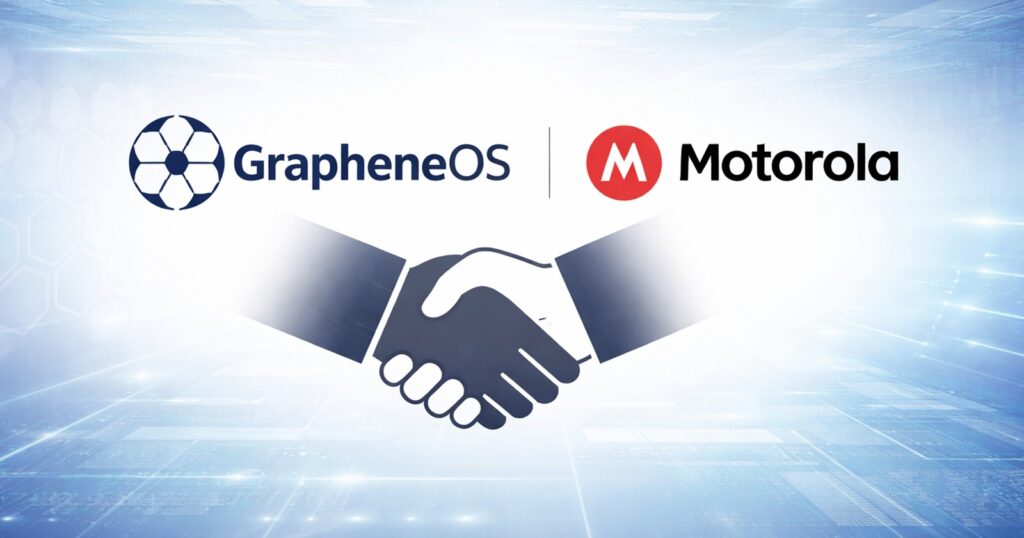
What makes this especially notable is the timing. GrapheneOS is no longer just a niche privacy project fighting old wars on forums. In recent months, the project has moved into a much more consequential phase, with Motorola officially announcing a long-term partnership with the GrapheneOS Foundation at MWC 2026.
GrapheneOS said Motorola reached out first and described the arrangement as a non-exclusive partnership built around bringing future Motorola devices up to the project’s security standards. Granted, this is a potentially massive turning point for the project.
That does not prove anything about Donaldson’s motives, and it would be sloppy to pretend otherwise. But it does sharpen the subtext in a way WIRED’s article almost invites.
WIRED’s own reporting describes the original Copperhead split as a clash between Donaldson’s push to commercialize the project and Micay’s resistance to deals he believed could compromise the OS or its values.
Fast-forward to 2026, and GrapheneOS is now entering the kind of major OEM relationship that once seemed to sit near the center of that old tension, only this time under a nonprofit foundation, with GrapheneOS insisting the partnership remains non-exclusive and aligned with its own standards.
Put differently, the hardware-validation future Donaldson appeared to want with CopperheadOS is now arriving on GrapheneOS without him, and I suspect the timing of the WIRED interview has something to do with it.
That is ultimately why this story matters beyond the usual open-source personality war. WIRED and GrapheneOS are not merely arguing over tone. They are offering materially different histories of how Copperhead became GrapheneOS, who controlled what, and why the split happened.
Until more primary documents or court outcomes settle the disputed parts, the safest reading is that WIRED chose the feud as its organizing frame, while GrapheneOS believes that choice flattened a much messier technical and organizational history into a cleaner, more dramatic narrative.
For a project built on trust, control, and security guarantees, that was always going to explode the moment the article went live.

We stand out from the tech-media crowd because we break news stories; we mainly bring you stuff that you won’t find anywhere in the mainstream tech media. Our stories have been picked up by some of the world’s most popular websites and media outlets—more info is available here.

Hillary Keverenge
2723 Posts
Tech has been my playground for over a decade. While the Android journey began early, it truly took flight with the revolutionary Lollipop update. Since then, it's been a parade of Android devices (with a sprinkle of iOS), culminating in a mostly happy marriage with Google's smart home ecosystem. Expect insightful articles and explorations of the ever-evolving world of Android and Google products coupled with occasional rants on the Nest smart home ecosystem.
Next article View Article
Android 17 QPR1 Beta 3 breaks Microsoft Teams and Outlook for Pixel users [U: Fix]
Update (May 21, 2026): A fix for the issue is currently live with the Intune beta app. Multiple users have confirmed that installing version 5.0.6983.0, currently...
May 20, 2026 2 Min Read