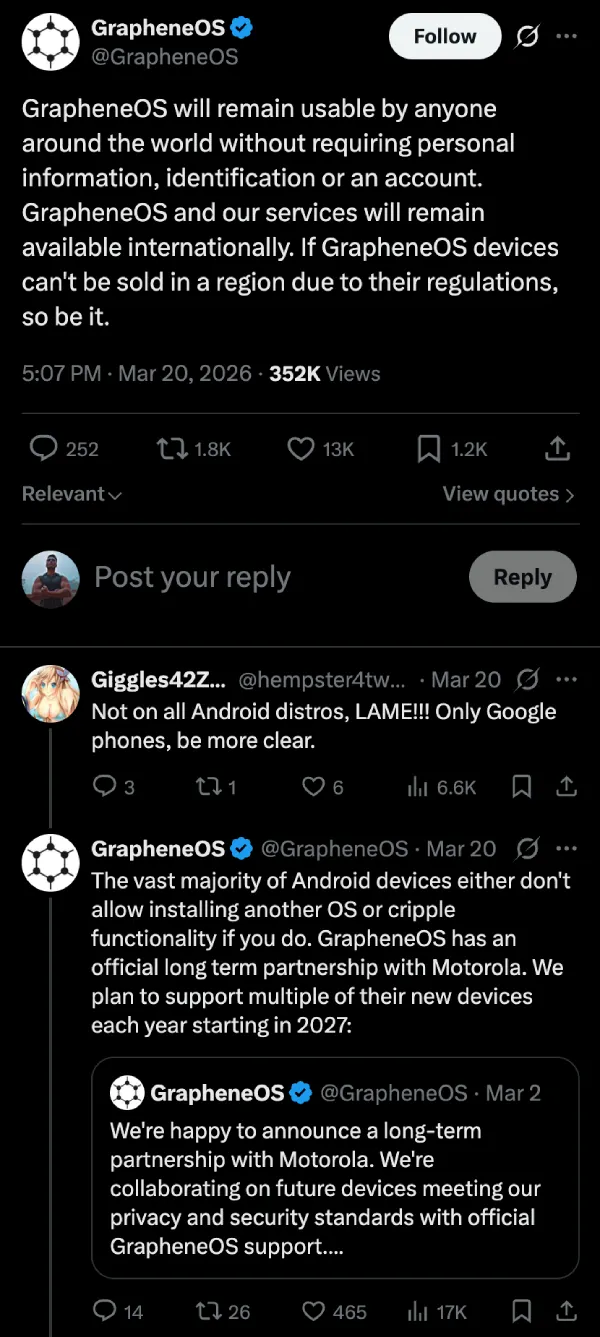
The team at GrapheneOS laid out their position clearly on X. The privacy-focused Android project announced that its operating system and services will remain available to people everywhere. No identification, accounts, or personal information will ever be required. If this approach prevents them from selling official devices in certain regions, the team is prepared to accept that outcome.
New laws in several places prompted this firm response. Brazil’s Digital ECA law, known officially as Law 15.211, took effect on March 17. It demands age verification on devices and threatens fines reaching up to about 9.5 million dollars. California plans to introduce something similar through the Digital Age Assurance Act, referred to as AB-1043, which begins in January 2027.
That measure would require operating systems to gather age or birthdate details during initial setup and pass the data along to apps. Colorado appears to be moving toward comparable requirements as well.
Yet GrapheneOS refuses to shift its direction. Operating as a Canadian nonprofit, the foundation has centered its hardened Android version on exceptional privacy and security from the start. The system ships without Google services included by default, and it never pushes users to sign up for accounts. This philosophy remains unchanged.
Official support currently centers on Google Pixel devices. The developers noted that many other Android phones either prevent custom installations altogether or disable key functions after bootloader unlocking. They point interested users toward their FAQ for the complete list of supported hardware.
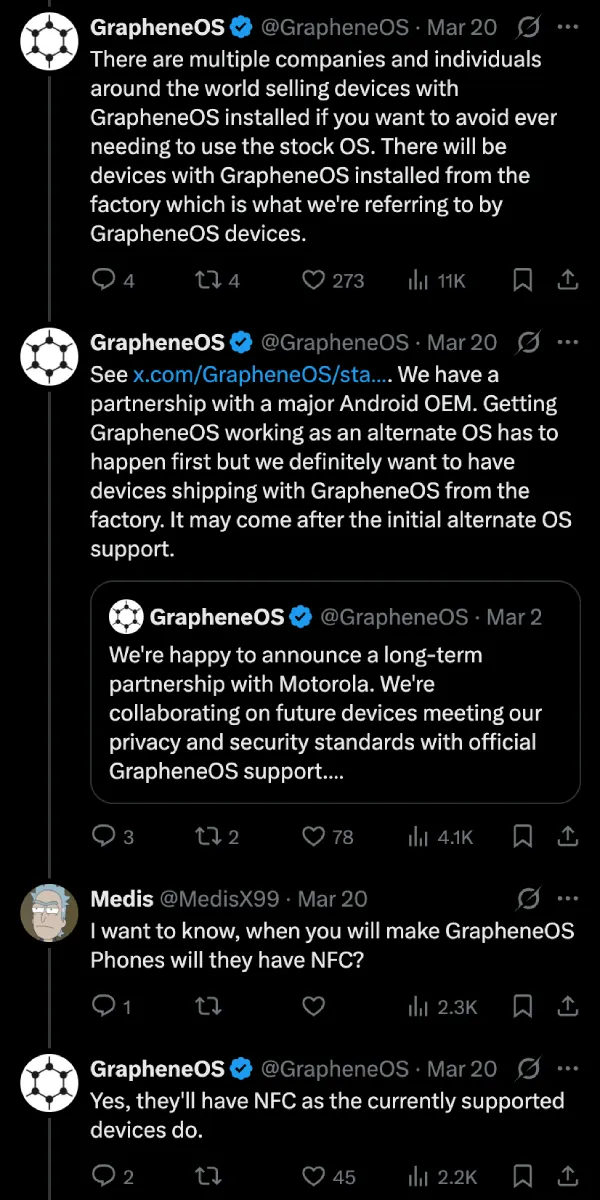
Those concerned about age checks on standard firmware can turn to third-party sellers who already provide phones with GrapheneOS pre-loaded. Official factory models are also in development. The project formed a partnership with Motorola earlier this month, and a dedicated GrapheneOS Motorola device should arrive in 2027.
Throughout the discussion, the team confirmed that features like NFC will continue working normally. They stressed that their main goal involves delivering genuine privacy and security, though users remain free to run Google apps inside a secure environment.
For users, the process stays refreshingly simple. Download the software, install it, and start using it with no additional hurdles. And honestly, that’s how it should be, but it looks like we’re stuck between a rock and a hard place for now.
Would you consider hopping over to GrapheneOS if you’re forced to verify your age? Let us know in the comments below.
Featured image generated with AI


Dwayne Cubbins
3088 Posts
I cover fast-moving stories across apps, online platforms, and everyday tech — phones, wearables, consoles, and whatever else people are fighting with this week. Bugs, rollouts, scams, policy enforcement, and the occasional internet-culture rabbit hole are all fair game. My goal is simple — make confusing tech news readable. When I'm not working, I'm working out or chilling with my dog. Got a tip? You can find me on X @dcubbins.
Next article View Article