For weeks, Pixel owners have been questioning the whereabouts of the January update for older devices. While the latest Pixel 10 series received its security patch on schedule (albeit with a few hiccups here and there), the Pixel 6 and Pixel 7 series were notably left out in the cold.
Following our report last month regarding the Pixel 7 and Pixel 6 skipping the January update, we are seeing mounting evidence that this wasn’t a glitch in the matrix. It appears Google is quietly transitioning its “legacy” hardware, specifically the Pixel 6 and 7 lineups, from a monthly cadence to a Quarterly Update Schedule.
Google is “prioritizing engineering cycles”
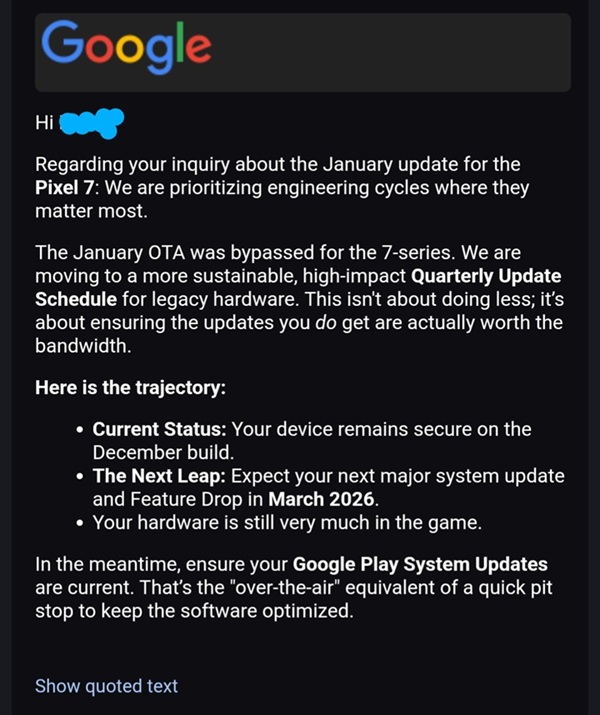
While Google has yet to release an official press statement, a screenshot circulating on Reddit (shared by a user allegedly in contact with Google Support) provides the starkest confirmation yet.
In the correspondence, a support representative explicitly states that the January OTA was “bypassed for the 7-series.” The reasoning offered is a shift in resource allocation:
“We are prioritizing engineering cycles where they matter most… We are moving to a more sustainable, high-impact Quarterly Update Schedule for legacy hardware.”
The email further notes that this change isn’t about “doing less,” but ensuring that the updates delivered are “worth the bandwidth.” The representative points to March 2026 for the next major system update and Feature Drop for the Pixel 7, confirming that these devices remain secure on the December build in the interim.
The “Samsungification” of Pixel updates
While this might shock long-time Pixel purists used to the monthly security update dopamine hit, this trajectory is standard practice in the broader Android ecosystem.
Samsung, the world’s largest Android vendor, has utilized this lifecycle management for years. Galaxy S and Fold devices typically start with monthly patches, transition to a quarterly schedule as they age, and eventually move to bi-annual updates before reaching end-of-life. The Galaxy Z Fold 3, Z Flip 3, and Galaxy S21 series, for instance, are currently on quarterly updates after spending their previous life receiving monthly updates.
The logic is sound: as hardware ages, the necessity for rapid-fire patching diminishes compared to the need for stability. By moving to a quarterly cadence, Google can dedicate more time to refining software for older chipsets (like the original Tensor and G2), theoretically avoiding the bugs that often plague rushed monthly patches on aging hardware.
If the alleged email holds, Pixel 6 and 7 owners should mark their calendars for March 2026. Until then, the advice remains to keep Google Play System and app updates current to keep core system components optimized without a full OS patch.


Hillary Keverenge
2723 Posts
Tech has been my playground for over a decade. While the Android journey began early, it truly took flight with the revolutionary Lollipop update. Since then, it's been a parade of Android devices (with a sprinkle of iOS), culminating in a mostly happy marriage with Google's smart home ecosystem. Expect insightful articles and explorations of the ever-evolving world of Android and Google products coupled with occasional rants on the Nest smart home ecosystem.
Next article View Article