Months after GrapheneOS publicly claimed that Google and several carriers had “broken” RCS messaging through recent backend changes, new information from the team now sheds more light on the current state of RCS support, particularly for users on AT&T and T-Mobile.
Back in September, we reported on GrapheneOS’ analysis that Google and carriers were rolling out changes that interfered with RCS functionality on alternative Android implementations. According to the team, these changes caused Google Messages’ RCS stack to behave inconsistently, especially when running outside Google-certified builds.
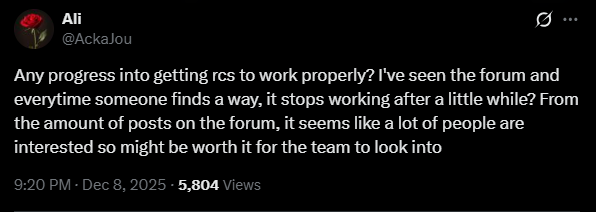
Now, in a new X (Twitter) exchange, a user asked the project about the status of RCS on the privacy-focused OS, writing:
“Any progress into getting RCS to work properly?”
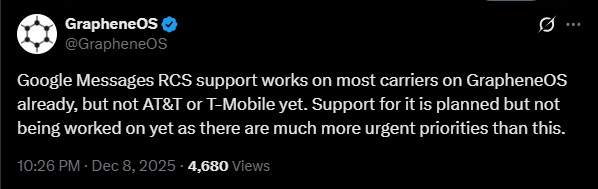
In response, GrapheneOS clarified the current situation across major U.S. carriers:
“Google Messages RCS support works on most carriers on GrapheneOS already, but not AT&T or T-Mobile yet. Support for it is planned but not being worked on yet as there are much more urgent priorities than this.”
This statement confirms several things:
1. RCS is stable on most carriers
GrapheneOS says Google Messages’ RCS works “on most carriers,” suggesting that whatever backend changes Google and carriers introduced earlier this year are not universally blocking the protocol on non-certified Android builds.
2. AT&T and T-Mobile remain outliers
The two U.S. carriers that remain problematic are AT&T and T-Mobile. Both companies rely heavily on Google’s standardized RCS/GSMA Universal Profile implementation, but they also employ their own carrier-level enforcement and device-certification checks. These checks have historically affected support for RCS on custom ROMs or non-certified systems, and GrapheneOS appears to be no exception.
3. No immediate fix coming
While support for AT&T and T-Mobile is planned, GrapheneOS says it is not being actively worked on, citing “much more urgent priorities.” Given the team’s small size and security-focused development model, coupled with the controversies they’re dealing with, it’s not surprising that RCS reliability, which depends heavily on Google’s proprietary implementation, sits lower on the roadmap.
For Pixel owners running GrapheneOS, particularly in the U.S., this limitation remains one of the few functional differences compared to stock Android.
We’ll continue monitoring developments around RCS compatibility as GrapheneOS works through its priority list.
Tech has been my playground for over a decade. While the Android journey began early, it truly took flight with the revolutionary Lollipop update. Since then, it's been a parade of Android devices (with a sprinkle of iOS), culminating in a mostly happy marriage with Google's smart home ecosystem. Expect insightful articles and explorations of the ever-evolving world of Android and Google products coupled with occasional rants on the Nest smart home ecosystem.