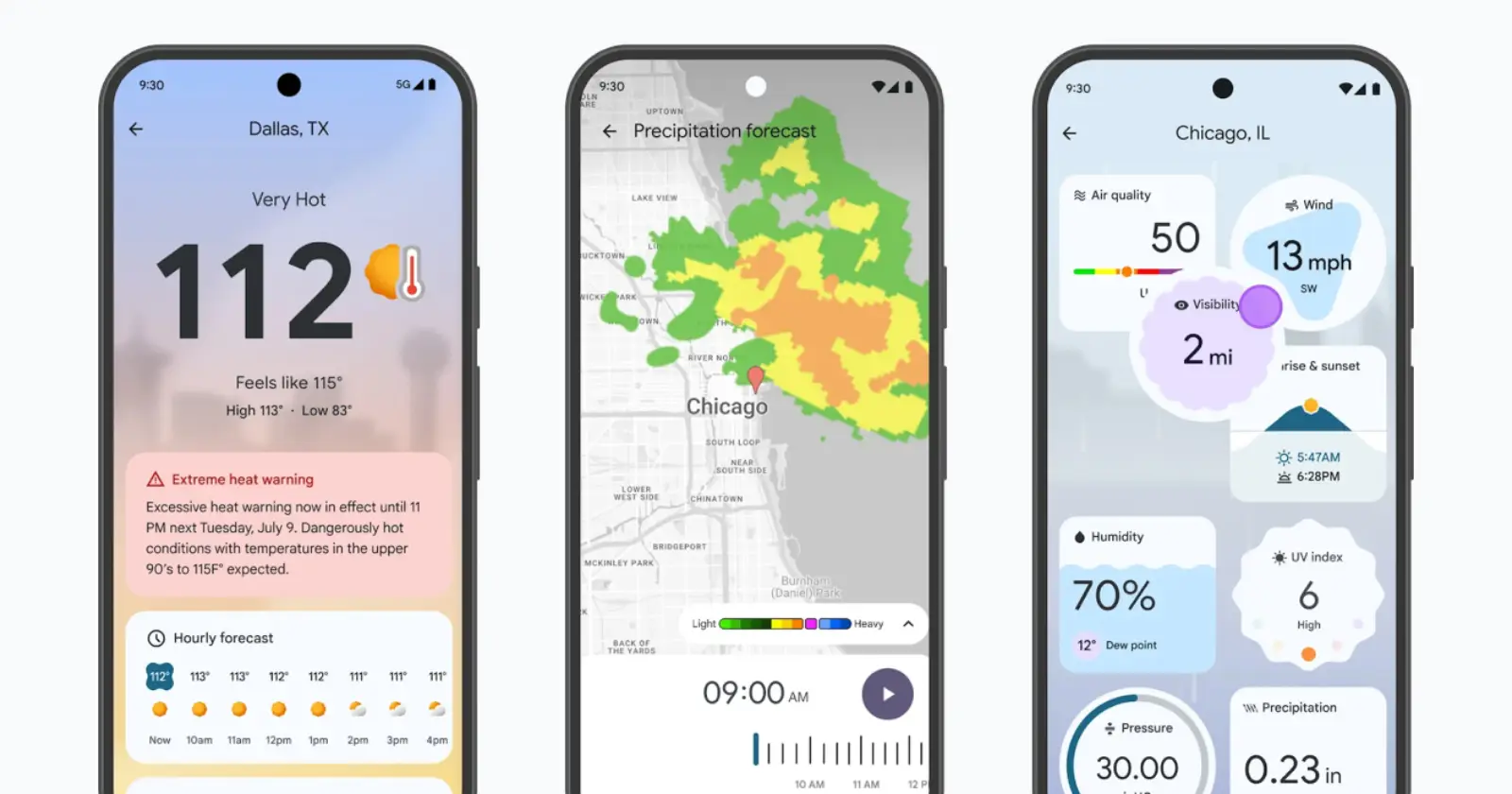
With severe winter storms currently sweeping across parts of North America, accurate weather data isn’t just a convenience. It is a safety necessity. However, a growing number of Pixel owners are reporting that the Google Pixel Weather app has become dangerously unreliable, with many pointing the finger at Google’s increasing reliance on AI-generated forecasting over local sensor data.
The core of the complaint, which has gained significant traction on Reddit, suggests that Google’s shift from traditional data sources (like The Weather Channel/IBM) to its own in-house AI models (WeatherNext / GraphCast) has resulted in “hallucinations.”
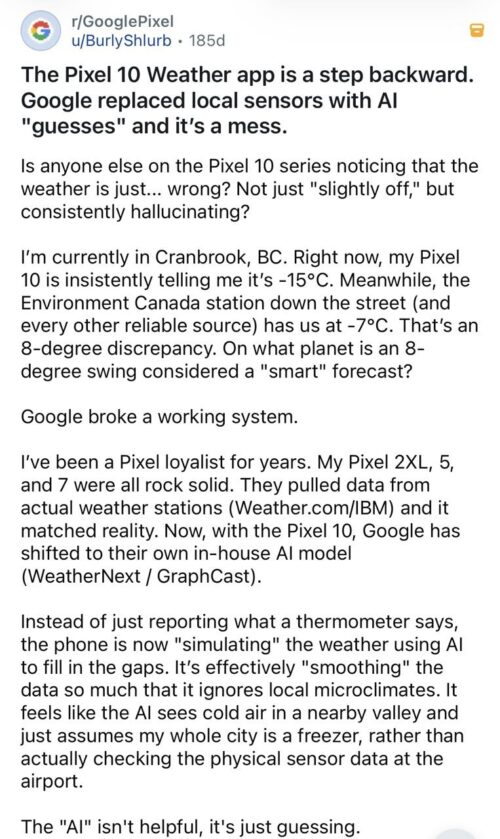
Users argue that instead of simply reporting data from nearby physical weather stations, the Pixel Weather app is “simulating” weather to fill in gaps. This process appears to be obliterating local microclimates.
One user in Cranbrook, BC, highlighted a glaring discrepancy where their Pixel 10 reported a temperature of -15°C, while the Environment Canada station down the street and every other reliable source read -7°C.
“It feels like the AI sees cold air in a nearby valley and just assumes my whole city is a freezer, rather than actually checking the physical sensor data at the airport,” the user noted. “Google broke a working system.”
This sentiment is echoed by long-time Pixel loyalists who claim previous models were “rock solid” because they pulled data that matched reality. The Pixel 10, by comparison, is being described by frustrated users as a “generative guess-machine.”
Dangerous weather inaccuracies
While temperature discrepancies are annoying, precipitation errors are proving potentially dangerous. Reports from the New England area describe the app predicting a mere 0.5 inches of snow during a severe weather event where the National Weather Service (NWS) was calling for 7-11 inches. Conversely, other users have seen the app predict nearly 2 feet of snow when other sources predicted less than an inch of rain and ice.
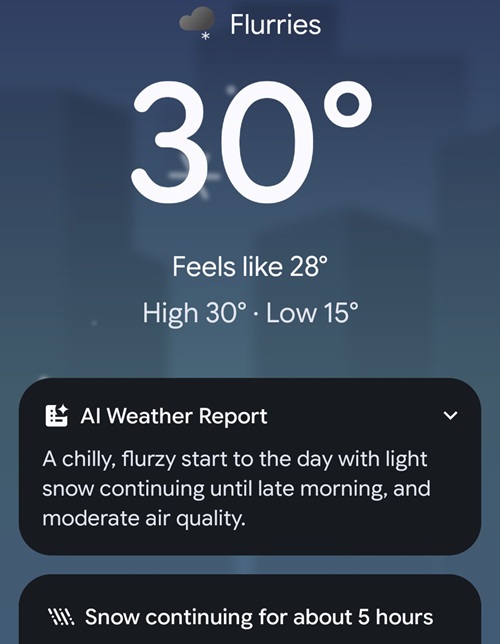
The AI’s descriptors have also come under fire. One user reported the app describing a full snowfall as “Flurzy”—a seemingly AI-generated term that doesn’t exist in meteorological glossaries. Another noted that the app described 22-below (Fahrenheit) weather simply as “chilly,” failing to convey the life-threatening windchill.
According to Google’s support documentation, their weather forecast is created from an internal system utilizing weather models and observations from global agencies, with “Nowcast” utilizing radar and numerical weather prediction data.
However, the user experience suggests that the integration of AI is prioritizing the model over the measurement. As one Reddit user questioned, “Training a proper AI model to forecast the Weather would be more expensive than just reading the data from the weather station, wouldn’t it?”
Not just a Pixel problem
While Pixel users are vocal about the regression in quality, they aren’t entirely alone. A recent report from The New York Times highlights that iPhone users are experiencing similar “wild” behavior with Apple’s native weather app.
Since Apple’s acquisition of Dark Sky and the subsequent integration of its own modeling, inaccuracies have spiked across the board. The Times report suggests that something fundamental is occurring within the various data streams these tech giants are pulling from, though the aggressive application of AI modeling seems to be the common denominator exacerbating the issue on both platforms.
It is disappointing to see a utility as fundamental as a weather app regress in functionality. The promise of AI is usually to enhance precision, but in the context of meteorology, it appears to be over-smoothing data to the point of fiction. When a $1,000 smartphone cannot agree with a thermometer down the street, it might be time to dial back the “smart” features and return to the basics.
Are you seeing these issues on your Pixel Weather app? Let us know in the comments below.


Hillary Keverenge
2723 Posts
Tech has been my playground for over a decade. While the Android journey began early, it truly took flight with the revolutionary Lollipop update. Since then, it's been a parade of Android devices (with a sprinkle of iOS), culminating in a mostly happy marriage with Google's smart home ecosystem. Expect insightful articles and explorations of the ever-evolving world of Android and Google products coupled with occasional rants on the Nest smart home ecosystem.
Next article View Article