


The Chrome zero-day Google patched earlier this month was hiding in code written back in 1999. ACS Information Age spoke to the Melbourne researcher who found it.
Arni Hardarson, co-founder of Neonix Security, spotted the flaw in libxslt, a library Chrome uses to turn XML documents into regular webpages. It’s tracked as CVE-2026-125350, a high-severity use-after-free bug, and Google says an exploit for it exists “in the wild.”
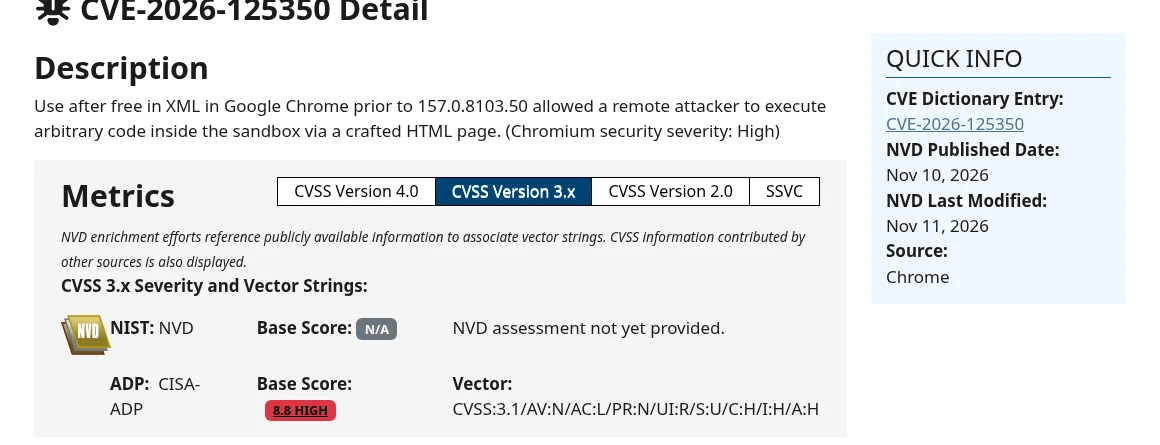
Google’s release notes show Hardarson reported it on October 12. The fix shipped on November 9 in a Chrome 157 follow-up update (157.0.8103.50/.51), days after Chrome 157 was announced with 200+ security fixes.
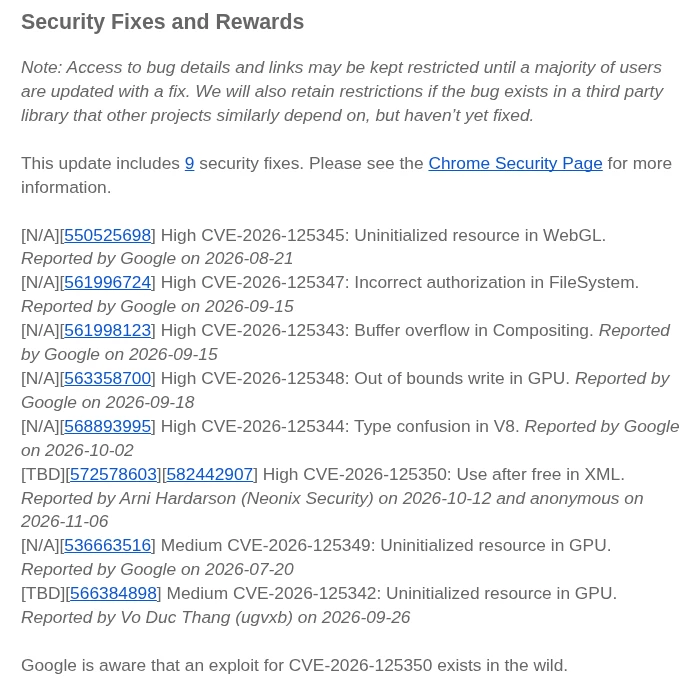
The interesting thing here is that Hardarson says “when I originally reported the vulnerability, we didn’t know it was being actively exploited.” Google hasn’t said what those attacks looked like, and it didn’t answer ACS before publication.
He also says the trigger is pretty ordinary. “In my testing, loading specially crafted web content was enough to trigger the bug. There was no need to install anything or approve a permission prompt.”
The code runs inside Chrome’s sandbox, so on its own it can’t take over your PC. An attacker would generally need a second bug to break out, which is the kind of problem we saw when Google rushed out a fix for a separate flaw that could run code outside the sandbox.
CISA added CVE-2026-125350 to its Known Exploited Vulnerabilities catalogue on November 10.

Hardarson picked Chrome because he “wanted a tough target,” but he says other software that runs libxslt could be affected too, depending on the version and how it uses the library. WebKit is one project that has used it.
Google has actually been trying to ditch this stuff. It pulled client-side XSLT support on November 17, after saying back in October 2025 that “complex, aging codebases” like libxslt are “notoriously susceptible to memory safety vulnerabilities.” Chrome 158 then arrived with 204 more security fixes.
If you’re on Chrome 158, you’re well past the fixed build. Otherwise, update and relaunch the browser.


Dwayne Cubbins
3249 Posts
I cover fast-moving stories across apps, online platforms, and everyday tech — phones, wearables, consoles, and whatever else people are fighting with this week. Bugs, rollouts, scams, policy enforcement, and the occasional internet-culture rabbit hole are all fair game. My goal is simple — make confusing tech news readable. When I'm not working, I'm working out or chilling with my dog. Got a tip? You can find me on X @dcubbins.