





The developer of the Helium browser has ruled out the possibility of it showing up on Googlebooks, saying that Helium’s core user base is unlikely to buy a Googlebook.
This information comes from a reply by @uwukko (the developer of the Helium browser) on X. Someone enquired whether the developer had any plans to bring the Helium browser to Googlebooks, to which he replied that there weren’t any. You can view a screenshot of this conversation attached below.
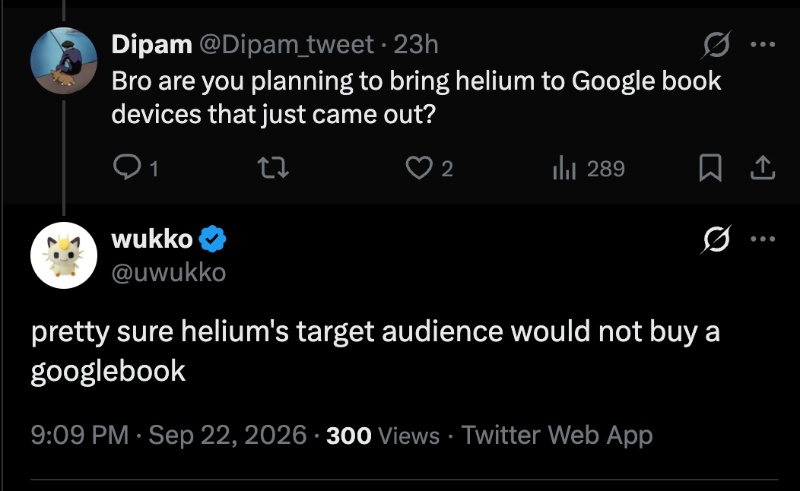
Helium’s target audience includes minimalists who want a light browser, developers, and those who want the merits of Chromium without Google’s trackers. Googlebook users simply don’t fall under these categories.
For those unaware, Googlebooks are a new laptop category. They run Googlebook OS, which is an Android-based desktop system built on ChromeOS foundations. They’re sold as “companions” to Android devices. They can browse phone files, run Play Store apps natively, and have heavy integration with Gemini. Every unit also includes a year of Google AI Pro. Google’s pitch with this hardware is an ecosystem experience for those already in the Android ecosystem.
Helium, on the other hand, is a free open-source Chromium fork. It strips Google services, telemetry, and more trackers from the engine by default. It also anonymizes Web Store traffic, and someone using Helium is unlikely to be a fan of Google’s laptops with an ecosystem lock-in.
Googlebooks are Google-first laptops, built for Gemini and Google Play. Since Helium basically works to keep Google out as much as possible, porting a de-Googled browser onto a Googlebook doesn’t make much sense.
I don’t personally think it was a technical problem; it’s just that there’s an audience mismatch.
The whole discussion began with @uwukko posting about rate limits for Chromium code search. Google has recently added mandatory account verification for that, and we covered that here.
In other Helium news, the developer recently tested an iOS version of it. However, he ended up calling it a “cheaper Safari” and hit reset. More on that here.


Sudhanshu K
287 Posts
I have been a consumer technology enthusiast for over 5 years. Thanks to my experience in software beta testing and product reviews, I've understood and learnt a lot about what bugs and issues bother people, and I spend time trying to simplify their solutions. I cover smartphones, software, social media, apps, AI, and most consumer tech gadgets. Actively pursuing a Computer Science bachelor’s degree. I'm mostly active on Twitter/X (@TechWhirlUlt), drop a DM or tag me if you want to share info or connect!