When your Wi-Fi drops mid-presentation, and the spreadsheet you’re sharing dissolves into a blur, that’s the encoder throwing away detail to keep up. A change just merged into Chromium by Google and Microsoft engineers tackles exactly that, with a narrow goal of keeping shared text readable even when the picture goes choppy.
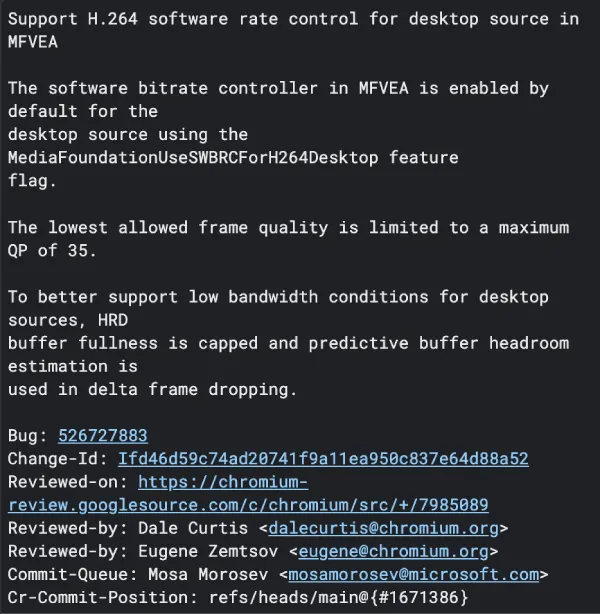
Credit for catching it goes to Android Authority, which flagged the Windows-only tweak to H.264 screen sharing, the path Chrome and Edge lean on for GPU-accelerated encoding.
Microsoft engineer Mosa Morosev wrote the code (Gerrit CL 7985089), and Chromium’s Dale Curtis and Eugene Zemtsov signed off before it landed on July 31.
Until now, a weak connection let the encoder crank compression up to H.264’s maximum quantization parameter of 51, the point where text stops being legible. Fine for a webcam feed. Useless for a wall of eight-point type. Capping that parameter at 35 and dropping the frame rate once it’s reached flips that logic, so your cursor and scrolling turn janky during a bandwidth dip while the words themselves stay sharp.
Deeper in, there’s an “admission gate” running inside Chromium’s software bitrate controller. It predicts how big each frame will be, checks it against the buffer it has left, then sends or drops it accordingly. Keyframes get held back when the buffer is swamped, which chokes off the flood of full-frame refreshes a struggling connection keeps demanding.
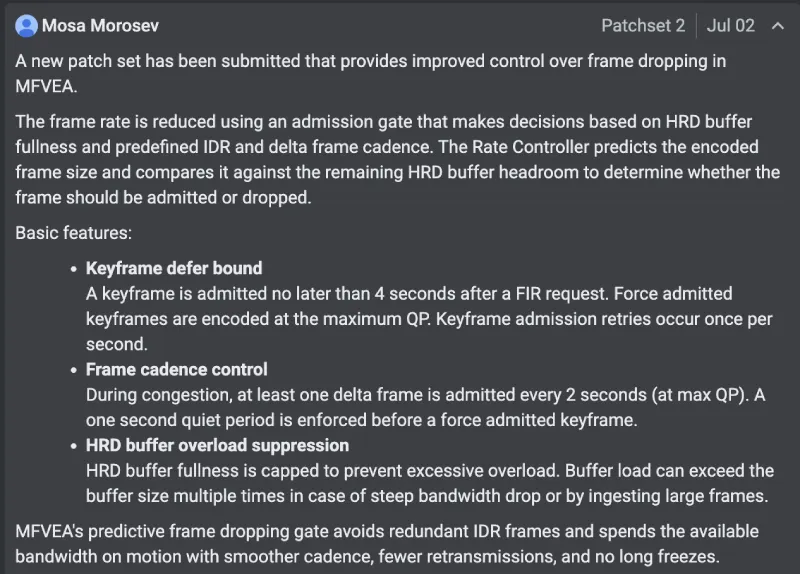
How much does it help? On a Teams call throttled to 600 kbps upstream, the new encoder more than doubled the frame rate over the old OpenH264 path (2.01 fps against 0.91) and cut retransmission packets from 1,240 to 924. It’s in the same vein of quiet Chromium plumbing the two companies have been shipping lately, including the clipboard overhaul that made pasting faster.
Being a Chromium-level fix, it reaches both Chrome and Edge on Windows with no toggle to hunt down
That said, since the change has been merged already, you can look forward to it showing up in builds soon. Meanwhile, Microsoft has been chipping at Chrome elsewhere too, recently letting people sign into Edge with a Google account.


Dwayne Cubbins
3078 Posts
I cover fast-moving stories across apps, online platforms, and everyday tech — phones, wearables, consoles, and whatever else people are fighting with this week. Bugs, rollouts, scams, policy enforcement, and the occasional internet-culture rabbit hole are all fair game. My goal is simple — make confusing tech news readable. When I'm not working, I'm working out or chilling with my dog. Got a tip? You can find me on X @dcubbins.
Next article View Article