The Tor Project has published Tor Browser 16.0a9, giving testers another look at the browser’s next major release. While this is still an alpha build that isn’t meant for everyday browsing, it marks an important milestone. Tor Browser has now been rebased onto Firefox ESR 153 after months of work behind the scenes.
That transition has been underway since December. Instead of waiting until the end of Firefox’s Extended Support Release cycle, the developers gradually moved Tor Browser’s alpha channel onto Firefox beta builds. The result is a much smaller jump when a new ESR arrives, and 16.0a9 is the first alpha release to fully make that move.
Of course, the alpha builds aren’t meant for daily browsing. You’d be better off staying on the stable builds to avoid running into bugs and issues.
Under the hood, the Firefox ESR 153 base brings in Mozilla’s latest security fixes. That includes patches for several high-severity vulnerabilities disclosed with Firefox 153, so the update isn’t just about keeping version numbers in sync. It also ensures Tor Browser continues receiving the latest protections from its upstream browser.
The migration itself was far from straightforward.
Unlike a standard Firefox install, Tor Browser carries hundreds of patches that change how the browser behaves and how it protects users’ privacy. Every major Firefox update risks breaking some of those modifications, especially when Mozilla redesigns parts of the interface or restructures the underlying code.
The developers summed up the challenge rather neatly, describing the process as “like maintaining the structural stability of sand-castle at high-tide with the waves crashing all around you.”
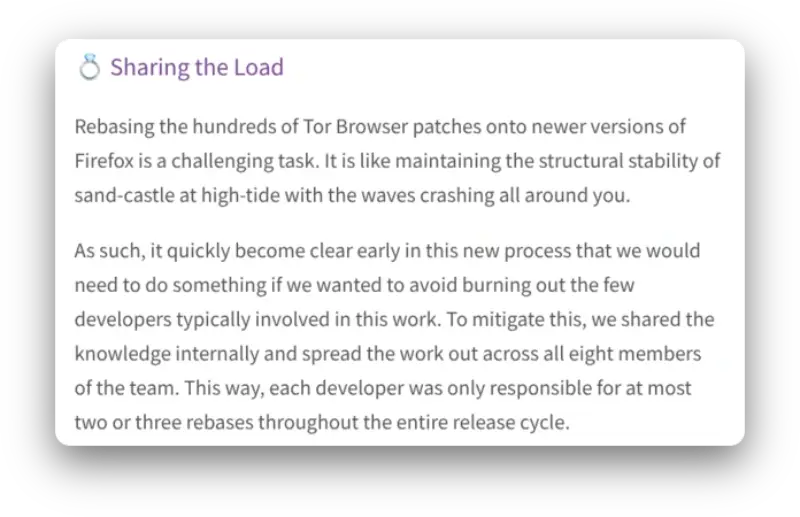
Rather than leaving that work to a small group of maintainers, the project spread the rebasing effort across all eight developers. Each person handled only a handful of rebases during the release cycle, which the team says helped reduce the risk of burnout while keeping development moving.
Firefox’s recent UI changes added another layer of work. Mozilla overhauled the desktop Settings page and migrated Firefox for Android from Material 2 to Material 3. Because Tor Browser includes its own connection settings, menus, and interface elements, many of those custom additions had to be redesigned and rewritten so they continued to fit naturally into the browser.
Android brought a different headache altogether.
The Google Play Store limits app downloads to roughly 100 MB, and Firefox has steadily grown over the past year. To stay under that cap, the Tor team changed how Firefox’s omni.ja archive is compressed. According to the developers, that recovered around 3 MB, enough to keep the Android package within Google’s size restrictions without removing features.
Feature development has also taken a back seat for now. The team says its priority is reviewing the changes inherited from Firefox ESR 153, fixing regressions, and making sure everything still aligns with Tor Browser’s threat model before version 16 is promoted to the stable channel.
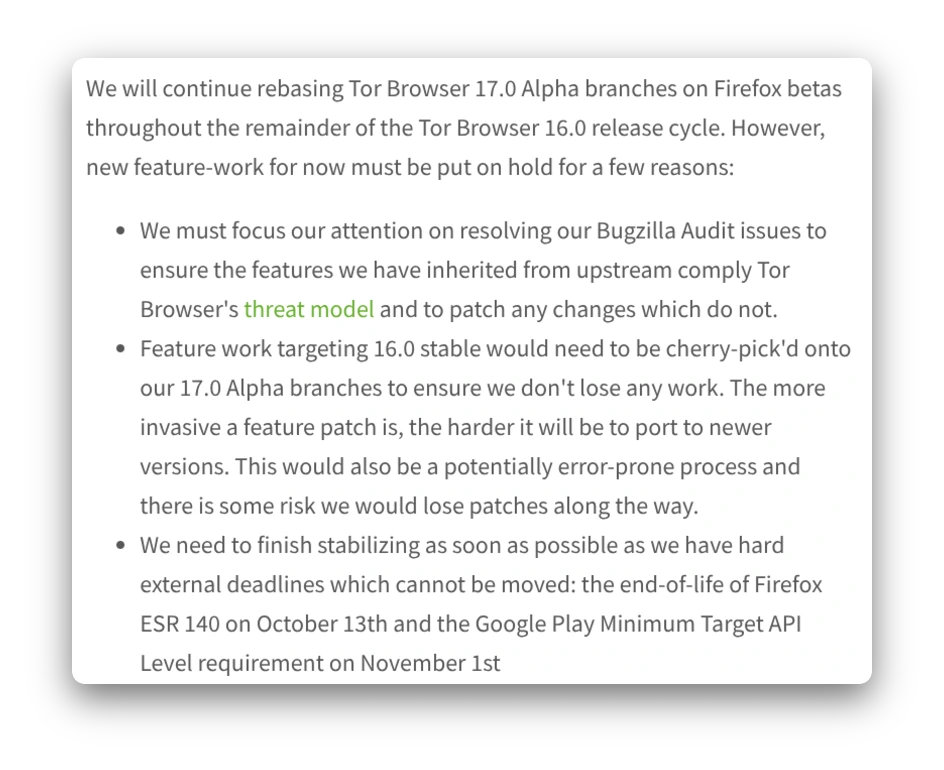
So far, the developers say they’ve rebased both the desktop and Android versions onto Firefox ESR 153, reviewed more than 250 upstream changes, and resolved roughly half of the issues identified during that audit.
If everything goes according to plan, Tor Browser 16 should reach the stable channel in September. That would put the release about a month ahead of last year’s schedule.


Dwayne Cubbins
3078 Posts
I cover fast-moving stories across apps, online platforms, and everyday tech — phones, wearables, consoles, and whatever else people are fighting with this week. Bugs, rollouts, scams, policy enforcement, and the occasional internet-culture rabbit hole are all fair game. My goal is simple — make confusing tech news readable. When I'm not working, I'm working out or chilling with my dog. Got a tip? You can find me on X @dcubbins.
Next article View Article