





@firefox is back on X 🎉
— Ente (@enteio) July 21, 2026
Good time to revisit one of privacy OGs
Here's how they scored 👇 pic.twitter.com/HP0m2guw3p
This year, privacy/security-centric browsers are the talk of the town. We’ve seen so many interesting projects, such as Helium, Project Ladybird, and evolutions of existing ones such as Brave and DuckDuckGo browsers.
The browsers that focus predominantly on security at a convenience cost are largely enthusiast-focused, such as Mullvad, Ladybird, Librewolf, and Tor. However, a normal internet user would likely value convenience more, which brings me to this question: What’s the best browser that’s a balance of both convenience and privacy?
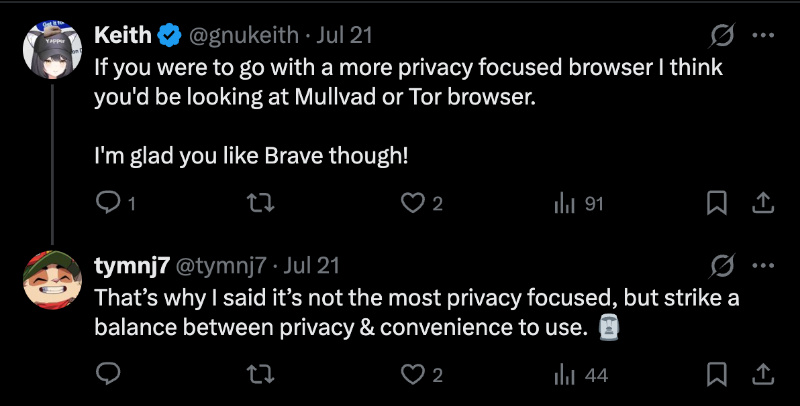
On X, @tymnj7 had the same question, to which Brave’s PM said that Tor and Mullvad are the best for something “more privacy-focused.”
Here’s how it all started: the Ente account on X welcomed Firefox’s return to the platform, giving it specific scores on various privacy and security parameters. Firefox scored a B in their grading, and they say it’s recommended for everyday browsing, though it has a few tradeoffs in transparency and data collection. The Ente account on X regularly posts such scores for browsers, email services, etc.
For those unaware, Ente is an open-source, end-to-end encrypted cloud platform. It’s a privacy-first platform and is positioned as an alternative to mainstream services such as Apple’s iCloud or Google Drive.
As you can see in the image below, @tymnj7 stated that Brave is the best overall balanced (subjectively), since it runs on Chromium, which is great for compatibility and extensions.
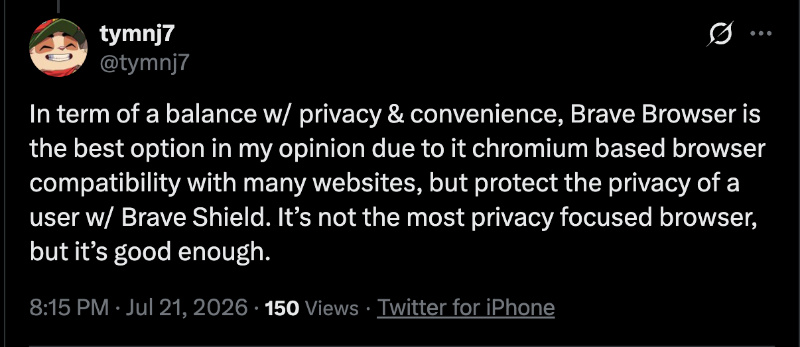
Other browsers such as Waterfox or Librewolf use the Firefox browser engine, which isn’t as good at extension support. Brave also protects privacy with Brave Shield and makes the right tradeoffs.
In a reply to this statement, Brave’s PM seems to agree with this opinion. If someone’s looking for a browser that’s primarily privacy-focused, even at the cost of a bit of convenience, he’d recommend Mullvad browser or Tor.
Tor stands out because it’s private by design. Thanks to Onion routing (encrypted traffic in layers) and a decentralized network, it’s a long-standing browser that sacrifices pure convenience. On the other hand, Mullvad is largely a fork of the Tor browser, but without the Tor network. It’s strong at anti-fingerprinting and also has an excellent built-in VPN service.
However, these are definitely not the only choices for someone who still values the experience. Brave, Helium, and Firefox are all considerable alternatives for someone who doesn’t have privacy as the fundamental requirement.
In fact, we recently covered how Helium is stepping up its fight against browser fingerprinting.

We stand out from the tech-media crowd because we break news stories; we mainly bring you stuff that you won’t find anywhere in the mainstream tech media. Our stories have been picked up by some of the world’s most popular websites and media outlets—more info is available here.

Sudhanshu K
321 Posts
I have been a consumer technology enthusiast for over 5 years. Thanks to my experience in software beta testing and product reviews, I've understood and learnt a lot about what bugs and issues bother people, and I spend time trying to simplify their solutions. I cover smartphones, software, social media, apps, AI, and most consumer tech gadgets. Actively pursuing a Computer Science bachelor’s degree. I'm mostly active on Twitter/X (@TechWhirlUlt), drop a DM or tag me if you want to share info or connect!
Next article View Article

Safari Technology Preview 248 arrives with CSS, JavaScript, and media fixes
Apple just rolled out Safari Technology Preview 248. Don’t expect much in the way of new features here. It’s mostly a cleanup release, with fixes for CSS, JavaScript...
Jul 23, 2026 1 Min Read