






We've been steadily improving Brave Search's maps with better images, additional result types, and more! 🗺️📌
— Brave (@brave) June 25, 2026
You can open place search by clicking the dedicated "Maps" button below the search bar. pic.twitter.com/g6tR2nDjSl
A few years ago, Brave users had a simple request: bring Maps to Brave Search.
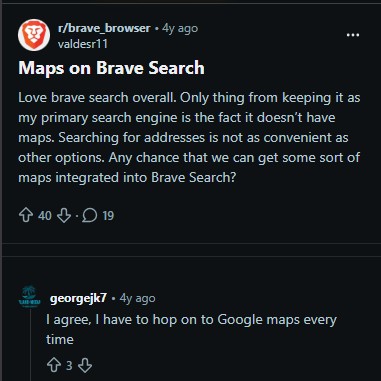
Today, that wish has largely been fulfilled. Brave Search now features a built-in Maps experience that continues to gain new capabilities, to the point where some users are no longer asking whether Brave should have Maps; rather, they’re asking whether it’s time for the company to launch a dedicated Maps app.
If you were hoping that’s next on Brave’s roadmap, the company has some disappointing news.
Brave has confirmed that it currently has no plans to develop a standalone Maps application. Instead, it intends to keep Maps integrated within the Brave Search experience, where it has been steadily expanding the feature set.
Brave Search Maps keeps getting better
The clarification came shortly after Brave highlighted another round of improvements to Maps in Brave Search. Sharing the update on social media, the company said it has been “steadily improving Brave Search’s maps with better images, additional result types, and more.”
Users can access the feature by selecting the dedicated Maps tab below the Brave Search bar or by heading directly to the Maps section within Brave Search. This is another sign that Brave continues to invest in its privacy-focused search engine as it takes on more established alternatives.
But don’t expect a dedicated Brave Maps app
Following the announcement, one Brave user asked a question that has likely crossed the minds of many others: When will there be a standalone Brave Maps app? Brave left little room for interpretation. The company replied that there are no plans for a dedicated Maps app.
Instead, users seeking faster access are encouraged to add the Brave Search widget to their Android or iPhone home screen. From there, they can jump into Brave Search, including Maps, without needing a separate application.
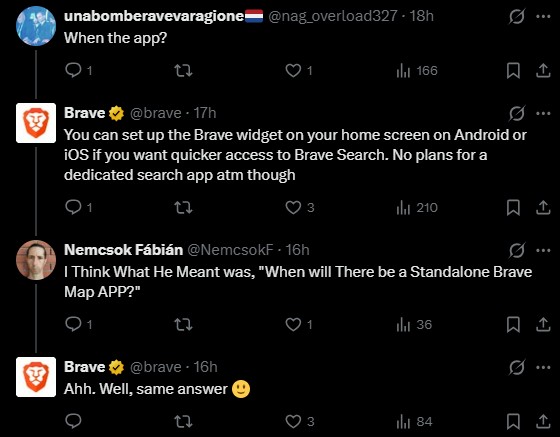
That response makes Brave’s strategy fairly clear, at least for now. Rather than treating Maps as its own product, the company sees it as another feature that complements the overall Brave Search experience.
It’s interesting to see how the conversation has changed
I’ve found this shift in user expectations particularly interesting. Back in 2022, discussions across the Brave community were centered on getting Maps into Brave Search in the first place. At the time, users wanted a way to search for places without relying on competing services or leaving Brave’s ecosystem.
Fast forward to today, and those conversations have evolved. Maps is now a core part of Brave Search, complete with place information, directions, photos, and regular improvements. Instead of requesting Maps support, users are now asking for an entirely separate application.
To me, that’s a sign of how far the feature has come. People typically don’t ask for standalone apps unless they already find the underlying service useful enough to deserve one.
Of course, software roadmaps aren’t set in stone. Brave didn’t say a dedicated Maps app will never happen. It simply said there are no current plans to build one. The company has steadily expanded its ecosystem over the years, growing from a privacy-focused browser into a platform that includes Brave Search, Brave Leo, Brave VPN, Brave Rewards, Brave Origin, and several other integrated services. Maps has also become noticeably more capable during that time.
So while a standalone Brave Maps app doesn’t appear to be on the horizon today, it’s probably too early to rule it out entirely.
For now, though, Brave seems content keeping Maps exactly where it is: inside Brave Search, where it will continue rolling out improvements rather than splitting the experience into its own app.

We stand out from the tech-media crowd because we break news stories; we mainly bring you stuff that you won’t find anywhere in the mainstream tech media. Our stories have been picked up by some of the world’s most popular websites and media outlets—more info is available here.

Hillary Keverenge
2723 Posts
Tech has been my playground for over a decade. While the Android journey began early, it truly took flight with the revolutionary Lollipop update. Since then, it's been a parade of Android devices (with a sprinkle of iOS), culminating in a mostly happy marriage with Google's smart home ecosystem. Expect insightful articles and explorations of the ever-evolving world of Android and Google products coupled with occasional rants on the Nest smart home ecosystem.
Next article View Article
Grok-based Xplorer browser is getting scheduled tasks, password manager support, & AI Spotlight for tabs
Xplorer, the new Chromium-based browser built around Grok AI, is evolving at a rapid pace. Barely a week after introducing itself as a Grok-native alternative to traditional browsers...
Jun 26, 2026 2 Min Read