South Korea’s new anti-piracy system takes effect today, and it could blow a hole in the global webtoon scene almost immediately. The government says the tougher blocking regime is meant to cut off illegal K-content sites faster, with estimated damage from delayed enforcement put at around 4 trillion won.
That sounds dry on paper. It probably won’t feel that way to readers for long.
A big reason is that this is not just about people losing access to a few shady reading sites. A lot of scanlation circles reportedly rely on Korean raw suppliers upstream, and if those sources disappear or get harder to reach, the slowdown hits everybody down the line. That includes fan translators, aggregator sites, and regular readers who have gotten used to near-instant uploads.
In fact, even before the laws came into effect, Chosun Biz reported that major illegal webtoon sites, including Newtoki, shut down or went offline ahead of the tougher measures. It’s worth noting that Newtoki alone had around 4.3 billion annual page views last year.
Readers across Reddit are panicking and bracing for a severe content drought. According to community translators, the sudden death of these massive upstream raw providers means the supply of source files for English translations is drying up almost overnight.
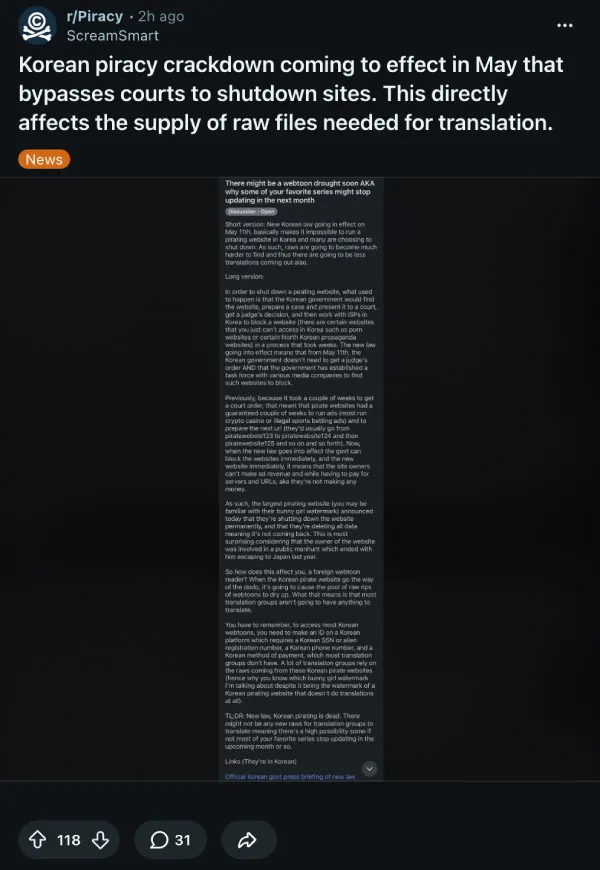
Many translation groups rely almost entirely on these aggregators. Without them, fan translations will likely stall, leaving readers who follow specific series totally stranded for the foreseeable future.
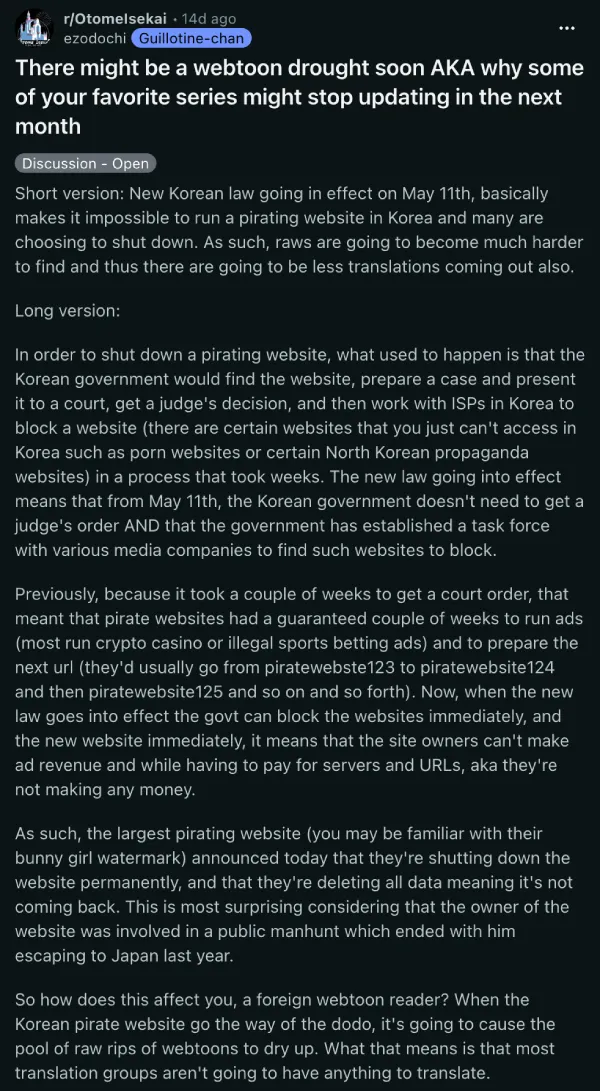
Getting legal raw files to translate is notoriously difficult for foreigners anyway. Signing up for Korean platforms like Naver or KakaoPage typically requires a verified Korean social security number and a local phone number.
Things are getting heavily locked down on the technical side too. Naver recently deployed invisible, user-specific watermarks. If a leaked chapter surfaces, the platform can immediately trace the image back to the individual buyer’s ID and ban the account.
Local internet service providers are fully on board. Telecom giants like KT, SK Broadband, and LG Uplus publicly pledged cooperation with the government copyright protection task force this afternoon.
For years, pirate site operators just played a slow game of whack-a-mole with regulators, spinning up new domains every time a court order finally went through weeks later.
Now the government can kill those clone sites the second they pop up. It is starting to look like the golden age of free, same-day manhwa translations is genuinely over.
Featured image generated with AI


Dwayne Cubbins
3093 Posts
I cover fast-moving stories across apps, online platforms, and everyday tech — phones, wearables, consoles, and whatever else people are fighting with this week. Bugs, rollouts, scams, policy enforcement, and the occasional internet-culture rabbit hole are all fair game. My goal is simple — make confusing tech news readable. When I'm not working, I'm working out or chilling with my dog. Got a tip? You can find me on X @dcubbins.
Next article View Article