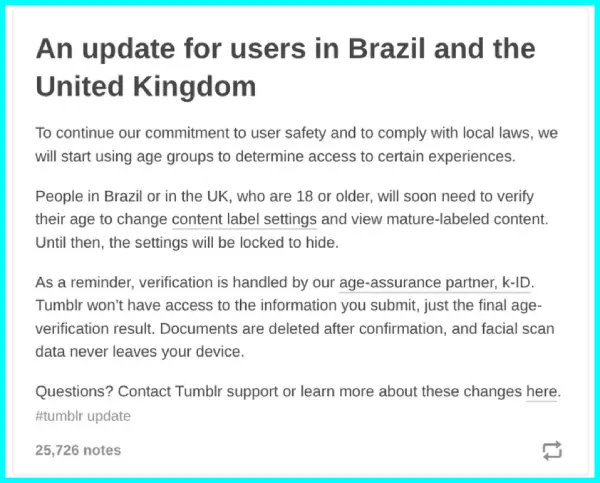
Tumblr is now making age verification mandatory for users in the United Kingdom and Brazil who want to access mature content.
The platform has started locking down content label settings in those regions. To view anything flagged as mature, users aged 18 and older must now hand over a government ID, scan their face, or link a bank account. Until they comply, the settings are locked to hide.
To handle these checks, Tumblr is partnering with a third-party company called k-ID. According to an update on the official Changes blog, the move is designed to comply with local laws. This lines up with aggressive new internet regulations like the UK’s Online Safety Act and Brazil’s Digital ECA.
The verification process offers four paths. Users can upload a photo ID, use a digital credential called AgeKey, connect a supported bank via ConnectID, or opt for an on-device facial scan.
Tumblr promises it does not store any of this sensitive data. The company says ID documents are deleted after confirmation, and video selfies used for facial scans never actually leave the phone.
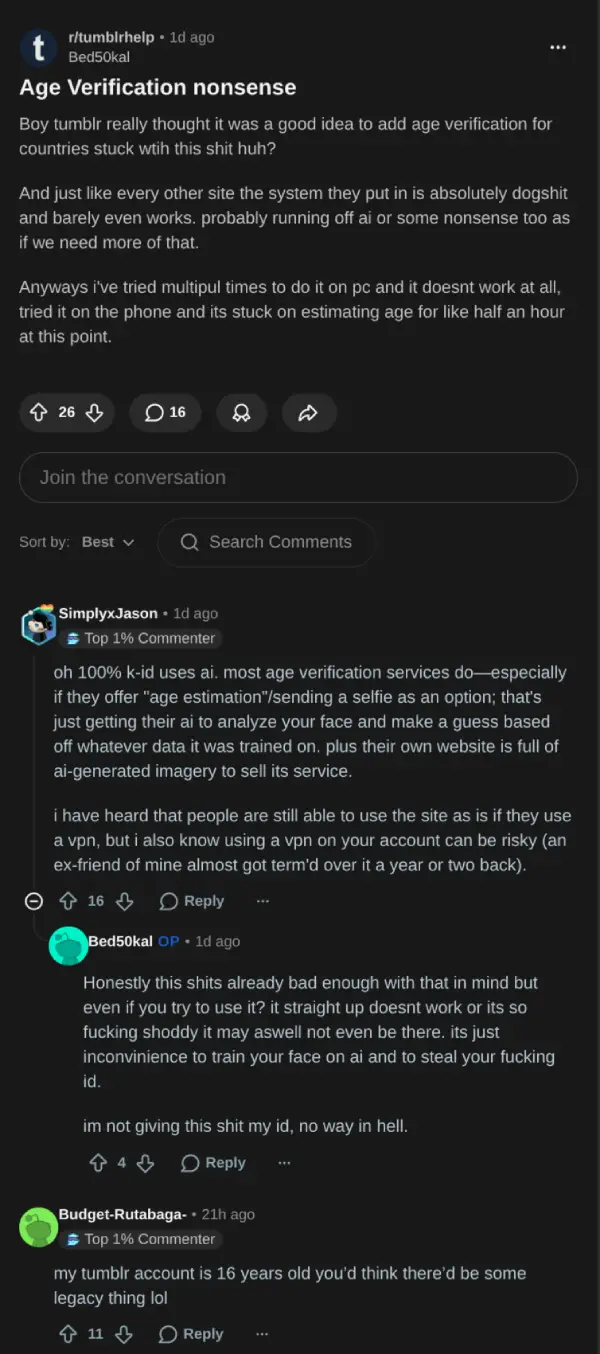
To no one’s surprise, the community is furious. Over on Reddit, users are calling the rollout a buggy mess. Some users reported that the facial estimation tool gets stuck loading for upward of half an hour without actually verifying them.
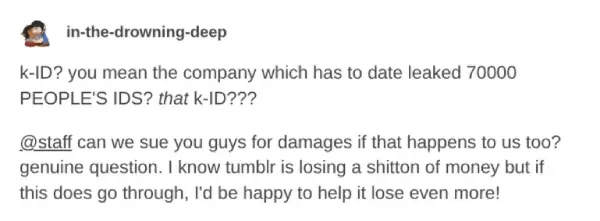
Meanwhile, on Tumblr itself, users are sharing posts raising alarms about k-ID’s security track record. Some are pointing to reports of a recent data breach that exposed thousands of user IDs.
However, it’s worth noting that k-ID was not actually involved in the incident.
Sadly, this is becoming the new normal for the internet. Apple recently baked similar mandatory age checks into iOS 26.4 for UK users. Meanwhile, Discord faced massive backlash over a recent age verification bug that completely locked adults out of their own servers.
For now, these strict restrictions only apply to Tumblr users caught in the crosshairs of British and Brazilian internet laws. But as age-gating legislation picks up steam globally, it is pretty clear that more regions will soon be forced to follow suit.


Dwayne Cubbins
3146 Posts
I cover fast-moving stories across apps, online platforms, and everyday tech — phones, wearables, consoles, and whatever else people are fighting with this week. Bugs, rollouts, scams, policy enforcement, and the occasional internet-culture rabbit hole are all fair game. My goal is simple — make confusing tech news readable. When I'm not working, I'm working out or chilling with my dog. Got a tip? You can find me on X @dcubbins.
Next article View Article