GrapheneOS has made plenty of noise recently about building more replacements for Google services that Android apps rely on, but one reply to a user complaint on X may have revealed an even bigger long-term ambition.
After a user praised the OS but complained about poor video sharing over text, GrapheneOS clarified that MMS is fully supported in its default Messaging app, while RCS already works through Google Messages on GrapheneOS. It then added the key detail: making an alternative to Google Messages for RCS would be “extremely hard,” but it is something the project plans to do.
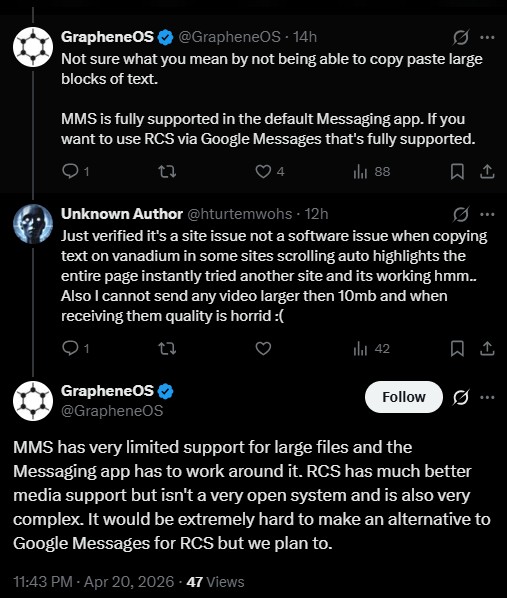
That matters because, right now, GrapheneOS users who want RCS are still tied to Google’s own messaging app. This means the default messaging app on GrapheneOS cannot be used to send and receive RCS messages.
RCS support on GrapheneOS currently depends on Google Messages with sandboxed Google Play, and Google Play services handles part of the verification and configuration process. Also, RCS with Google Messages is only known to work in the Owner profile, with some carriers also requiring extra permissions for Google Play services. In other words, RCS is supported today, but not in a way that fully breaks dependence on Google.
That is why this reply stands out. GrapheneOS has already been moving beyond simple compatibility work and toward replacing or rerouting pieces of Google’s service layer where possible. Apps using Google Play geolocation are redirected to GrapheneOS’s own implementation by default, while the OS also offers its own network location options instead of forcing users onto Google’s location stack. This broader direction gives much more weight to the idea of GrapheneOS eventually targeting RCS in a similar way.
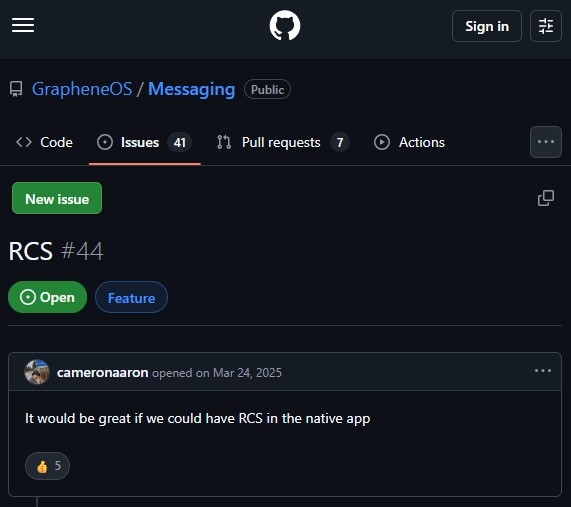
There is also already a public feature request asking for RCS in the native GrapheneOS Messaging app. That issue was opened in March 2025, but it currently has no assignee, no milestone, and no linked development work.
So, to be clear, this is not a launch announcement or even a roadmap. It is a statement of intent, and one attached to a feature GrapheneOS itself admits would be extremely difficult to pull off.
Still, if GrapheneOS ever succeeds, it would chip away at one of the biggest remaining Google dependencies in the modern Android experience. And for a project built around reducing trust in Google without wrecking usability, that would be a very big deal indeed.


Hillary Keverenge
2723 Posts
Tech has been my playground for over a decade. While the Android journey began early, it truly took flight with the revolutionary Lollipop update. Since then, it's been a parade of Android devices (with a sprinkle of iOS), culminating in a mostly happy marriage with Google's smart home ecosystem. Expect insightful articles and explorations of the ever-evolving world of Android and Google products coupled with occasional rants on the Nest smart home ecosystem.
Next article View Article