





Canonical stepped in to calm a rapidly spreading fire on March 4, posting an official response on Ubuntu’s Discourse after days of speculation about whether Ubuntu plans to add mandatory age verification to comply with California’s new Digital Age Assurance Act (AB 1043).
In short, nothing has been confirmed. Canonical says it is reviewing AB 1043 internally with legal counsel but currently has “no concrete plans on how, or even whether, Ubuntu will change in response.”
The confusion started when Lunduke Journal reported that Ubuntu and elementary OS developers were actively working on age verification functionality tied to the California law. The post went viral, racking up over 371,000 views on X, and immediately set off alarm bells on Linux forums, Reddit, and other tech forums.
Ubuntu Planning Mandatory Age Verification
Ubuntu & Elementary OS developers are planning to add age verification functionality, in a way which impacts all Linux users, to comply with a new California law. pic.twitter.com/tqUTWMt3hk
— The Lunduke Journal (@LundukeJournal) March 3, 2026
Part of what seems to have made people nervous is how broad the law actually is. California’s AB 1043, the Digital Age Assurance Act, was signed by Governor Gavin Newsom on October 13, 2025. Starting January 1, 2027, operating system providers will be required to collect age information at account setup and pass an encrypted age bracket signal to eligible applications. These brackets range from “under 13” to “18+.” The goal is to apparently give developers a privacy-preserving way to handle age compliance, without requiring users to hand over ID documents or personal records.
That places OS providers like Canonical, Microsoft, and Apple directly in the compliance chain. For Linux users outside the US, the idea of a California state law reshaping how their operating system behaves at setup was not a comfortable thought.
Canonical’s Discourse post also made clear that the Ubuntu developer mailing list thread that started all of this was just an informal community discussion, not an official announcement. Developers were just brainstorming about it. Nobody was shipping code.
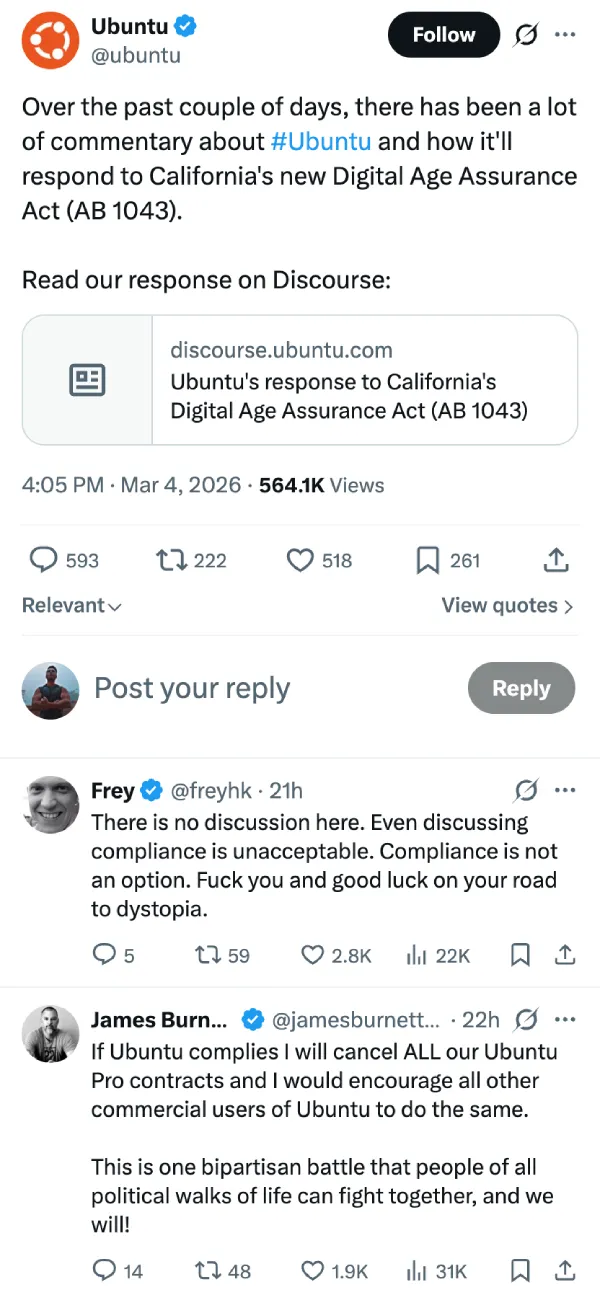
Comments under Ubuntu’s post on X show that people still aren’t happy. Business users threatened to cancel Ubuntu Pro contracts, some called for blocking California access entirely rather than complying, and others said they would pull Ubuntu from every environment they control.
Gaming on Linux also noted that Fedora developers have separately weighed in on AB 1043 too, making it clear this is not a Canonical-specific headache. The entire Linux ecosystem will need a coherent answer to this law at some point.
Canonical’s current stance is straightforward: no decision has been made, and when there is one, it will come through official channels.
Featured image generated with AI


Dwayne Cubbins
3055 Posts
I cover fast-moving stories across apps, online platforms, and everyday tech — phones, wearables, consoles, and whatever else people are fighting with this week. Bugs, rollouts, scams, policy enforcement, and the occasional internet-culture rabbit hole are all fair game. My goal is simple — make confusing tech news readable. When I'm not working, I'm working out or chilling with my dog. Got a tip? You can find me on X @dcubbins.
Next article View Article
