If you’re in the EU and noticing some posts just… gone from profiles, you’re not imagining it.
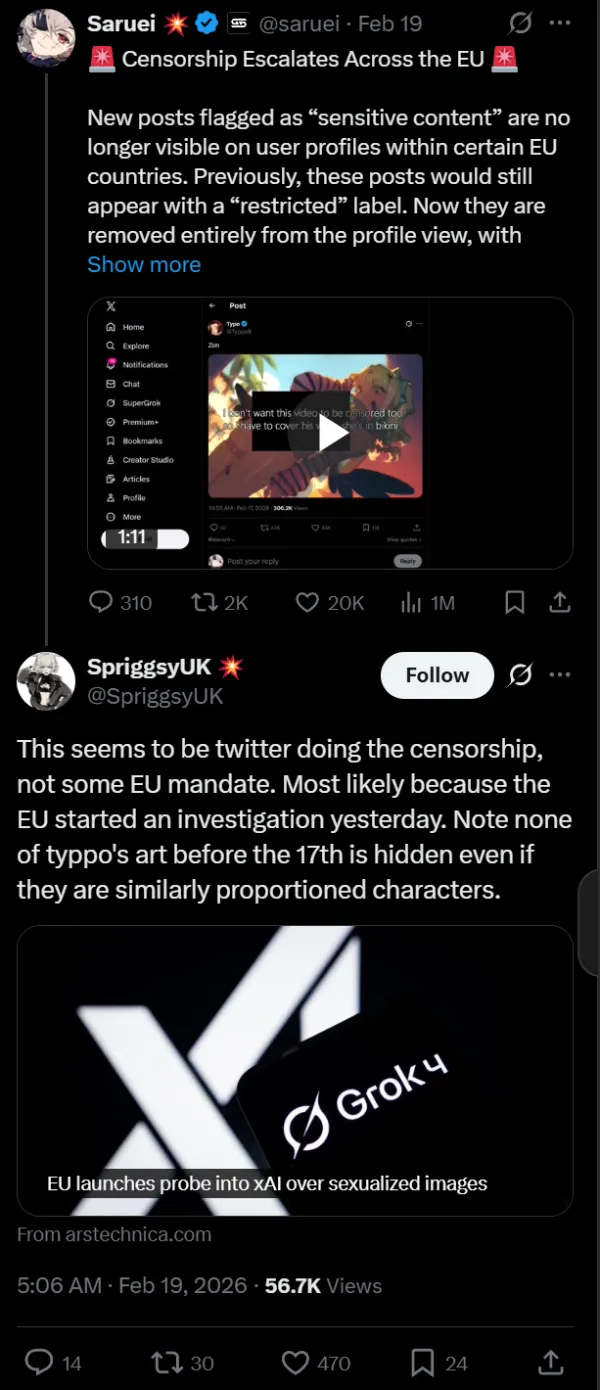
Yesterday, VTuber and artist @saruei posted about what looks like a real change in how X handles “sensitive content” for European users. Posts that were previously visible behind a “restricted” label (you still had to click through to see them) are now completely absent from profiles in certain EU countries. No warning, no notice. They’re just not there.
She tested this across France, Ireland, and Belgium, and got the same result each time. Access those same profiles from outside the EU, and the posts come back. (Note: The post has now been taken down for some reason)
After Saruei’s post went viral with over a million views, @GrenadesW followed up with a broader test today across as many EU countries as possible and confirmed it likely affects the entire region.
‼️ Followup to Censorship Escalation in EU
As pointed out by @saruei – “sensitive content” is no longer being displayed. Not just hidden by a grey box – completely removed as if they never were. No notice, no warning.
In a follow-up to her testing me and my team checked as… https://t.co/HrdPvgxkcz pic.twitter.com/zDOKvVmJAI
— Whiskey Project 🥃 Tactical VTuber (@GrenadesW) February 20, 2026
Some users also reported their “Display sensitive content” toggle had been unchecked without their knowledge, but re-enabling it reportedly didn’t help. Posts stayed hidden regardless.
Now, the obvious question is whether this is X’s own doing or an EU mandate. Based on user testing and context, it appears to be the former. One reply noted that posts predating February 17 seemed largely unaffected, which suggests a recent internal decision rather than a blanket regulatory order.
The regulatory context is hard to ignore, though. We’ve been covering the Grok content controversy since it blew up in December, when the AI started generating nudified images of women in public threads. Musk later clarified Grok’s approach to NSFW generation, saying it would allow upper body nudity but stop short of deepfakes of real people. Not long after, though, Grok seemed to flip the other way entirely, with users saying it was censoring almost everything.
On January 26, the European Commission opened a formal DSA investigation into Grok and X’s recommender systems, pointing specifically at AI-generated sexual deepfakes. The EU privacy watchdog launched a separate probe into non-consensual AI imagery, and Ireland’s data protection authority opened its own inquiry in mid-February. French authorities also raided X’s Paris offices on February 3 as part of a cybercrime investigation tied to Grok. So with multiple enforcement actions running at the same time, X moving quietly on content visibility isn’t really a big surprise.
What some users are pushing back on, though, is the broader implication. As @saruei noted in a follow-up post, if X starts hiding content based on flagging or interaction metrics, it’s not a stretch to imagine the same logic eventually applying to political posts or coverage of live events.
X has not responded to these reports. We’ll keep an eye out for any further developments and will update the article accordingly.
Featured image generated with AI


Dwayne Cubbins
3200 Posts
I cover fast-moving stories across apps, online platforms, and everyday tech — phones, wearables, consoles, and whatever else people are fighting with this week. Bugs, rollouts, scams, policy enforcement, and the occasional internet-culture rabbit hole are all fair game. My goal is simple — make confusing tech news readable. When I'm not working, I'm working out or chilling with my dog. Got a tip? You can find me on X @dcubbins.
Next article View Article