





![Persona CEO Rick Song goes public with full email chain, expresses disappointment over vmfunc ‘surveillance’ report [Updated]](https://piunikaweb.com/wp-content/uploads/2026/02/persona-logo-text-featured.webp "Persona CEO Rick Song goes public with full email chain, expresses disappointment over vmfunc ‘surveillance’ report [Updated]")
[CEO of Persona here] Thank you for saying this @vmfunc. One of the brightest spots of this tough situation has been my interactions with them, although I did crash out a couple days ago (I’ve never experienced an online crashout before, but I will say it was exhilarating and I… pic.twitter.com/HCk1H3K8Ke
— Rick Song (@rickcsong) February 21, 2026
Update 22/02/26 – 10:20 am (IST): The story has since taken a notably warmer turn. Yesterday, Persona’s CEO Rick Song, posted on X acknowledging that his earlier “crashout” was a mistake, saying he has since deleted those posts at celeste’s urging because “these exchanges should be kept over email because this is not meant to be a spectacle.”
Song shared the latest round of emails publicly, including celeste’s message noting that “this exchange restored some of my faith in how disclosure can work. most of the time it’s lawyers and silence and NDAs and threats.” Song shared the same thoughts, writing that celeste has been “thorough, transparent, direct, and even kind and considerate,” and expressed genuine admiration for their cybersecurity research — including a separate passkeys project — beyond just the Persona investigation.
The dialogue is still active. Song confirmed Persona’s team remains committed to answering the outstanding questions from vmfunc’s 18-point list, specifically Q3, Q4, Q5, Q7, Q9, Q10, Q12, Q14, Q15, Q16, and Q18, which remain unanswered as of publishing, and said responses will come once the team, currently “absolutely slammed,” can take the time to be accurate. celeste has confirmed they will notify Song before Part 2 goes live, maintaining the same no-surprises standard as before.
Original article published on February 22, 2026, follows:
Persona CEO Rick Song has broken his silence on X, publicly releasing the full email correspondence between himself and security researchers at vmfunc in the wake of explosive allegations that the identity verification company runs a large-scale surveillance setup.
In a detailed thread posted today, Song linked back to a post where he shared multiple screenshots of the email exchange ahead of vmfunc’s planned follow-up blog posts. He explained the move was necessary because his earlier signed statement, released without context, had only fueled more conspiracy theories around Persona.
“I am genuinely disappointed in how all of this has been handled,” Song wrote. “What has really been frustrating for me is that I also admire @vmfunc’s work and their clear talent.”

The emails, which began on February 16, show Song first reaching out directly to researcher celeste the day after the report. He thanked them for the source-map callout, confirmed the issue was already being fixed, and clarified that the exposed cluster was a new development environment the company is migrating to for better reliability — not the production cluster that underwent FedRAMP assessment.
In follow-up messages, Song proactively sent celeste a list of Persona executives and leaders with their LinkedIn profiles, asking that vmfunc update its post to reference leadership instead of individual engineers and interns. He cited violent threats and harassment directed at his team, particularly newer grads and junior staff, after the report’s “BETRAYAL” section highlighted specific employees. vmfunc has since removed the individual names.
Despite the tension, Song committed to answering vmfunc’s 18 written questions in full, with no rush. He offered a recorded public conversation over Signal if preferred. He described this as Persona’s first major media crisis.
vmfunc’s celeste quickly confirmed the authenticity of the emails released by Song (noting one was missing from his initial batch) and attached the overlooked message. In their reply, celeste thanked Song for engaging as CEO rather than through lawyers, but declined a private call. They insisted on written answers published in full for a verifiable public record. They plan to release the complete exchange as “Part 2” once the back-and-forth concludes.
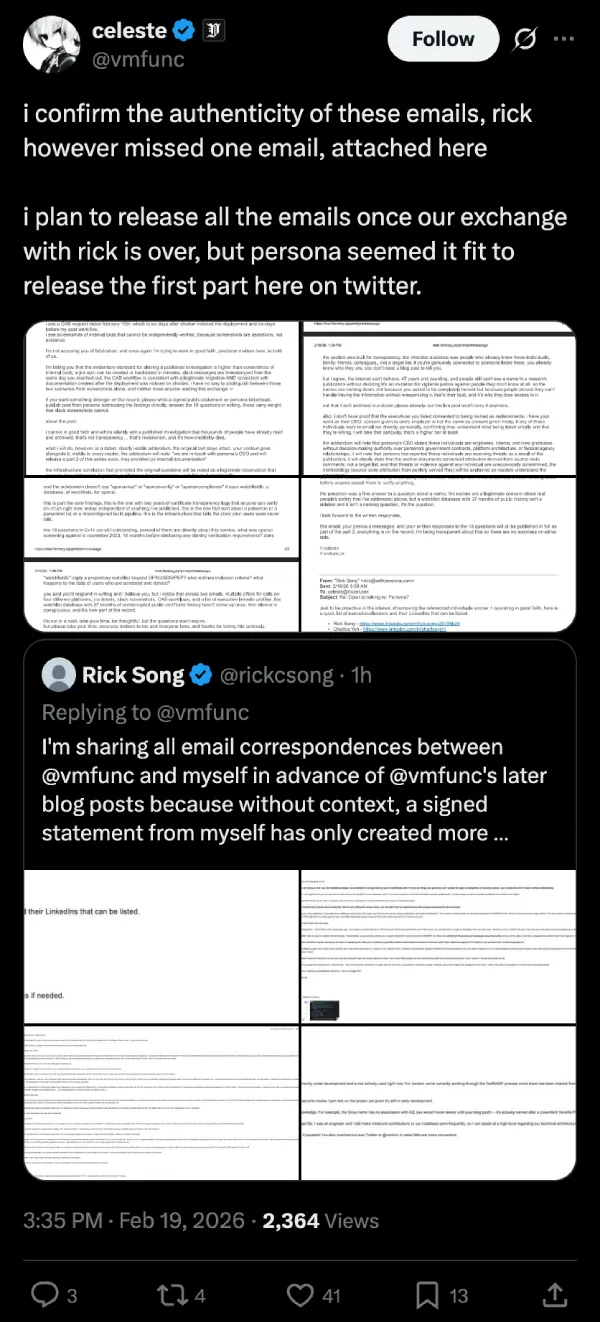
But things just heated up even further. celeste also made a lengthy post and accused Song of taking control of the narrative by publishing the emails before they could release Part 2 with their analysis. They described the move as crisis communications rather than transparency and defended their work as investigative journalism into a platform handling biometric data and government reporting.

Song replied minutes later, apologizing for an emotional response. He explained that his team is exhausted and working through the night due to the situation. He pushed back on the responsible disclosure framing, citing OWASP guidelines and the Society of Professional Journalists code of ethics, and asked that vmfunc publish their follow-up sooner to address what he sees as misinformation.
As we reported earlier today, the February 16 vmfunc report claimed 53 megabytes of Persona’s government dashboard codebase, across 2,456 files, sat unprotected on a public FedRAMP-authorized endpoint via exposed Vite source maps. The code revealed capabilities such as direct Suspicious Activity Reports to FinCEN and FINTRAC, biometric face lists stored for up to three years, and suspicious entity detection checks.
The exchange between Song and vmfunc remains ongoing. Stay tuned to PiunikaWeb for more updates.
Disclosure: The email conversations in this article were transcribed from the screenshots with AI

We stand out from the tech-media crowd because we break news stories; we mainly bring you stuff that you won’t find anywhere in the mainstream tech media. Our stories have been picked up by some of the world’s most popular websites and media outlets—more info is available here.

Dwayne Cubbins
3093 Posts
I cover fast-moving stories across apps, online platforms, and everyday tech — phones, wearables, consoles, and whatever else people are fighting with this week. Bugs, rollouts, scams, policy enforcement, and the occasional internet-culture rabbit hole are all fair game. My goal is simple — make confusing tech news readable. When I'm not working, I'm working out or chilling with my dog. Got a tip? You can find me on X @dcubbins.
Next article View Article

ChatGPT code reveals ‘Citron Mode’ as the internal name for upcoming adult mode [U: Delayed]
Update 07/03/26 - 04:01 pm (IST): OpenAI has reportedly delayed ChatGPT’s planned “adult mode” again, saying it wants to focus on higher-priority work like intelligence upgrades...
Mar 07, 2026 2 Min Read