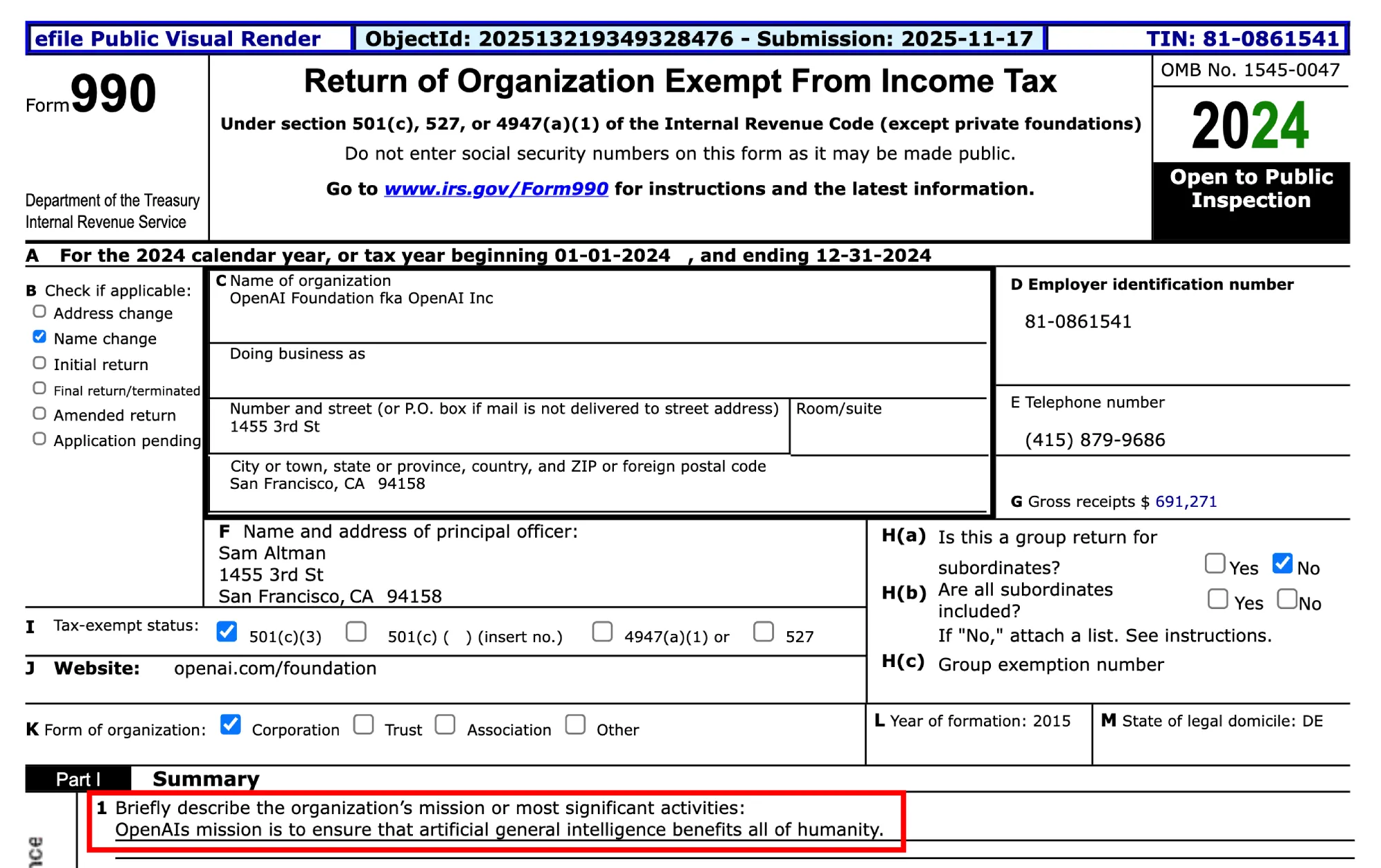
A couple of Reddit posts comparing OpenAI’s IRS Form 990 filings have sparked discussion about whether the company is backing away from its safety commitments. The same post shared on r/singularity and r/ChatGPT highlighted that OpenAI’s 2024 nonprofit tax return uses notably shorter mission language than its 2023 filing.
The 2024 Form 990 lists OpenAI’s mission as simply: “ensure that artificial general intelligence benefits all of humanity.” That’s a significant trim compared to what appeared the year before.
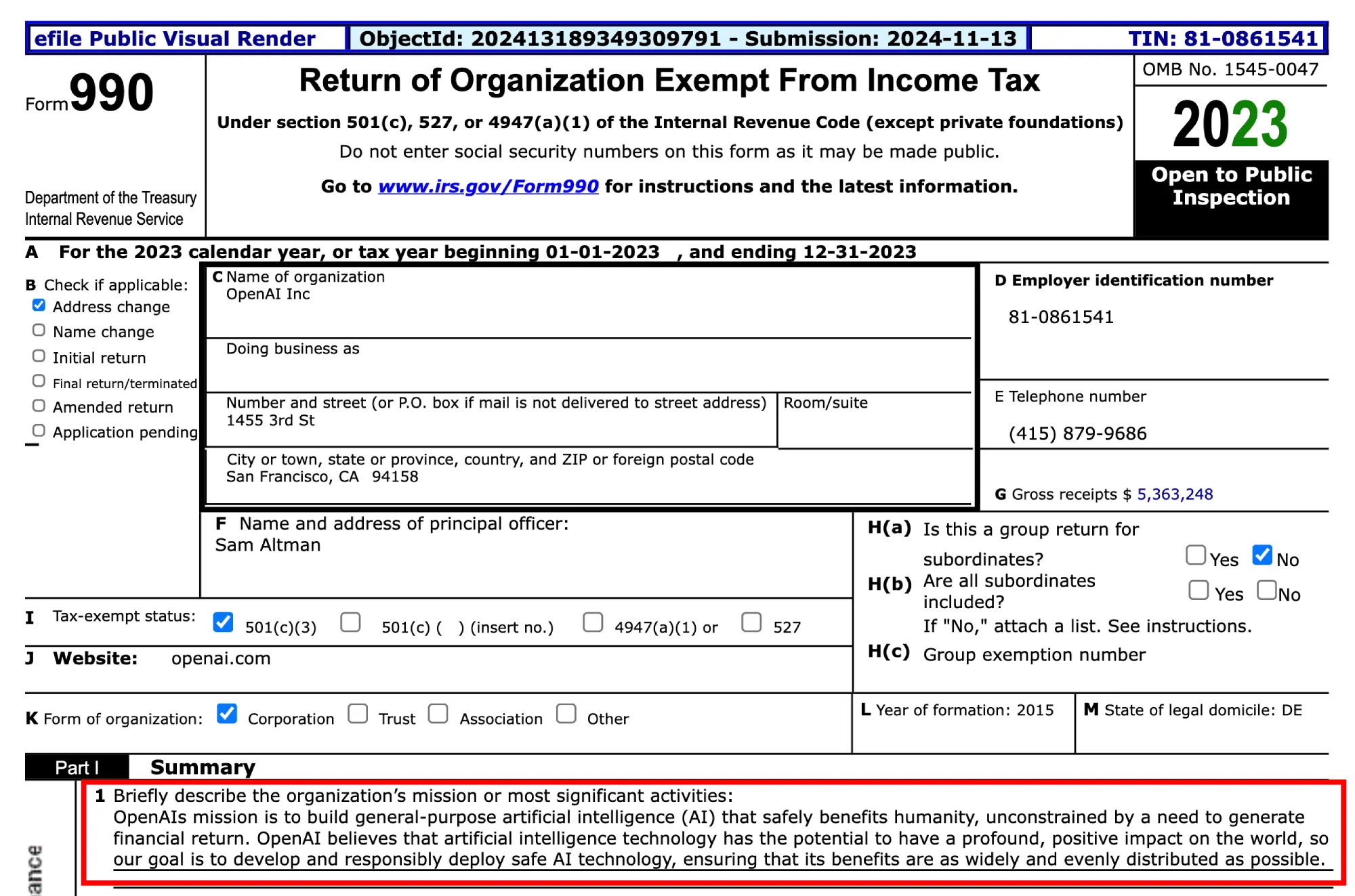
I checked the tax documents on ProPublica’s Nonprofit Explorer to verify the claims and look at earlier years. OpenAI’s 2023 and 2022 Form 990 filings both stated the organization’s mission was “to build general-purpose artificial intelligence (AI) that safely benefits humanity, unconstrained by a need to generate financial return.” Those versions went on to describe OpenAI’s goal to “develop and responsibly deploy safe AI technology” with benefits distributed widely.
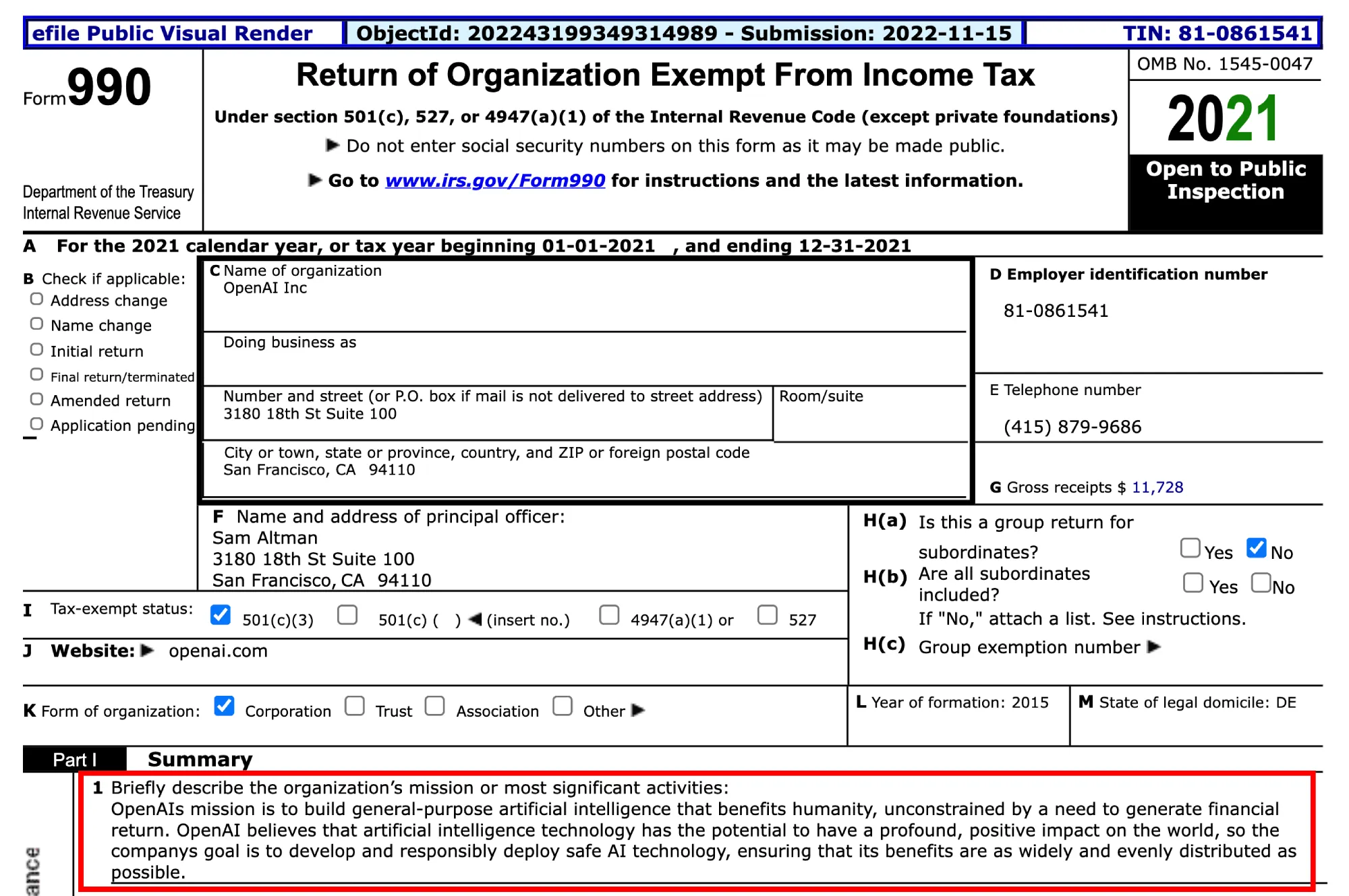
The 2021 filing had similar phrasing but without the word “safely” before “benefits humanity.”
Going back to 2019 and 2020, OpenAI described its goal as advancing “digital intelligence in the way that is most likely to benefit humanity as a whole, unconstrained by a need to generate financial return.”
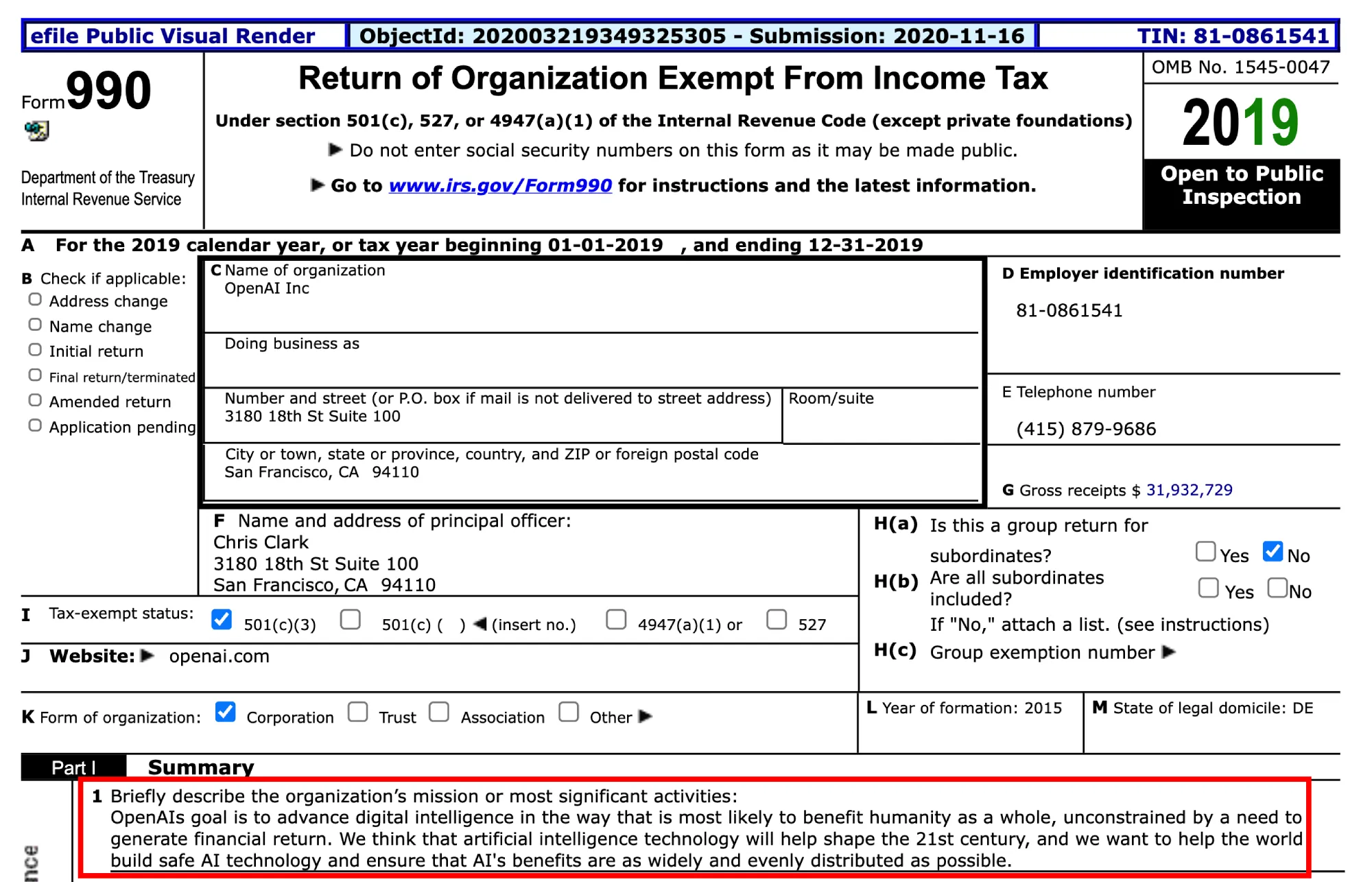
So what changed? The shorter mission statement in the 2024 filing actually mirrors the exact wording used in OpenAI’s Charter, which was published back in April 2018. That document states: “OpenAI’s mission is to ensure that artificial general intelligence (AGI) benefits all of humanity.”
Safety isn’t absent from the Charter, it’s just addressed separately as one of the core principles under a section titled “Long-term Safety.”
It’s worth noting that OpenAI completed a major restructuring in October 2025. The company converted its for-profit arm into a Delaware Public Benefit Corporation while keeping its nonprofit parent in control.
Delaware Attorney General Kathy Jennings approved the move, which allows OpenAI to raise capital while technically maintaining oversight by the OpenAI Foundation (the renamed nonprofit entity).
The restructuring followed months of back-and-forth with regulators. OpenAI had initially planned to give the nonprofit only a minority stake, but reversed course in May 2025 after pushback from civic leaders and discussions with attorneys general in Delaware and California.
Whether the Form 990 wording shift represents a meaningful policy change or simply standardization with Charter language remains up for debate.
OpenAI’s public-facing pages still reference safety throughout their materials, including dedicated sections on safety and alignment. But for users tracking the company’s evolution from its nonprofit roots, the streamlined tax filing summary has definitely got them questioning the company’s mission.
Featured image generated with AI


Dwayne Cubbins
3104 Posts
I cover fast-moving stories across apps, online platforms, and everyday tech — phones, wearables, consoles, and whatever else people are fighting with this week. Bugs, rollouts, scams, policy enforcement, and the occasional internet-culture rabbit hole are all fair game. My goal is simple — make confusing tech news readable. When I'm not working, I'm working out or chilling with my dog. Got a tip? You can find me on X @dcubbins.
Next article View Article