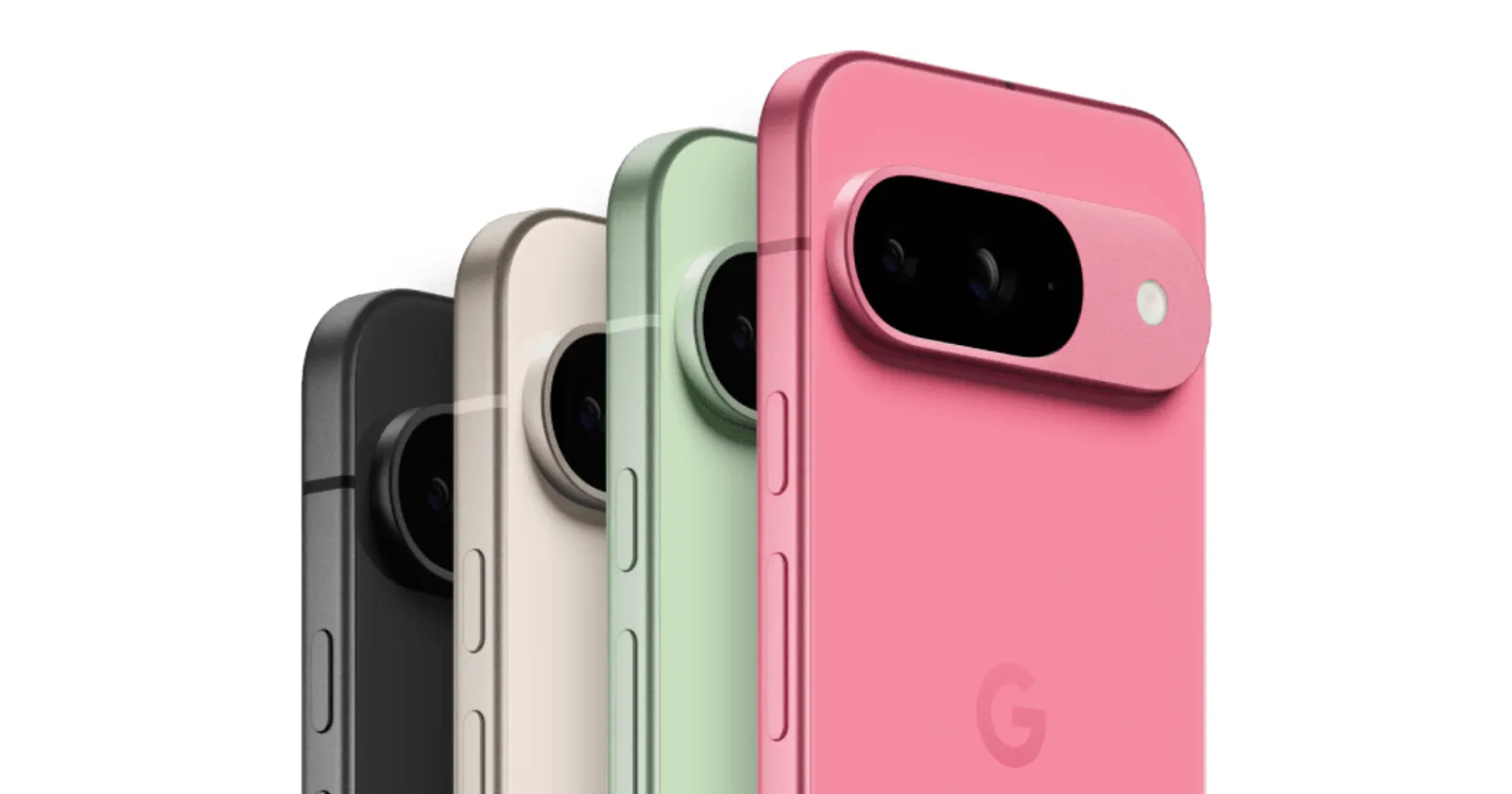
GrapheneOS has long been synonymous with Google Pixel hardware, but new statements from the project suggest that relationship may not last forever. As the privacy-focused Android OS moves closer to launching its first officially supported non-Pixel devices, the team is now openly acknowledging that future Pixel phones may not automatically receive GrapheneOS support.
In a recent clarification, the GrapheneOS team reiterated that Pixels remain the only Android devices meeting all of its firmware, driver, and hardware security requirements, including features such as hardware memory tagging (MTE). That exclusivity, however, is no longer a permanent design choice. It’s a limitation that the project is actively working to overcome.
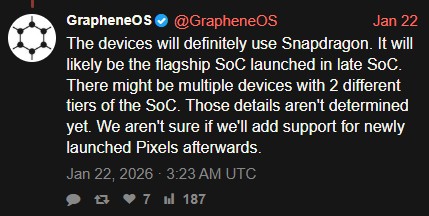
According to the team, GrapheneOS is collaborating with a major Android OEM, possibly Motorola, to ensure that a subset of its 2027 devices fully meets GrapheneOS’ stringent security and update standards. These devices will definitely use Snapdragon chipsets, likely the flagship SoC launching in late 2026, with the possibility of multiple devices using different tiers of that platform.
What stands out most is what comes next.
GrapheneOS now says it is “not sure if we’ll add support for newly launched Pixels afterwards.” While that may sound like a cautious, non-committal statement, it marks a notable shift in tone for a project that has historically treated Pixel support as a given.
Reading between the lines, GrapheneOS appears to be preparing for a future where Pixel devices are no longer the default or primary hardware platform.
What this could mean for Pixel users
Based on current timelines, Google’s Pixel 11 is expected to launch later this year, while the first GrapheneOS-supported non-Pixel devices are unlikely to arrive before 2027. If that schedule holds, Pixel 11 would almost certainly receive GrapheneOS support.
However, once non-Pixel hardware is officially on the market, the calculus changes.
If Google follows its usual annual cadence, Pixel 12 would likely arrive in mid-to-late 2027, right around the time GrapheneOS’ partner OEM is expected to ship its first compliant devices. That raises a reasonable, though still speculative, possibility: Pixel 11 could be the last new Pixel to gain GrapheneOS support, with Pixel 12 and later models potentially excluded.
To be clear, GrapheneOS has not confirmed this. The team has only said it is uncertain about adding support for newly launched Pixels after its non-Pixel hardware debuts. Still, the wording strongly suggests that Pixel exclusivity is being treated as a temporary phase, not a long-term strategy.
Why GrapheneOS might move on from Pixels
The shift makes sense from a project-level perspective. GrapheneOS has repeatedly emphasized that its reliance on Pixels is not ideological, but practical. Google’s devices uniquely offer long-term firmware updates, robust driver support, strong verified boot chains, and early access to advanced security features like MTE.
Once another OEM can deliver the same baseline with Snapdragon hardware, proper firmware updates, and upstream cooperation, GrapheneOS no longer needs to align itself with Google’s hardware roadmap.
In other words, Pixel support may soon become optional rather than essential.
For now, Pixels remain the safest bet for GrapheneOS users. But if the project’s non-Pixel ambitions pan out in 2027, the Pixel era of GrapheneOS may finally be approaching its end after nearly a decade.


Hillary Keverenge
2723 Posts
Tech has been my playground for over a decade. While the Android journey began early, it truly took flight with the revolutionary Lollipop update. Since then, it's been a parade of Android devices (with a sprinkle of iOS), culminating in a mostly happy marriage with Google's smart home ecosystem. Expect insightful articles and explorations of the ever-evolving world of Android and Google products coupled with occasional rants on the Nest smart home ecosystem.
Next article View Article