
It is an almost annual tradition at this point: a new Pixel launches, and shortly after, discussions about thermals heat up—literally. The Pixel 10 Pro, despite its advancements with the Tensor G5, has not been immune to reports of running hot, particularly on the latest Android 16 QPR builds.
Now, in a rather interesting development, a developer in the rooting community claims to have identified a massive configuration oversight by Google that leaves the phone thermally “blind” for minutes at a time.
According to a recent GitHub entry, a user going by the handle marx161-cmd began digging into the vendor files of the Pixel 10 Pro to diagnose why their device was heating up significantly during heavy usage.
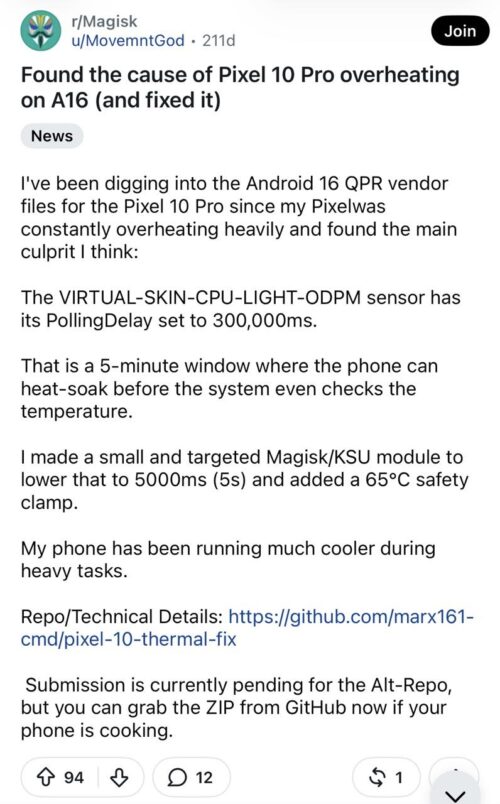
What they found appears to be a startling configuration choice—or error—in the device’s thermal management files.

The developer alleges that a critical thermal sensor config, specifically VIRTUAL-SKIN-CPU-LIGHT-ODPM, has its PollingDelay set to 300,000ms. In plain English, that is a five-minute window where the system potentially does not check that specific temperature sensor.
As the developer notes on GitHub:
“That is a 5-minute window where the phone can heat-soak before the system even checks the temperature… During heavy workloads, the CPU can hit 90°C+ before the Thermal HAL even attempts to sample the temperature.”
If accurate, this means the Pixel 10 Pro could be running high-intensity tasks for a full five minutes, generating excess heat and soaking the chassis, before the software realizes it needs to throttle performance to cool down.
To prove the theory, the developer released a “surgical” Magisk/KernelSU module titled Pixel 10 Pro Thermal Polling Fix.
The module overlays a modified thermal_info_config.json file that makes the following aggressive changes:
- Reduces polling delay: Drops the check interval from 300,000ms (5 minutes) to just 5,000ms (5 seconds).
- Safety clamp: Adds a hard threshold at 65°C to force earlier thermal management.
- Hysteresis: Adjusts the passive delay to prevent the CPU frequency from bouncing erratically.
The developer claims their unit has been running “much cooler” during heavy tasks since applying the patch. But at what cost?
While a cooler phone sounds ideal, it is worth noting the trade-offs here. As several commenters pointed out, thermal management is a balancing act between heat and speed.
By forcing the phone to check its temperature every 5 seconds and clamping it at 65°C, the fix essentially forces the Pixel 10 Pro to throttle earlier. The phone stays cool because the processor is being slowed down much sooner than Google’s stock configuration allows.
This has led to speculation within the community regarding Google’s intent. Some users theorize that the 5-minute delay might not be a bug, but a deliberate choice to allow the Pixel 10 Pro to sustain peak performance for longer durations (like in benchmark tests or gaming) before throttling kicks in, even at the expense of battery health and device temperature.

It is important to approach this with a healthy dose of skepticism. Currently, this is a solitary report from one developer, and the fix has not yet been verified on a wide scale. Furthermore, this requires root access (Magisk or KernelSU) to install.
Modifying thermal config files can lead to unexpected behavior or performance degradation. However, for those comfortable with modding who feel their Pixel 10 Pro is acting more like a hand warmer than a smartphone, the pixel-10-thermal-fix is currently available on GitHub.


Hillary Keverenge
2723 Posts
Tech has been my playground for over a decade. While the Android journey began early, it truly took flight with the revolutionary Lollipop update. Since then, it's been a parade of Android devices (with a sprinkle of iOS), culminating in a mostly happy marriage with Google's smart home ecosystem. Expect insightful articles and explorations of the ever-evolving world of Android and Google products coupled with occasional rants on the Nest smart home ecosystem.
Next article View Article