Over the past few weeks, GrapheneOS has been squarely in the limelight. The discourse has ranged from technical roadmaps to heated disputes with other privacy entities. We’ve seen the developers clarify that RCS support on carriers like AT&T and T-Mobile is paused due to urgent priorities, and we’ve covered the drama surrounding a user who blamed the OS for a ‘premeditated murder’ charge after police allegedly cracked their Pixel phone.
While Phreeli markets itself as a “privacy-by-design” carrier, GrapheneOS is actively discouraging its community from using the service, citing technical limitations and deep-seated hostilities with Phreeli’s founders.
The rise of Phreeli
Launched earlier this month, Phreeli bills itself as “the first wireless service built entirely around privacy-by-design.” Led by CEO Nicholas Merrill—a known privacy advocate who challenged an FBI National Security Letter in 2004—the carrier claims to separate personal information from network activity.
According to their press release, Phreeli utilizes a “Double-Blind Armadillo” architecture. This system purportedly uses cryptographic tokens to verify accounts without exposing private data to the network. Their key selling points include:
No credit checks or contracts.
Sign-ups requiring only a ZIP+4 code and payment method (including crypto).
A promise not to sell call data or monetize user behavior.
Coverage is provided via the T-Mobile network, with plans starting at $25/month.
The “Silent SMS” debate sparks conflict
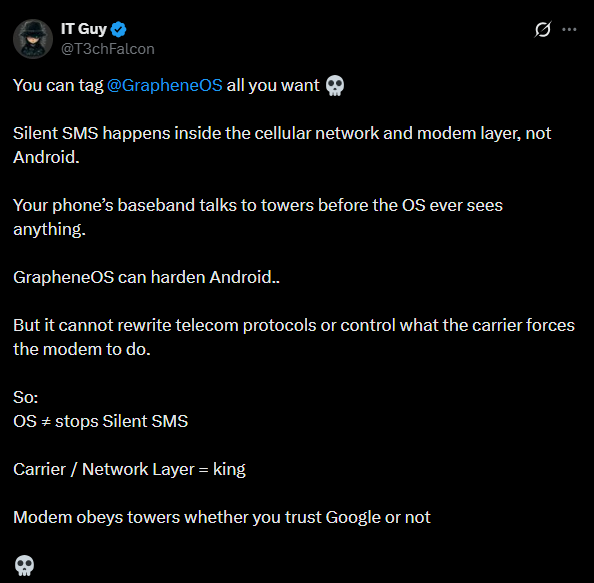
The tension between GrapheneOS and Phreeli came to a head following discussions on X (formerly Twitter) regarding “Silent SMS.” This surveillance technique involves sending a hidden ping to a phone, forcing it to communicate with a cell tower and reveal its location, all without the user seeing a notification.
Apparently, the operating system cannot control the baseband modem since Silent SMS happens inside the cellular network and modem layer, and not Android. While GrapheneOS can harden Android, it cannot rewrite telecom protocols or control what the carrier forces the modem to do.
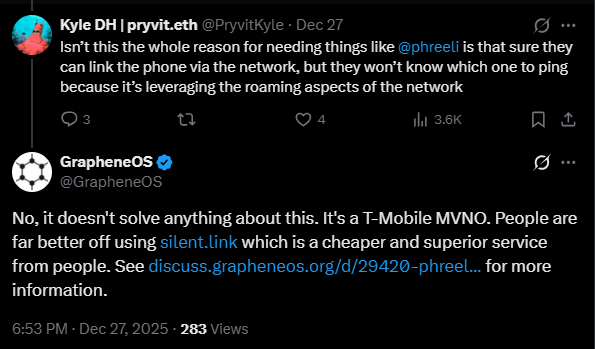
When a user suggested that Phreeli might be the solution since they claim to anonymize the subscriber identity by hiding private data from the network, GrapheneOS shut down the idea immediately.
GrapheneOS: Phreeli is “security theater”
GrapheneOS argues that because Phreeli is a T-Mobile MVNO (Mobile Virtual Network Operator), it is subject to the same physical network tracking as any other T-Mobile user. In a, the developers stated:
“Phreeli is a T-Mobile MVNO and has no control over what T-Mobile does with user data and metadata.”
The core argument is that while Phreeli might obscure who pays the bill, they cannot stop T-Mobile’s towers from triangulating the device or the modem from responding to network commands.
The recommendation: Use Silent.link
Instead of Phreeli, GrapheneOS is recommending users opt for Silent.link, an eSIM provider that focuses on roaming data.
According to GrapheneOS, using a service like Silent.link (which costs a flat fee of roughly $9 for an eSIM) offers superior privacy for the following reasons:
Roaming mode: It uses roaming data, often defaulting to the cheapest available carrier, which can add a layer of separation compared to a direct subscriber link.
Disposability: Users can buy a new eSIM for each new device, preventing a long-term link between a phone number and a device identity.
No number attachment: They recommend combining a data-only eSIM with a VoIP service (over a VPN) for calls and texts, avoiding the traditional cellular tracking tied to a permanent phone number.
“Bad blood”: The history between GrapheneOS and Phreeli
Beyond the technical arguments, there is significant personal animosity between the GrapheneOS team and Phreeli’s leadership.
In their forum post and on X, GrapheneOS leveled serious accusations against Phreeli’s founders, specifically Nicholas Merrill (formerly of CalyxOS) and his co-founders. GrapheneOS claims:
CalyxOS fallout: They allege Merrill left CalyxOS in a state of disarray, leaving users without security updates (specifically the 2025-06-05 patch level) and refusing an orderly transition.
Harassment allegations: GrapheneOS claims one of Phreeli’s co-founders is an active “Kiwi Farms user” who has engaged in “libel and harassment” against the GrapheneOS founder, including leaking personal information.
Historical conflict: The developers link the Phreeli team to the 2018 hostile takeover attempt of the CopperheadOS project (the predecessor to GrapheneOS).
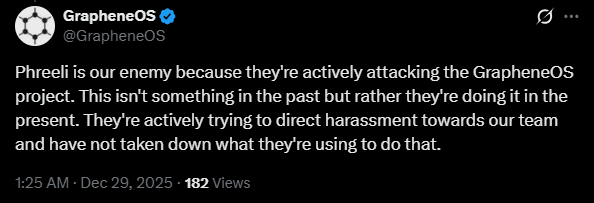
GrapheneOS went as far as to label Phreeli an “enemy” of the project:
“A carrier marketed as private that’s still actively waging a war against the only privacy and security hardened mobile OS doesn’t make much sense… Phreeli is clearly not for GrapheneOS users since using cellular service from people trying to destroy the OS project you use doesn’t make much sense.”
While Phreeli represents a new approach to privacy similar to Brave’s premium services, GrapheneOS views it as a threat. The OS developers have indicated they will not drop support for Phreeli technically, but they may add a “warning recommending people switch carriers” and have suggested users file chargebacks for “false marketing.”
For now, the advice from the GrapheneOS camp is clear: Avoid Phreeli and stick to roaming eSIMs like Silent.link for maximum privacy.
We stand out from the tech-media crowd because we break news stories; we mainly bring you stuff that you won’t find anywhere in the mainstream tech media. Our stories have been picked up by some of the world’s most popular websites and media outlets—more info is available here.
Tech has been my playground for over a decade. While the Android journey began early, it truly took flight with the revolutionary Lollipop update. Since then, it's been a parade of Android devices (with a sprinkle of iOS), culminating in a mostly happy marriage with Google's smart home ecosystem. Expect insightful articles and explorations of the ever-evolving world of Android and Google products coupled with occasional rants on the Nest smart home ecosystem.
It has been over a month since GrapheneOS released the first experimental builds for the Pixel 10 series. Arriving back in late November 2025, just days after the team promised...