





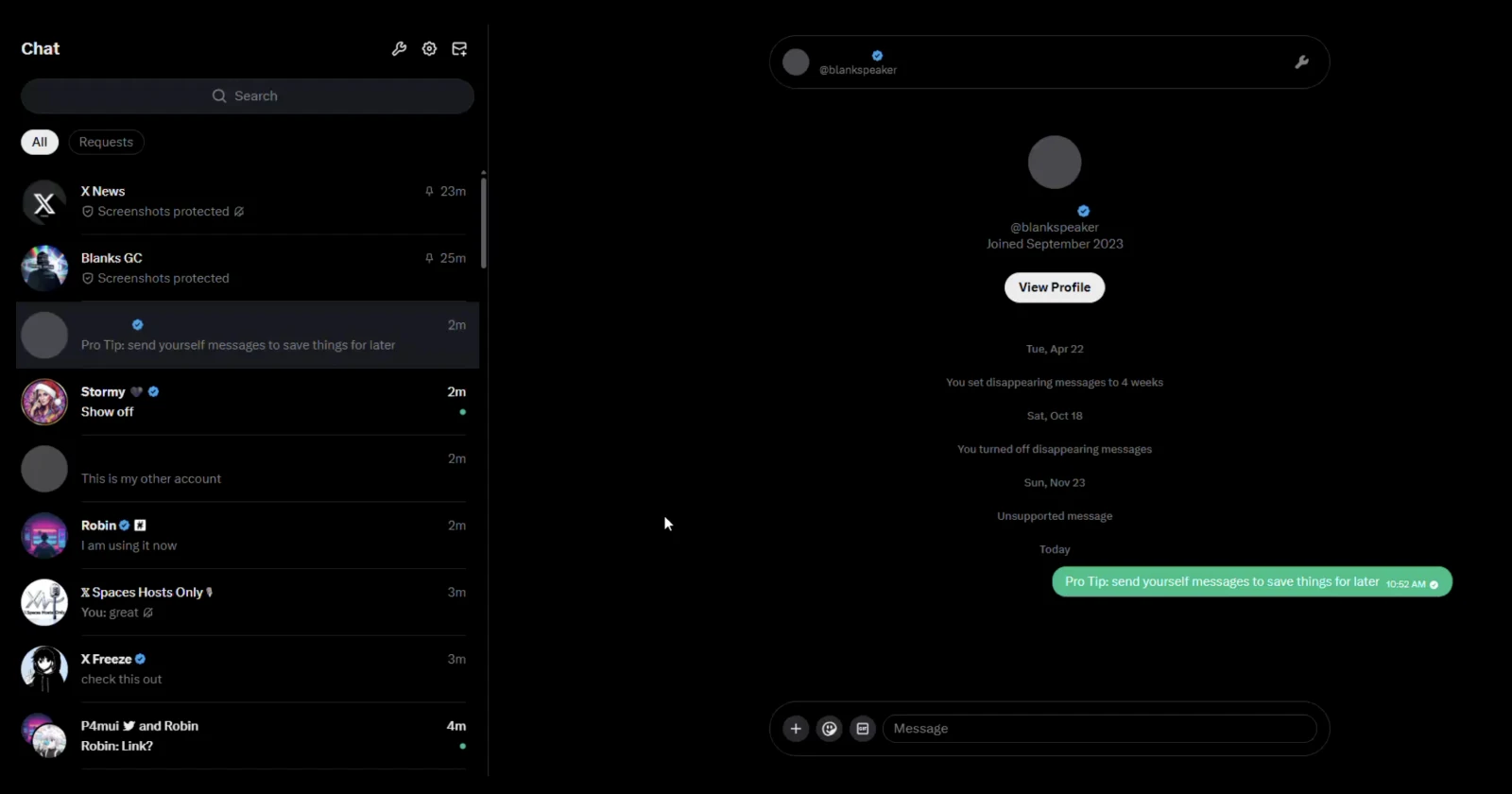
BREAKING: X CHAT standalone web app is OUT NOW!
— Nima Owji (@nima_owji) December 17, 2025
It's perfect for people who are not using X but still want to use X Chat to stay connected with their friends and family!
CHECK IT OUT: https://t.co/QOyJv7wv3N pic.twitter.com/jFqL3AKsKc
Update 17/12/25 – 03:55 pm (IST): Shortly after our post went live, app researcher Nima Owji highlighted with a post on X that the XChat website is live. It is accessible via the following URL: https://chat.x.com/
As mentioned in the original article, it offers nearly an identical experience to what you get with XChat on X. You can even tweak the accent colors, filter junk/spammy messages, and select who can message you between No one, Everyone, and Verified users.
I couldn’t find any signs on the app listing on the App Store or the Play Store, but I won’t be surprised if the mobile app goes live in the next few weeks, if not earlier.
Original article published on December 17, 2025, follows:
We knew this was coming. Back in November, reports surfaced that X was building a standalone messaging client to compete directly with WhatsApp and Signal. Now, thanks to a fresh set of leaks, we are finally seeing what that vision looks like.
The latest findings from @blankspeaker and X designer Michael Boswell confirm that the company is deep in development on a dedicated XChat client for both web and iOS. This follows a month of speculation after Elon Musk told Joe Rogan that a standalone app was “in the pipeline” to house the platform’s recently launched encrypted messaging features.
If you’ve been following the breadcrumbs, you know X has been aggressive here. In November, they began rolling out peer-to-peer encryption, disappearing messages, and screenshot blocking. But those features were still buried inside the main X app. And roughly a week ago, they completely replaced the old DMs system with Chat for everyone. These new leaks suggest they are about to break free.
The most concrete leak is the web interface. @blankspeaker showcased a “distraction-free” version of XChat that runs as a Progressive Web App (PWA). This is a massive quality-of-life upgrade for desktop users. Instead of keeping a browser tab open — and risking the productivity black hole of the “For You” feed — you can dock XChat as its own window.
BREAKING: Here is a look at the upcoming standalone X Chat website.
You will be able to access X Chat without all the distractions of the timeline. It can even be added a Webapp on your desktop or device for quick access.
Note: It is still in development so some things may be… pic.twitter.com/9Sl771s01K
— ️️️️ ️ᅠ️️️️ ️ᅠ️️️️ ️️️️️ ️ᅠ (@blankspeaker) December 16, 2025
It looks remarkably clean. The two-pane design mirrors the current DM drawer but feels significantly more robust, functioning much like the desktop versions of Telegram or Messenger. The leaker notes that while audio and video calling are expected, the build is currently in development.
On the mobile front, the design language is taking a sharp turn. Michael Boswell posted a teaser (disguised as a bug report) running on iOS 26. While Boswell didn’t exactly confirm it’s the XChat app in the spotlight, others have speculated that bit, plus Boswell also responded to one such post with the eyes emoji:
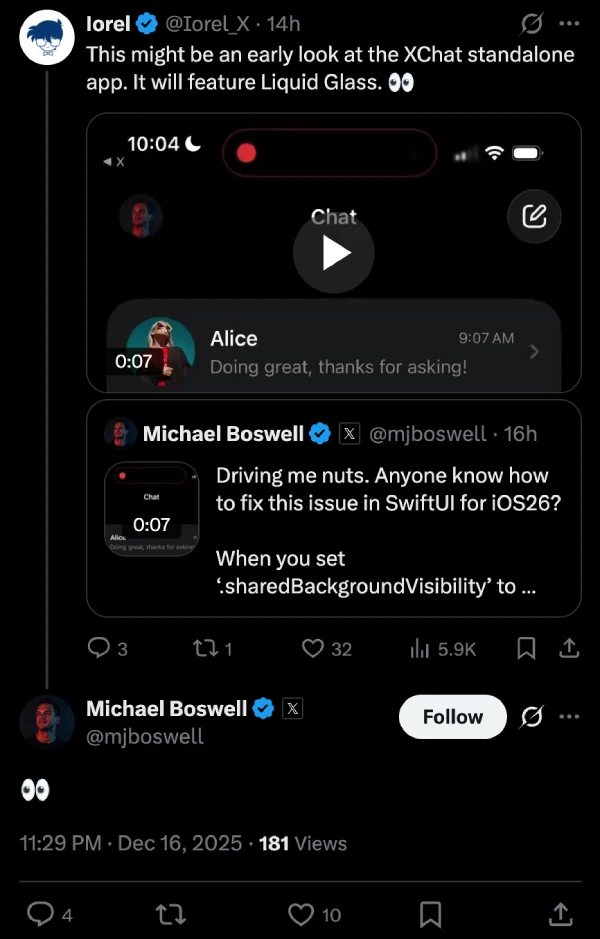
The interface utilizes Liquid Glass elements, a transparency-heavy aesthetic that blurs the background content behind the toolbar. However, the video only displays the top half of the app, featuring a profile icon on the left and what appears to be a button to initiate a new chat on the right.
Driving me nuts. Anyone know how to fix this issue in SwiftUI for iOS26?
— Michael Boswell (@mjboswell) December 16, 2025
When you set ‘.sharedBackgroundVisibility’ to ‘.hidden’ on a ‘ToolbarItem’, glass does not animate back to the resting state well.
Or is this one of those issues that only shows up on local builds? pic.twitter.com/lF9ukVTinb
It suggests X is trying to make the chat experience feel premium and native to Apple’s ecosystem, rather than just a web view wrapper. That said, I’m hoping that the XChat team working on the Android app considers adding support for Material 3 Expressive theming. Although I know that’s a long shot, who says we can’t dream?
However, a pretty interface is only half the battle; the infrastructure needs to be bulletproof, too. We just covered a concerning exploit where users could forge replies to nonexistent messages in group chats. While X has confirmed that fixing this loophole is a “top priority,” it’s a reminder that moving to a standalone app brings new scrutiny. If they want XChat to be a viable alternative to Signal, squashing bugs like that is non-negotiable before launch.
We don’t have a final launch date, but considering the functional PWA and the specific UI tuning on iOS, I’d wager we will see a beta release very soon.
Editor’s note: The headline has been updated to reflect the release of the standalone XChat website.

Dwayne Cubbins
1841 Posts
My fascination with Android phones began the moment I got my hands on one. Since then, I've been on a journey to decode the ever-evolving tech landscape, fueled by a passion for both the "how" and the "why." Since 2018, I've been crafting content that empowers users and demystifies the tech world. From in-depth how-to guides that unlock your phone's potential to breaking news based on original research, I strive to make tech accessible and engaging.