





The tech giant that pretty much owns the browser market just made a move that could spell trouble for the scrappy AI browser startups trying to reinvent how we surf the web. Google has begun rolling out Gemini integration to all Chrome desktop users on both Windows and Mac.
This isn’t just another feature update. It’s Google flexing its muscles in what’s quickly becoming one of the most interesting battles in tech right now. While companies like Perplexity and The Browser Company have been busy building AI-first browsers from scratch, Google just said “hold my coffee” and dropped an AI assistant directly into the browser that already commands over 60% of the market.
With Gemini in Chrome, users can get AI assistance in their desktop browser to easily get key takeaways, clarify concepts, find answers and more, using the content of the browser tab they’re viewing. The integration goes deeper than you might expect. The new Gemini in Chrome integrates with Google apps like Calendar, YouTube and Maps, so users can access those services without moving to a different webpage.
Here’s where things get really interesting for the competition. Perplexity debuted its browser Comet in July for AI tasks, making it available to paying subscribers. The Browser Company pivoted from their beloved Arc browser to create Dia, an AI-native experience. Both companies have been positioning themselves as the future of web browsing, built around AI from day one.
But Google’s approach is fundamentally different, and arguably more dangerous for the newcomers. Instead of asking users to switch browsers entirely, they’re bringing the AI revolution to Chrome users where they already are. Users will have the option to quickly access Google Search’s AI Mode, the company’s most powerful AI search, right from the Chrome address bar on their computer.
Just weeks ago, we covered how Google hinted that AI Mode might become the default search experience, a move that could fundamentally change how people find information online. Now, with Gemini baked directly into Chrome, that transformation feels inevitable.
Google did reach out to publications, noting that this won’t be the case. Heck, even Google Search’s VP said it’s not happening.
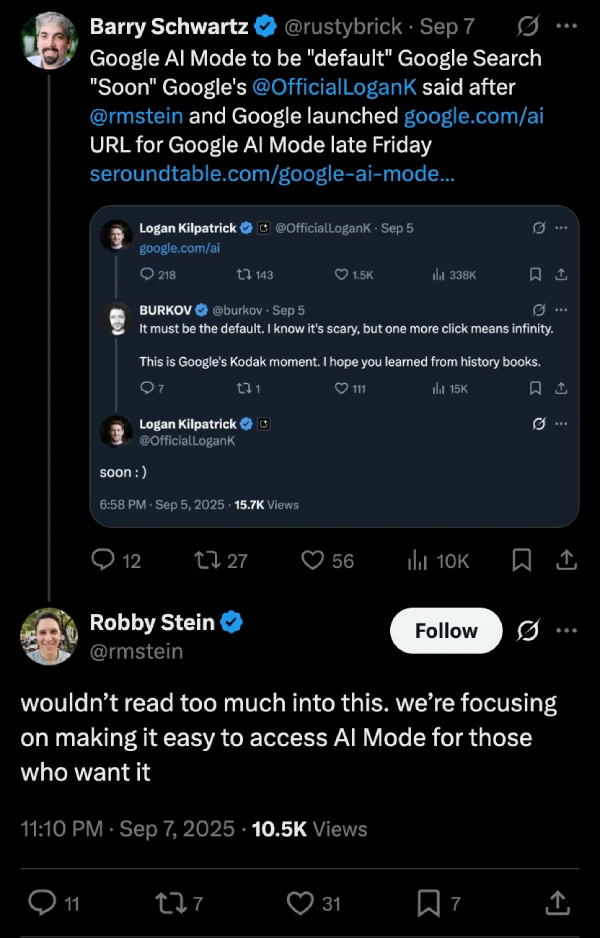
But I want you to hear me out. The placement of Google’s AI Mode button in Chrome’s new address bar and in Google Search already makes it clear that the company is betting on people clicking the button instead of opting for the regular search experience. I mean, it’s right there in the search bar itself, making it seem like that’s the default option to choose.
So yes, while technically Google hasn’t replaced the traditional search experience with AI Mode, the design language makes it clear that it’s exactly what Google aims towards.
Either way, that’s a rant for another day. Coming back to what’s new with the browser. Chrome’s Enhanced Protection will now use Gemini Nano to stop more sophisticated scams, and AI will help detect and reduce spammy notifications and unwanted permission requests. There’s even an AI password agent in the works that can automatically navigate to websites and change passwords for you.
The competitive implications are stark. Comet and Dia have been trying to prove that AI-first browsing requires rebuilding the browser from scratch. Google’s approach suggests otherwise. Why learn a new interface when your current browser can just get smarter?
Of course, Google has advantages that startup competitors can’t match. They control the search engine, the ad network, the email service, the calendar app, and now they’re integrating all of it with AI assistance in the browser. Users can launch Gemini in Chrome from the top of their Chrome window, and it uses the context of the page they’re on so they can ask questions and get help without opening a new tab.
For users, this could be genuinely useful. The AI can summarize articles, explain complex topics, and help with research across multiple tabs. But for the AI browser startups that have raised millions betting on the future of AI-native browsing, Google’s move represents an existential challenge. When the platform owner decides to add AI natively, do specialized AI browsers still have a reason to exist?
But Google isn’t alone. OpenAI, with its massive funding, is also looking to break into the browser market. It could explain why The Browser Company agreed to be acquired by Atlassian earlier this month. Without the funding, Dia would frankly stand no chance against Chrome, and the odds are still not in its favor.
That said, there’s also the question of trust and privacy. Google’s business model depends on data collection and advertising, which might give privacy-conscious users reason to prefer alternatives. The AI browser competitors have been positioning themselves as more ethical alternatives to Big Tech surveillance capitalism.
Still, Google’s move signals that the AI browser war is about to get much more competitive. The company that defined the modern web browser is now betting big on AI-powered browsing. For users, that probably means better AI tools in the browser they already use. For Google’s competitors, it means the fight for the future of browsing just got a lot harder.
The new Gemini experience in Chrome is currently only live for users in the US. Feel free to share your thoughts on Gemini in Google Chrome in the comments below. I’m interested to hear your take.

Dwayne Cubbins
1821 Posts
My fascination with Android phones began the moment I got my hands on one. Since then, I've been on a journey to decode the ever-evolving tech landscape, fueled by a passion for both the "how" and the "why." Since 2018, I've been crafting content that empowers users and demystifies the tech world. From in-depth how-to guides that unlock your phone's potential to breaking news based on original research, I strive to make tech accessible and engaging.
Next article View Article
