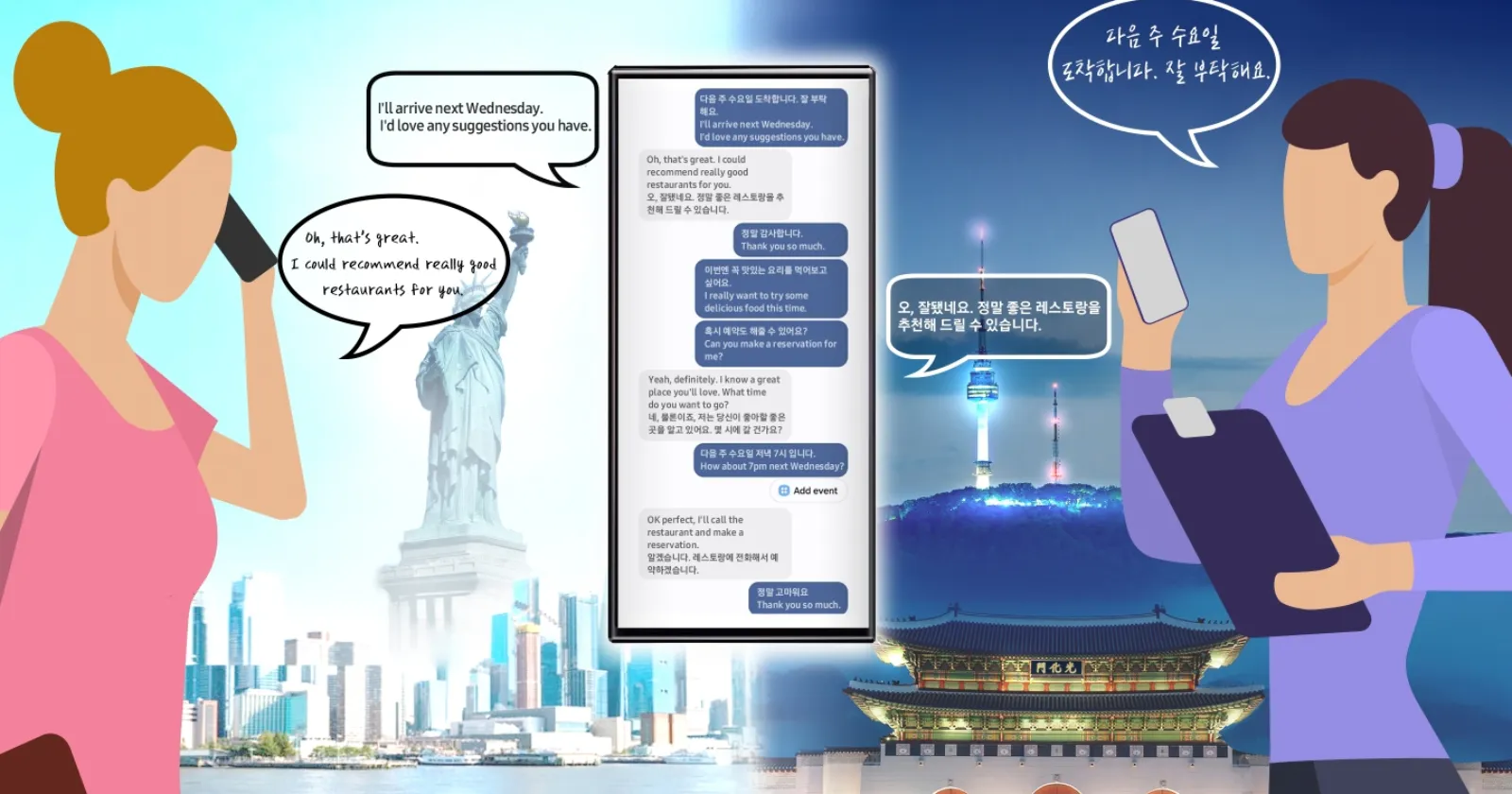
In its recent press release, Samsung confirmed that it’s introducing a new feature called ‘AI Live Translate Call’. This indicates the South Korean giant is ready to take on Google’s ‘Live Translate’ function that is currently exclusive to Pixel phones. At the time of this writing, Live Translate is available on the Pixel 6 and later models, including the Fold.
Samsung claims the AI Live Translate Call feature will be available “with the latest Galaxy AI phone”. So it’s highly likely that the Galaxy S24 will debut with Samsung’s alternative to Google’s Live Translate. The company also says its ‘Galaxy AI’ experience leverages both on-device capabilities and cloud-based AI. However, the AI Live Translate Call will make use of the device’s on-board AI, ensuring private conversations never leave your device.
The feature will be baked into the native Phone app, allowing users to translate speech to text in real-time. Samsung says “audio and text translations will appear in real-time as you speak.” This should ensure that the conversation on the phone is seamless. It also does away with the need of relying on third-party apps. But we’ll have to see for ourselves how it stacks up to Google’s Live Translate.
Google currently offers translations for its Live Translate feature in the following languages, according to its official documentation:
| Chat | Media | Interpreter Mode |
|---|---|---|
| Arabic (AR) | German (DE) | German (DE) |
| Danish (DA) | English (EN) | English (EN) |
| German (DE) | Spanish (ES) | Spanish (ES) |
| English (EN) | French (FR) | French (FR) |
| Spanish (ES) | Italian (IT) | Italian (IT) |
| Farsi (FA) | Japanese (JP) | Japanese (JP) |
| French (FR) | ||
| Hindi (HI) | ||
| Italian (IT) | ||
| Japanese (JP) | ||
| Korean (KO) | ||
| Dutch (NL) | ||
| Polish (PL) | ||
| Portuguese (PT) | ||
| Russian (RU) | ||
| Swedish (SV) | ||
| Thai (TH) | ||
| Turkish (TR) | ||
| Vietnamese (VI) | ||
| Chinese, Simplified (zh_CN) | ||
| Chinese, Traditional (zh-TW) |
So it’s left to be seen how many languages Samsung’s AI Live Translate Call supports when it launches. That said, Samsung seems to be going all out with AI on its upcoming phones. Earlier this week, the company showed off its in-house generative AI model dubbed Gauss. This on-device AI model can generate and edit images, compose emails, summarize documents, and even help you with coding.
At one point in time, raw specifications and performance were the biggest trend, then we moved on to who has the best cameras, and now, it seems AI will be the next big USP for brands to sell their phones. Google has already been ahead of the curve here with its Pixel phones, but it’s good to see the competition catching up. This should encourage Google to quit taking it slow and start expanding access to all AI features on Pixel devices to other regions and in other languages too. At present, most AI capabilities of Pixel phones are restricted to the US and the English language.


Dwayne Cubbins
3128 Posts
I cover fast-moving stories across apps, online platforms, and everyday tech — phones, wearables, consoles, and whatever else people are fighting with this week. Bugs, rollouts, scams, policy enforcement, and the occasional internet-culture rabbit hole are all fair game. My goal is simple — make confusing tech news readable. When I'm not working, I'm working out or chilling with my dog. Got a tip? You can find me on X @dcubbins.
Next article View Article